Finding Particular Solutions Using Initial Conditions and Separation of Variables
مُقدَّم| English | المعنى |
|---|---|
| general solution/ˈdʒenərəl səˈluːʃn/ | A family of solutions containing arbitrary constants or parameters that represents all solutions of the specified type. |
| initial condition/ɪˈnɪʃl kənˈdɪʃn/ | الشرط الأولي |
| particular solution/pəˈtɪkjʊlə səˈluːʃn/ | الحل الخاص |
One curve out of a whole family
- Separating variables gives a general solution with a constant $C$: a whole family of curves. A real situation follows only one of them.
- An initial condition 初始条件 such as $y(0)=3$ picks that one curve. The result is the particular solution 特解. Almost every AP exam has a free-response part that asks for one.
The procedure
- 1. Separate: all $y$ terms with $dy$, all $x$ terms with $dx$. 2. Integrate both sides and write $+C$ once.
- 3. Substitute the initial condition straight away to find $C$. 4. Then solve for $y$, and state where the solution is valid.
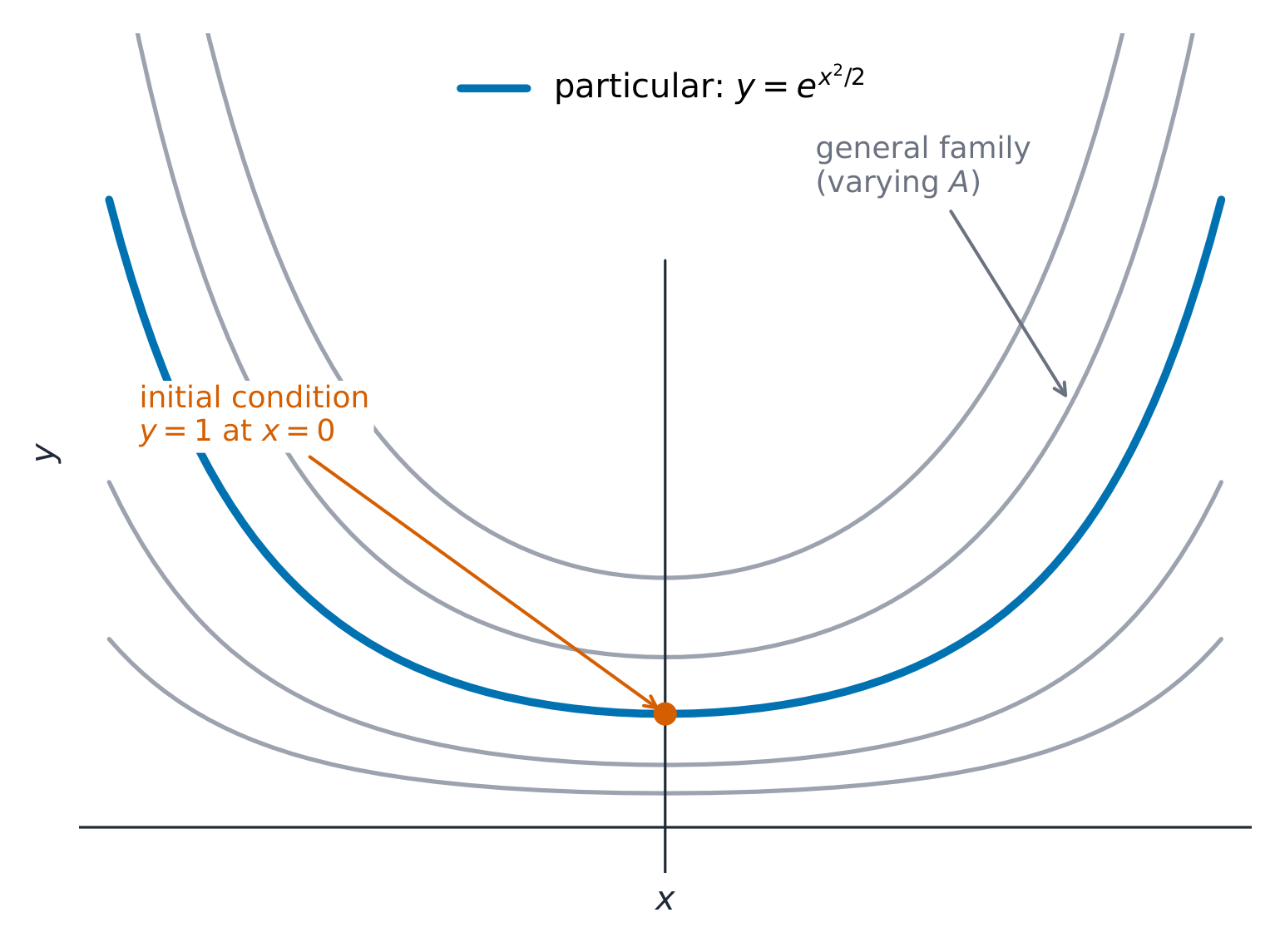
The initial point picks one curve
The general solution is a whole family; the initial condition $y(x_0)=y_0$ selects the single curve through that point.
Solve $\dfrac{dy}{dx}=3x^2$ with $y(0)=2$. Find $y(2)$.
الصعوبة 2/5 · 140 عملة + مكافأة صغيرة عند الإنجاز الأول اليوم
$y=x^3+C$; $y(0)=2$ gives $C=2$. $y(2)=8+2=10$.
A logarithm and an exponential. Solve $\dfrac{dy}{dx}=(y-1)\cos x$ with $y(0)=3$.
- Separate: $\dfrac{dy}{y-1}=\cos x\,dx$. Integrate: $\ln|y-1|=\sin x+C$.
- At $(0,3)$: $\ln2=0+C$, so $C=\ln2$.
- $|y-1|=e^{\sin x+\ln2}=2e^{\sin x}$. At the start $y-1=2>0$, so $y=1+2e^{\sin x}$.
Solve $\dfrac{dy}{dx}=2y$ with $y(0)=3$. Find $y(1)$ to 2 decimal places.
الصعوبة 2/5 · 140 عملة + مكافأة صغيرة عند الإنجاز الأول اليوم
$\ln|y|=2x+C$, so $y=Ae^{2x}$ و $A=3$. $y(1)=3e^2\approx22.17$.
Using $y=1+2e^{\sin x}$, find $y\left(\tfrac{\pi}{2}\right)$ to 2 decimal places.
الصعوبة 2/5 · 140 عملة + مكافأة صغيرة عند الإنجاز الأول اليوم
$1+2e^1\approx1+5.44=6.44$.
Why find $C$ before solving for $y$
- Right after integrating, the equation is simplest. Substituting there avoids messy constants such as $e^{C}$ or $\sqrt{2C}$.
- It also tells you which branch you are on: the sign of $y-1$, or which square root, comes from the initial point.
You may substitute the initial condition before solving for $y$, right after integrating.
الصعوبة 1/5 · 100 عملة + مكافأة صغيرة عند الإنجاز الأول اليوم
True, and it is usually the easiest moment to do it.
Choosing the square root. Solve $\dfrac{dy}{dx}=\dfrac{x}{y}$ with $y(1)=-2$.
- $y\,dy=x\,dx$, so $\dfrac{y^2}{2}=\dfrac{x^2}{2}+C$.
- At $(1,-2)$: $2=\dfrac12+C$, so $C=\dfrac32$, and $y^2=x^2+3$.
- $y(1)$ is negative, so take the negative root: $y=-\sqrt{x^2+3}$.
Solve $\dfrac{dy}{dx}=\dfrac{x}{y}$ with $y(0)=-4$.
الصعوبة 1/5 · 100 عملة + مكافأة صغيرة عند الإنجاز الأول اليوم
$y^2=x^2+C$ with $C=16$. $y(0)$ is negative, so take the negative root.
A solution with a limited domain. Solve $\dfrac{dy}{dx}=2xy^2$ with $y(0)=1$.
- $y^{-2}\,dy=2x\,dx$, so $-\dfrac1y=x^2+C$. At $(0,1)$: $-1=C$.
- $-\dfrac1y=x^2-1$, so $y=\dfrac{1}{1-x^2}$.
- The curve has vertical asymptotes at $x=\pm1$. The solution through $(0,1)$ is valid only for $-1<x<1$.
For the solution $y=\dfrac{1}{1-x^2}$ through $(0,1)$, find $y\left(\tfrac12\right)$ to 3 decimal places.
الصعوبة 2/5 · 140 عملة + مكافأة صغيرة عند الإنجاز الأول اليوم
$1\div(1-\tfrac14)=\tfrac43\approx1.333$.
State the domain
- A particular solution must be differentiable on an interval containing the initial $x$. Stop at a vertical asymptote, a zero denominator or a negative number under a root.
- In the last example, $y=\dfrac{1}{1-x^2}$ also has pieces for $|x|>1$, but they are not connected to the point $(0,1)$, so they are not part of this solution.
The solution of $\dfrac{dy}{dx}=2xy^2$ with $y(0)=1$ هي $y=\dfrac{1}{1-x^2}$. On which interval is it valid?
الصعوبة 1/5 · 100 عملة + مكافأة صغيرة عند الإنجاز الأول اليوم
The interval must contain $x=0$ and cannot cross the asymptotes at $x=\pm1$.
The general solution is $y=x^2+C$, and the curve passes through $(1,5)$. Find the particular solution.
5 - 1 fixes the constant.
$y=x^2+C$ passes through $(1,5)$. What is the particular solution?
الصعوبة 1/5 · 100 عملة + مكافأة صغيرة عند الإنجاز الأول اليوم
C = 5 - 1 = 4.
- Add $C$ when you integrate, never at the end. For $\dfrac{dy}{dx}=xy$, writing $y=e^{x^2/2}+C$ is wrong; the correct form is $y=Ae^{x^2/2}$.
- AP mark schemes give no credit for the rest of the solution if the variables are not separated correctly, or if $C$ is missing.
- Do not drop the absolute value in $\ln|y|$ without using the initial condition to decide the sign.
A student solves $\dfrac{dy}{dx}=xy$, $y(0)=5$ and writes $y=e^{x^2/2}+4$. What went wrong?
الصعوبة 1/5 · 100 عملة + مكافأة صغيرة عند الإنجاز الأول اليوم
$\ln|y|=\tfrac{x^2}{2}+C$ gives $y=Ae^{x^2/2}$, so the answer is $y=5e^{x^2/2}$.
- Separate → integrate with one $+C$ → substitute the initial condition → solve for $y$.
- Use the initial point to choose signs and square roots.
- Give the solution on the interval that contains the initial $x$ and has no break.