Reactions of chlorine
مُقدَّم| English | المعنى |
|---|---|
| chlorate/ˈklɔːreɪt/ | كلورات |
| disproportionation/ˌdɪsprəˈpɔːʃəneɪʃn/ | تفرد ذاتي |
| water purification/ˈwɔːtə ˌpjʊərɪfɪˈkeɪʃn/ | تنقية المياه |
| bacteria/bækˈtɪərɪə/ | بكتيريا |
The chemistry that cleans water
- Adding chlorine to drinking water ended most cholera and typhoid outbreaks in cities. Household bleach is made from chlorine too.
- Both depend on one unusual kind of redox reaction: disproportionation 歧化.
Chlorine reaction route
Follow chlorine from water treatment to redox reactions.
Cold, dilute NaOH: bleach
- The products are sodium chloride and sodium chlorate(I) 氯酸盐, NaClO. NaClO solution is household bleach.
- Ionic equation: $\text{Cl}_2+2\text{OH}^-\rightarrow\text{Cl}^-+\text{ClO}^-+\text{H}_2\text{O}$.
Chlorine with cold, dilute sodium hydroxide forms:
الصعوبة 1/5 · 100 عملة + مكافأة صغيرة عند الإنجاز الأول اليوم
Cl₂ + 2NaOH → NaCl + NaClO + H₂O (chlorate(I)); hot concentrated NaOH gives chlorate(V) instead.
Hot, concentrated NaOH
- At about 70 °C the chlorate(I) ion disproportionates further, giving sodium chlorate(V), NaClO₃.
- Ionic equation: $3\text{Cl}_2+6\text{OH}^-\rightarrow5\text{Cl}^-+\text{ClO}_3^-+3\text{H}_2\text{O}$.
Which chlorine-containing products form when chlorine reacts with hot, concentrated sodium hydroxide?
الصعوبة 1/5 · 100 عملة + مكافأة صغيرة عند الإنجاز الأول اليوم
Hot alkali gives chlorate(V). Five Cl atoms fall by 1 for each one that rises by 5. Cold dilute alkali gives NaCl and NaClO 1 : 1.
Up and down at once
| Species | Cl₂ | Cl⁻ | ClO⁻ | ClO₃⁻ |
|---|---|---|---|---|
| Oxidation number of Cl | 0 | −1 | +1 | +5 |
- Disproportionation: the same element is oxidised and reduced in one reaction. Here Cl goes from 0 down to −1 and up to +1 or +5.
- The Roman numeral in the name gives the oxidation number: chlorate(I) is +1, chlorate(V) is +5.
These reactions of chlorine with NaOH are disproportionation because chlorine:
الصعوبة 1/5 · 100 عملة + مكافأة صغيرة عند الإنجاز الأول اليوم
Some chlorine goes to −1 (chloride) and some to +1 or +5 (chlorate) — the same element both up and down.
In the reaction of chlorine with sodium hydroxide, chlorine is only reduced.
الصعوبة 1/5 · 100 عملة + مكافأة صغيرة عند الإنجاز الأول اليوم
False. Chlorine is both oxidised (to ClO⁻ or ClO₃⁻) and reduced (to Cl⁻), which makes it a disproportionation reaction.
Chlorine dioxide, ClO₂, is also used to treat water. What is the oxidation number of chlorine in ClO₂? (Enter 4 for +4.)
الصعوبة 2/5 · 140 عملة + مكافأة صغيرة عند الإنجاز الأول اليوم
Each O is −2, so 2 × (−2) = −4. The molecule is neutral, so Cl is +4.
Water purification 水净化
- HOCl and ClO⁻ kill bacteria 细菌. Only small amounts are used, about 1 mg of chlorine per dm³ of water.
- Risks: chlorine gas is toxic, and chlorine can react with organic matter to form chlorinated compounds that may cause cancer. The benefit of safe water is far greater.
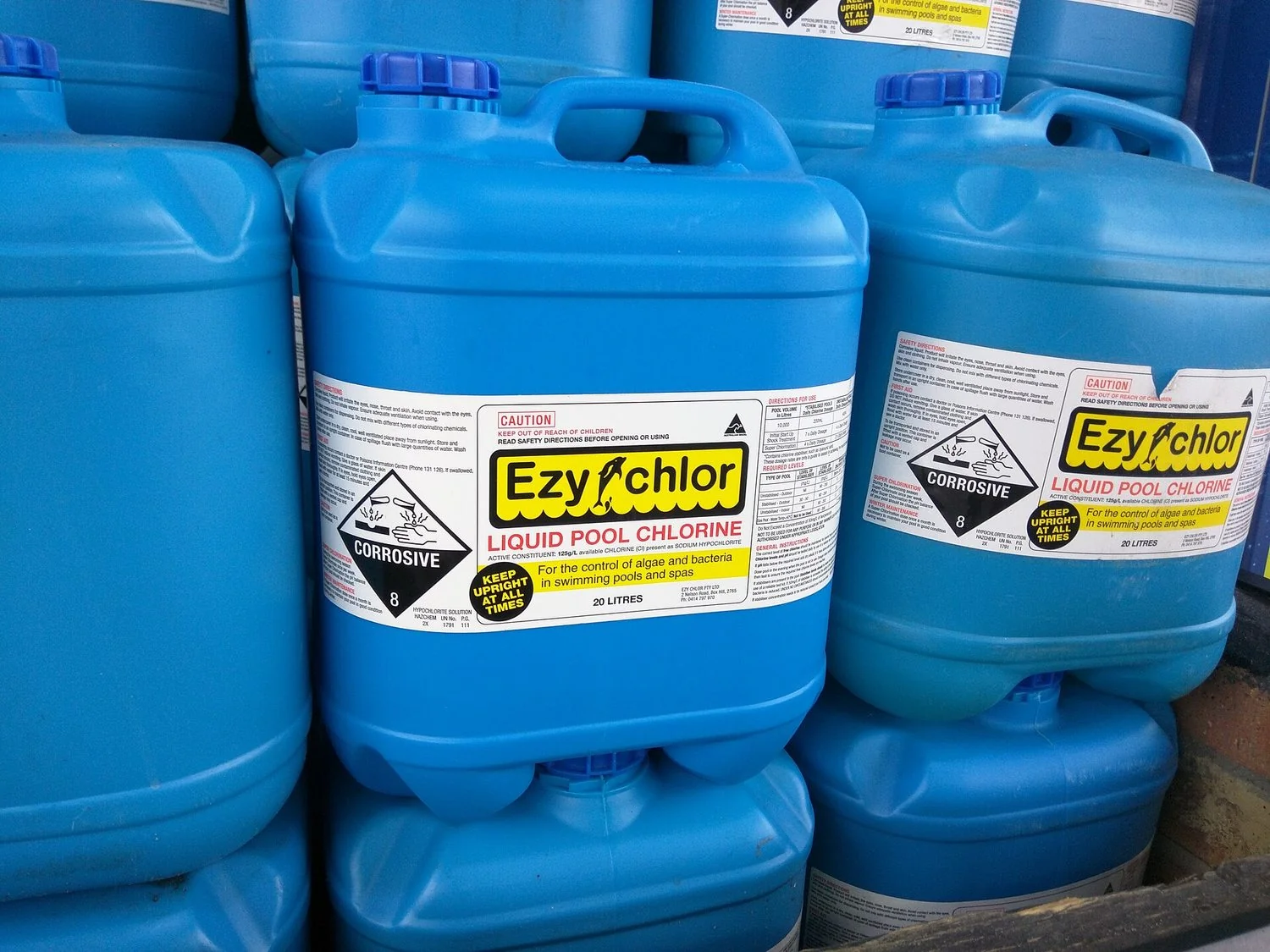
Chlorine is added to pool water to kill microbes
Chlorine makes water safe to drink because:
الصعوبة 1/5 · 100 عملة + مكافأة صغيرة عند الإنجاز الأول اليوم
Cl₂ + H₂O ⇌ HOCl + HCl; the HOCl and ClO⁻ kill bacteria.
Chlorine reacts with water to form a mixture used to disinfect water supplies.
الصعوبة 1/5 · 100 عملة + مكافأة صغيرة عند الإنجاز الأول اليوم
It forms chloric(I) acid, which kills microbes.
Match each chlorine reaction to its product/role.
الصعوبة 2/5 · 140 عملة + مكافأة صغيرة عند الإنجاز الأول اليوم
Each item links the term to its correct meaning.
What is the oxidation number of chlorine in chloric(I) acid, HOCl?
الصعوبة 2/5 · 140 عملة + مكافأة صغيرة عند الإنجاز الأول اليوم
H is $+1$ and O is $-2$, so $+1 - 2 + x = 0$ و $x = +1$, as the name chloric(I) says.
Which is a risk of chlorinating drinking water?
الصعوبة 1/5 · 100 عملة + مكافأة صغيرة عند الإنجاز الأول اليوم
Chlorinated organic compounds and the toxicity of chlorine gas are the risks. The amounts are small, and safe water saves many more lives.
Use oxidation numbers to explain the ratio in $3\text{Cl}_2 + 6\text{NaOH} \rightarrow 5\text{NaCl} + \text{NaClO}_3 + 3\text{H}_2\text{O}$.
- Cl starts at 0. In $\text{NaCl}$ it is $-1$ (a fall of 1); in $\text{NaClO}_3$ it is $+5$, since $+1 + x + 3(-2) = 0$ (a rise of 5).
- Electrons lost must equal electrons gained, so five Cl atoms fall by 1 for every one that rises by 5: 5 NaCl to 1 $\text{NaClO}_3$, using 6 Cl atoms, which is $3\text{Cl}_2$. In water treatment, $\text{Cl}_2 + \text{H}_2\text{O} \rightarrow \text{HCl} + \text{HOCl}$ is also a disproportionation: Cl goes to $-1$ and $+1$.
- Learn which conditions give which product: cold, dilute → ClO⁻ (+1); hot, concentrated → ClO₃⁻ (+5).
- In disproportionation, say the element is both oxidised and reduced, and give both oxidation numbers.
- Chlorine with water is reversible (⇌); write HOCl, not HClO₃.
You've got it
- Cl₂ + cold, dilute NaOH → NaCl + NaClO (bleach); hot, concentrated → 5NaCl + NaClO₃.
- Both are disproportionation: Cl goes from 0 to −1 and to +1 or +5.
- Cl₂ + H₂O ⇌ HOCl + HCl; HOCl kills bacteria. Benefits outweigh the small risks.