Replication of DNA and RNA
مُقدَّم| English | المعنى |
|---|---|
| replication/ˌreplɪˈkeɪʃn/ | الاستنساخ |
| semi-conservative/ˈsemi kənˈsɜːvətɪv/ | نصف محافظ |
| template/ˈtempleɪt/ | قالب |
| DNA polymerase/ˌdiː en ˈeɪ ˌpɒlɪməˈreɪz/ | إنزيم بلمرة DNA |
| lagging strand/ˈlæɡɪŋ strænd/ | السلسلة المتأخرة |
| leading strand/ˈliːdɪŋ strænd/ | السلسلة الرائدة |
| DNA ligase/ˌdiː en ˈeɪ ˈlɪɡeɪs/ | إنزيم ليجاز DNA |
| messenger RNA/ˈmesɪndʒə ˌɑː en ˈeɪ/ | الحمض النووي الريبوزي الرسول (mRNA) |
Copying DNA
- Before a cell divides, all its DNA must be copied — replication 复制.
- Each new molecule keeps one old strand and gains one new one.
- We call this semi-conservative 半保留 replication.
DNA replication is "semi-conservative" because each new molecule has:
الصعوبة 1/5 · 100 عملة + مكافأة صغيرة عند الإنجاز الأول اليوم
Each daughter molecule conserves one parental strand and pairs it with one new strand.
In semi-conservative replication, each new DNA molecule keeps one of the original strands.
الصعوبة 1/5 · 100 عملة + مكافأة صغيرة عند الإنجاز الأول اليوم
That is exactly what "semi-conservative" means — one old strand is conserved in each copy.
The steps of replication
- the double helix unwinds and the hydrogen bonds break, so the two strands separate.
- each old strand acts as a template 模板; free nucleotides pair with the exposed bases (complementary base pairing).
- the enzyme DNA polymerase DNA聚合酶 joins the new nucleotides into a strand — it can only add them in the 5′→3′ direction.
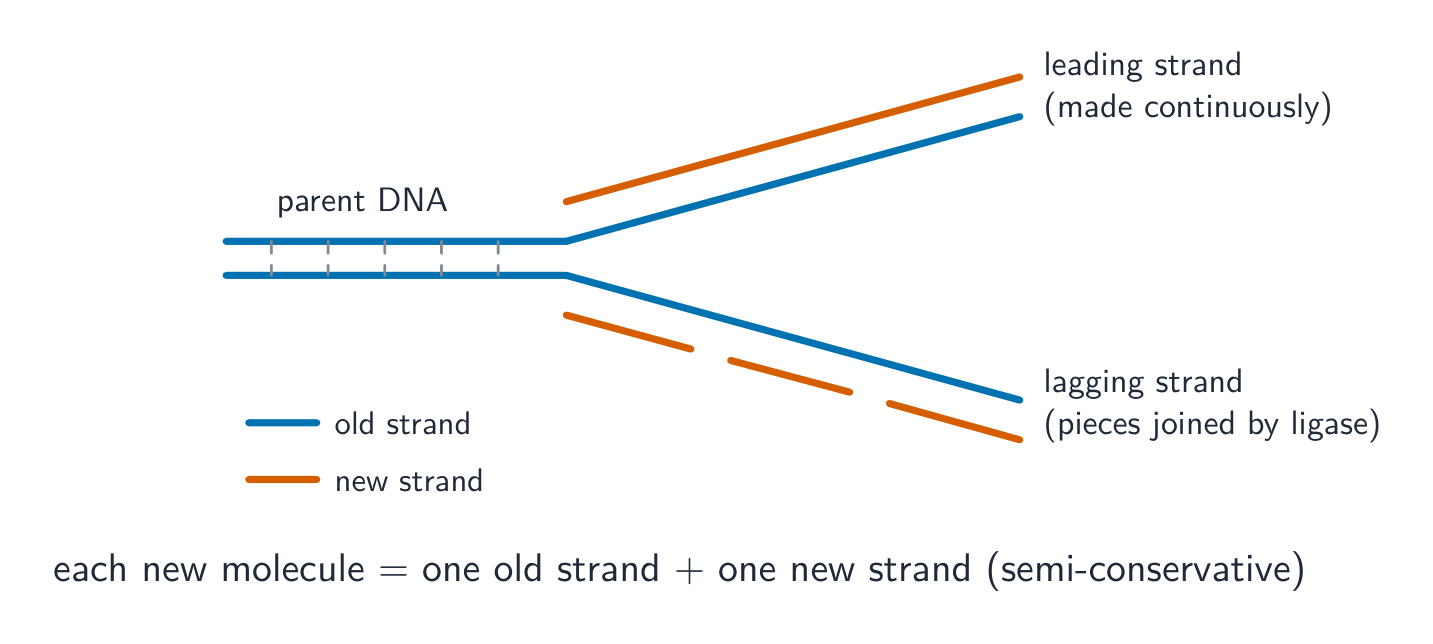
Semi-conservative DNA replication at a fork
Semi-conservative replication
Step through copying DNA. The helix unwinds, each old strand templates a new one, and you end with two identical molecules.
Free nucleotides line up against the exposed template bases by ______ base pairing.
الصعوبة 1/5 · 100 عملة + مكافأة صغيرة عند الإنجاز الأول اليوم
Each template base attracts its complement (A–T, C–G), so the new strand is an exact partner.
DNA polymerase adds new nucleotides:
الصعوبة 1/5 · 100 عملة + مكافأة صغيرة عند الإنجاز الأول اليوم
DNA polymerase can extend a strand only in the 5′→3′ direction, which is why the two strands are built differently.
Leading and lagging strands 后随链
- Because of the 5′→3′ rule, the two new strands are built differently:
- the leading strand 前导链 is made continuously, following the unwinding.
- the lagging strand is made in short pieces, joined together by DNA ligase DNA连接酶.
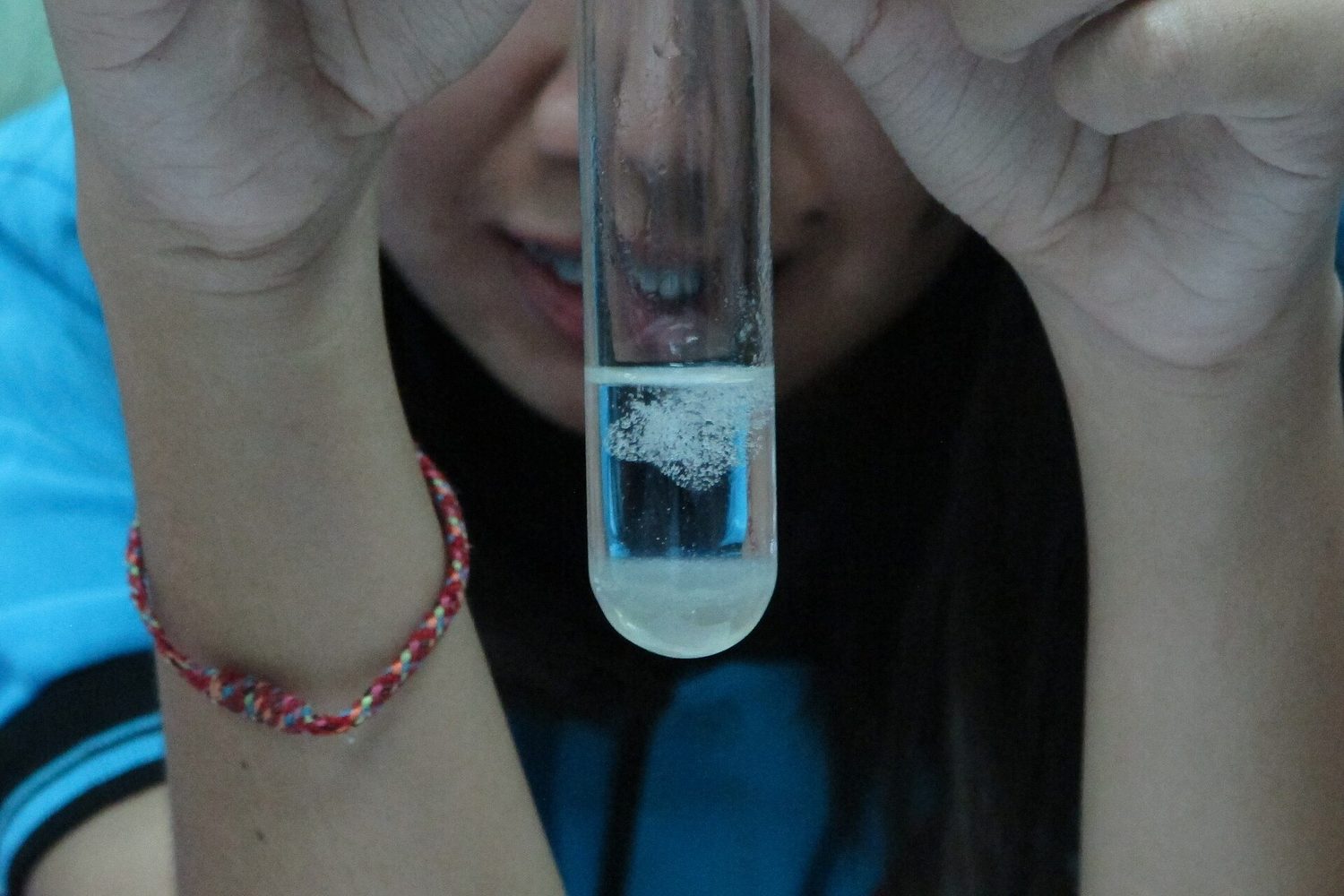
DNA extracted from cells appears as pale, stringy strands.
Put the steps of DNA replication in order.
الصعوبة 3/5 · 200 عملة + مكافأة صغيرة عند الإنجاز الأول اليوم
Unwind → expose templates → base-pair → join → two copies, each semi-conservative.
RNA
- RNA is also made of nucleotides, but it is:
- a single strand,
- built with the sugar ribose, and
- uses uracil in place of thymine.
- Messenger RNA 信使RNA (mRNA) carries a copy of a gene's instructions out of the nucleus.
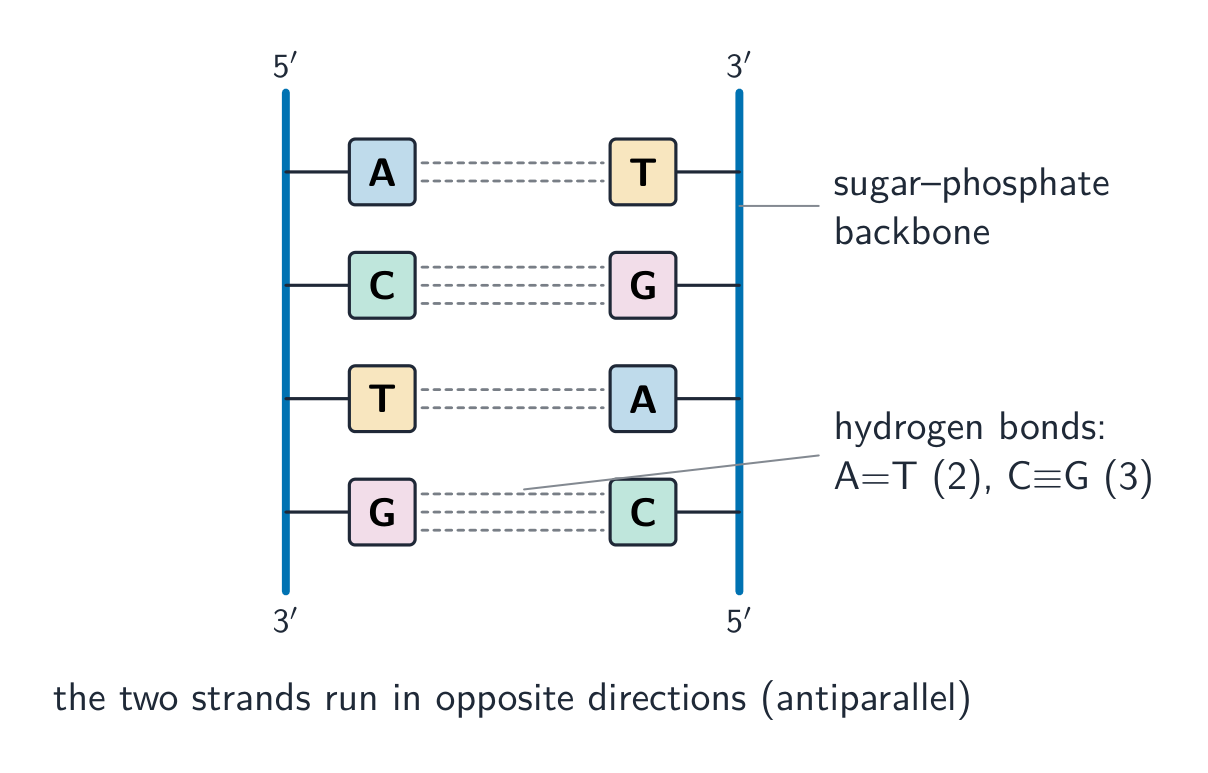
DNA: antiparallel strands held by complementary base pairs
How does RNA differ from DNA?
الصعوبة 1/5 · 100 عملة + مكافأة صغيرة عند الإنجاز الأول اليوم
RNA is a single strand with ribose sugar and uracil in place of thymine.
Match each feature to DNA or RNA.
الصعوبة 2/5 · 140 عملة + مكافأة صغيرة عند الإنجاز الأول اليوم
DNA: double-stranded, deoxyribose, thymine. RNA: single-stranded, ribose, uracil.
Worked example: the Meselson–Stahl result
Bacteria grown for many generations on heavy ¹⁵N are moved to light ¹⁴N and allowed to divide once, then twice. DNA is spun in a centrifuge. Predict the bands if replication is semi-conservative.
- After one division: each new molecule has one heavy (old) strand and one light (new) strand, so all DNA is hybrid: one band in the middle.
- After two divisions: each hybrid molecule separates; each strand pairs with a new light strand. Half the molecules are hybrid and half are light: two bands, equal in size. This is what Meselson and Stahl observed, ruling out conservative replication.
After one division in ¹⁴N, conservative replication would give:
الصعوبة 1/5 · 100 عملة + مكافأة صغيرة عند الإنجاز الأول اليوم
The original molecule stays heavy; the copy is wholly light.
Which enzyme joins the fragments of the lagging strand?
الصعوبة 1/5 · 100 عملة + مكافأة صغيرة عند الإنجاز الأول اليوم
Ligase seals the gaps between fragments.
You've got it
- replication is semi-conservative: each new molecule keeps one old strand
- unwind → strands separate → each is a template → DNA polymerase joins nucleotides 5′→3′
- leading strand continuous; lagging strand in pieces joined by DNA ligase
- RNA: single strand, ribose, uracil (not thymine); mRNA carries the gene copy out of the nucleus
Write from this case
- A DNA molecule unwinds.
- Each strand is a template for a new strand.
What is true of each new DNA molecule?
Each daughter molecule has one parental strand.
Why is replication called semi-conservative?
الصعوبة 1/5 · 100 عملة + مكافأة صغيرة عند الإنجاز الأول اليوم
Half of each new molecule is conserved.