Pythagoras' theorem · 勾股定理
| English | 中文 | Pinyin · 拼音 |
|---|---|---|
| Pythagoras/paɪˈθæɡərəs/ | 勾股定理 | gōu gǔ dìng lǐ |
| right-angled triangle/raɪt ˈæŋɡld ˈtraɪæŋɡl/ | 直角三角形 | zhí jiǎo sān jiǎo xíng |
| hypotenuse/haɪˈpɒtənjuːs/ | 斜边 | xié biān |
| Pythagorean triples/ˈpaɪθəɡɔːrɪən ˈtrɪplz/ | 勾股数 | gōu gǔ shù |
The rope that made a right angle
- Ancient Egyptian builders used a rope with 12 equally-spaced knots to create a perfect right angle: stretch it into a triangle with sides 3, 4, and 5 — the corner opposite the longest side is always $90^{\circ}$.
- Pythagoras 勾股定理 proved why this works, and his theorem is still the most-used result in all of mathematics.
造出一个直角的绳子
- 古埃及建筑工人用一根有 12 个等距打结的绳子来创造一个完美的直角:把它拉成一个边为 3、4 和 5 的三角形——最长边对面的角总是 $90^{\circ}$。
- 毕达哥拉斯证明了为什么这有效,而他的定理仍然是所有数学中最常用的结果。
The theorem
- In a right-angled triangle 直角三角形, the square on the hypotenuse 斜边 equals the sum of the squares on the other two sides:
- $c$ is the hypotenuse — the longest side, opposite the right angle.
The classic 3-4-5 triangle: $3^2 + 4^2 = 5^2$. The theorem works for every right-angled triangle.
$c$ must be the hypotenuse. The formula $a^2 + b^2 = c^2$ only works when $c$ is the side opposite the right angle. If you label the wrong side as $c$, you'll get the wrong answer.
定理
- 在一个直角三角形中,斜边上的正方形等于另外两条边上的正方形之和:
- $c$ 是斜边(hypotenuse)——最长的边,对着直角。
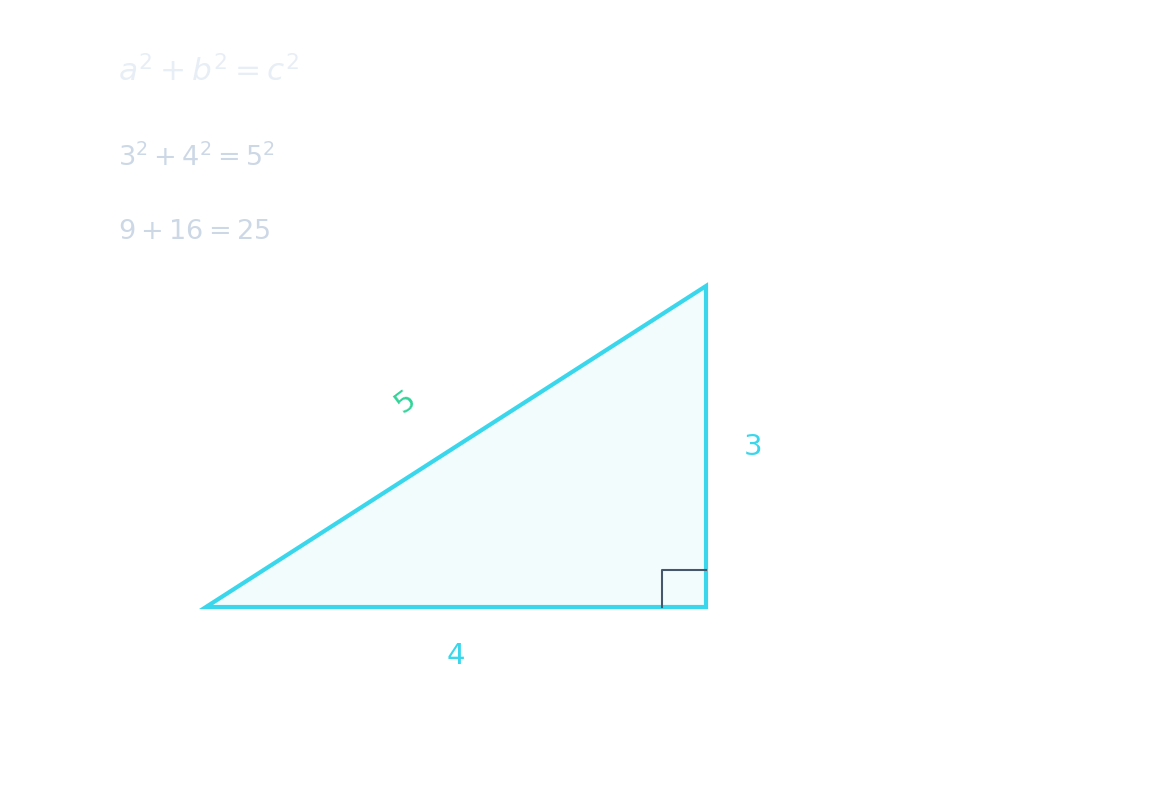
经典的 3-4-5 三角形:$3^2 + 4^2 = 5^2$。该定理对每个直角三角形都有效。
$c$ 必须是斜边。 公式 $a^2 + b^2 = c^2$ 只在 $c$ 是对着直角的边时有效。如果你把错误的边标记为 $c$,你会得到错误的答案。
Pythagoras' theorem · 勾股定理
a² + b² = c²
The squares on the two legs always add up to the square on the hypotenuse. · 两条直角边上的正方形总是加起来等于斜边上的正方形。
A right-angled triangle has short sides 3 cm and 4 cm. Find the hypotenuse (cm). · 一个直角三角形有短边 3 cm 和 4 cm。求斜边(cm)。
√(3² + 4²) = √25 = 5 cm. · √(3² + 4²) = √25 = 5 cm。
The hypotenuse of a right-angled triangle is: · 一个直角三角形的斜边是:
The hypotenuse is the longest side and lies opposite the 90° angle. · 斜边是最长的边并位于 90° 角的对面。
In Pythagoras theorem, a² + b² = c², the side c must be the . · 在勾股定理 a² + b² = c² 中,边 c 必须是。
c must always be the hypotenuse (the side opposite the right angle). · c 必须总是斜边(对着直角的边)。
Finding a missing side
- Finding the hypotenuse: $c = \sqrt{a^2 + b^2}$ (add and square-root).
- Finding a short side: $a = \sqrt{c^2 - b^2}$ (subtract and square-root).
Hypotenuse $13$, short side $5$: $b = \sqrt{13^2 - 5^2} = \sqrt{169 - 25} = \sqrt{144} = 12$.
Pythagoras as areas: the squares on the two shorter sides ($9+16$) add up to the square on the hypotenuse ($25$)
求一条缺失的边
- 求斜边:$c = \sqrt{a^2 + b^2}$(相加并开方)。
- 求一条短边:$a = \sqrt{c^2 - b^2}$(相减并开方)。
斜边 $13$,短边 $5$:$b = \sqrt{13^2 - 5^2} = \sqrt{169 - 25} = \sqrt{144} = 12$。

毕达哥拉斯作为面积:两条较短边上的正方形($9+16$)加起来等于斜边上的正方形($25$)
The hypotenuse is 13 cm and one short side is 5 cm. Find the other short side (cm). · 斜边是 13 cm,一条短边是 5 cm。求另一条短边(cm)。
√(13² − 5²) = √(169 − 25) = √144 = 12 cm. · √(13² − 5²) = √(169 − 25) = √144 = 12 cm。
A right-angled triangle has hypotenuse 10 cm and one short side 6 cm. Find the other short side (cm). · 一个直角三角形有斜边 10 cm 和一条短边 6 cm。求另一条短边(cm)。
√(10² − 6²) = √(100 − 36) = √64 = 8 cm. · √(10² − 6²) = √(100 − 36) = √64 = 8 cm。
Pythagorean triples 勾股数 worth knowing
- $3, 4, 5$ — the smallest triple.
- $5, 12, 13$ — the next most common.
- Multiples work too: $6, 8, 10$ and $9, 12, 15$ are also right-angled.
- Spotting a triple saves calculation time in exams.
值得知道的勾股数
- $3, 4, 5$——最小的勾股数。
- $5, 12, 13$——下一个最常见的。
- 倍数也有效:$6, 8, 10$ 和 $9, 12, 15$ 也是直角的。
- 发现一组勾股数在考试中节省计算时间。
A triangle with sides 6, 8, 10 is right-angled. · 一个边为 6, 8, 10 的三角形是直角的。
6² + 8² = 36 + 64 = 100 = 10². It is a multiple of the 3-4-5 triple. · 6² + 8² = 36 + 64 = 100 = 10²。它是 3-4-5 勾股数的一个倍数。
You've got it
- $a^2 + b^2 = c^2$, with $c$ the hypotenuse (opposite the right angle)
- to find a short side, subtract: $b = \sqrt{c^2 - a^2}$
- $3$-$4$-$5$ and $5$-$12$-$13$ are worth remembering
你掌握了
- $a^2 + b^2 = c^2$,其中 $c$ 是斜边(对着直角)
- 要求一条短边,相减:$b = \sqrt{c^2 - a^2}$
- $3$-$4$-$5$ 和 $5$-$12$-$13$ 值得记住