Indices in algebra · 代数中的指数
| English | 中文 | Pinyin · 拼音 |
|---|---|---|
| indices/ˈɪndɪsiːz/ | 指数 | zhǐ shù |
| coefficient/ˌkəʊɪˈfɪʃənt/ | 系数 | xì shù |
| index equations/ˈɪndeks ɪˈkweɪʒnz/ | 指数方程 | zhǐ shù fāng chéng |
The tower of powers
- How many times can you double a grain of rice before it fills a room? About 40 doublings — that's $2^{40} \approx 10^{12}$ grains.
- Index laws let you tame these enormous numbers, working with the powers instead of computing the values.
幂之塔
- 在一粒米填满一个房间之前你能把它翻倍多少次?大约 40 次翻倍——那是 $2^{40} \approx 10^{12}$ 粒。
- 指数定律(index laws)让你驾驭这些巨大的数,用幂而不是计算值来工作。
Algebraic index law lab · 代数指数法则练习
Classify index-law examples by the rule being used. · 根据所使用的规则对指数法则示例进行分类。
The three core rules
- Multiply same-base powers → add indices 指数: $\;a^m \times a^n = a^{m+n}$.
- Divide same-base powers → subtract indices: $\;a^m \div a^n = a^{m-n}$.
- Power of a power → multiply indices: $\;(a^m)^n = a^{mn}$.
$(5x^3)^2 = 5^2 \times (x^3)^2 = 25x^6$. Apply the power to every factor — the coefficient 系数 and the letter.
三条核心规则
- 乘同底数的幂 → 加指数:$\;a^m \times a^n = a^{m+n}$。
- 除同底数的幂 → 减指数:$\;a^m \div a^n = a^{m-n}$。
- 幂的幂 → 乘指数:$\;(a^m)^n = a^{mn}$。
$(5x^3)^2 = 5^2 \times (x^3)^2 = 25x^6$。把幂应用到每个因子——系数和字母。
(5x³)² = k·x⁶. What is the coefficient k? · (5x³)² = k·x⁶。系数 k 是多少?
(5x³)² = 5² × (x³)² = 25x⁶, so k = 25. · (5x³)² = 5² × (x³)² = 25x⁶,因此 k = 25。
a³ × a⁴ = a⁷.
Same base: add indices. a³ × a⁴ = a^(3+4) = a⁷. · 同底数相乘:指数相加。a³ × a⁴ = a^(3+4) = a⁷。
Complete the rule: (a^m)^n = a^(). · 补全规则:(a^m)^n = a^()。
Power of a power: multiply the indices. (a^m)^n = a^(mn). · 幂的幂:指数相乘。(a^m)^n = a^(mn)。
Working with coefficients
- Separate the number part from the letter part, simplify each, then recombine.
- $12a^5 \div 3a^{-2}$: numbers $12 \div 3 = 4$; letters $a^5 \div a^{-2} = a^{5-(-2)} = a^7$. Answer: $4a^7$.
- $6x^7y^4 \times 5x^{-5}y = 30x^{7+(-5)}y^{4+1} = 30x^2y^5$.
Subtracting a negative. $a^5 \div a^{-2} = a^{5 - (-2)} = a^{5+2} = a^7$. Subtracting a negative is adding.
处理系数
- 把数字部分与字母部分分开,各自简化,然后重新组合。
- $12a^5 \div 3a^{-2}$:数字 $12 \div 3 = 4$;字母 $a^5 \div a^{-2} = a^{5-(-2)} = a^7$。答案:$4a^7$。
- $6x^7y^4 \times 5x^{-5}y = 30x^{7+(-5)}y^{4+1} = 30x^2y^5$。
减去一个负数。 $a^5 \div a^{-2} = a^{5 - (-2)} = a^{5+2} = a^7$。减去一个负数就是加。
Simplify 12a⁵ ÷ 3a⁻². · 化简 12a⁵ ÷ 3a⁻²。
12/3 = 4 and a⁵ ÷ a⁻² = a^(5−(−2)) = a⁷, so 4a⁷. · 12/3 = 4 且 a⁵ ÷ a⁻² = a^(5−(−2)) = a⁷,因此结果为 4a⁷。
Index equations 指数方程
- Write both sides with the same base, then equate the powers.
- Solve $2^x = 32$: since $32 = 2^5$, we get $x = 5$.
- Solve $3^{2x} = 81$: since $81 = 3^4$, $2x = 4$, so $x = 2$.
指数方程
- 把两边都写成相同的底数,然后令指数相等。
- 解 $2^x = 32$:因为 $32 = 2^5$,我们得到 $x = 5$。
- 解 $3^{2x} = 81$:因为 $81 = 3^4$,$2x = 4$,所以 $x = 2$。
Solve 2^x = 32. · 解方程 2^x = 32。
32 = 2⁵, so x = 5. · 32 = 2⁵,因此 x = 5。
Solve 3^(2x) = 81. · 解方程 3^(2x) = 81。
81 = 3⁴, so 2x = 4, giving x = 2. · 81 = 3⁴,因此 2x = 4,得出 x = 2。
Where index laws appear
- Scientific notation relies on $10^a \times 10^b = 10^{a+b}$.
- Compound interest uses $(1+r)^n$ — a power of a real-world multiplier.
- Computer science: memory sizes are powers of 2 (KB $= 2^{10}$, MB $= 2^{20}$, GB $= 2^{30}$).
Powers and roots are inverses: the area of a square is $s^2$, and its side is $\sqrt{\text{area}}$.
指数定律出现在哪里
- 科学记数法依靠 $10^a \times 10^b = 10^{a+b}$。
- 复利使用 $(1+r)^n$——一个现实世界乘数的幂。
- 计算机科学:内存大小是 2 的幂(KB $= 2^{10}$,MB $= 2^{20}$,GB $= 2^{30}$)。
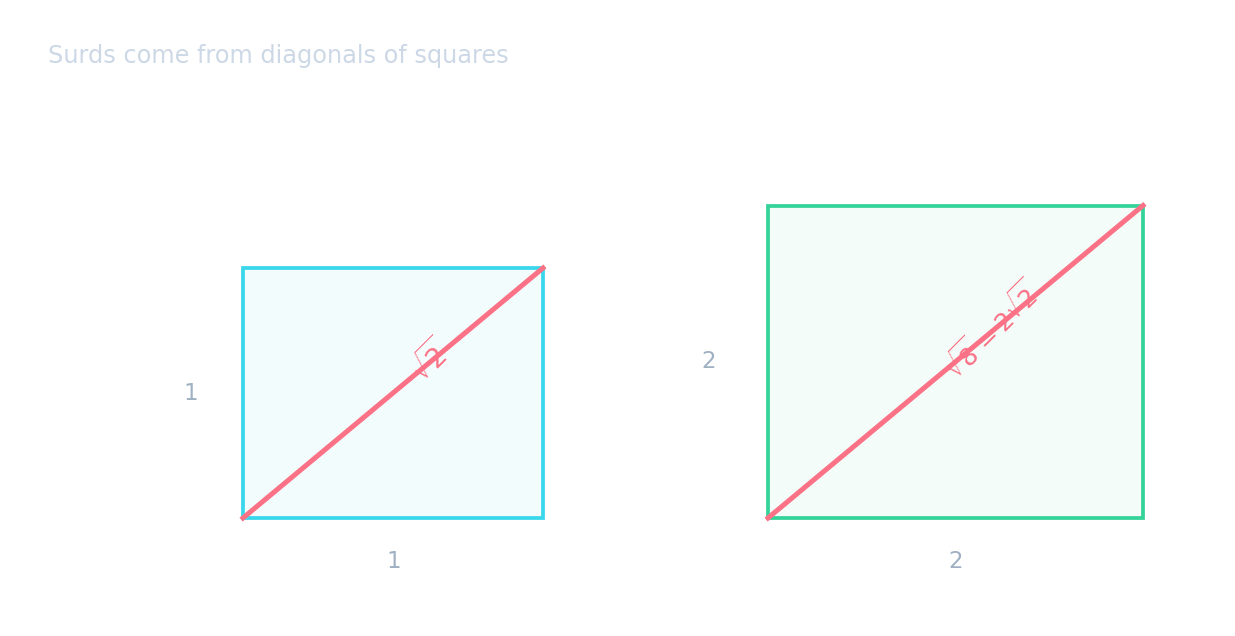
幂和根是逆运算:一个正方形的面积是 $s^2$,而它的边是 $\sqrt{\text{area}}$。
You've got it
- multiply → add indices; divide → subtract; power of a power → multiply
- handle coefficients and letters separately, then recombine
- solve index equations by writing both sides with the same base
- $(5x^3)^2 = 25x^6$; $\;12a^5 \div 3a^{-2} = 4a^7$; $\;2^x = 32 \Rightarrow x = 5$
你掌握了
- 乘 → 加指数;除 → 减;幂的幂 → 乘
- 分别处理系数和字母,然后重新组合
- 通过把两边写成相同的底数来解指数方程
- $(5x^3)^2 = 25x^6$;$\;12a^5 \div 3a^{-2} = 4a^7$;$\;2^x = 32 \Rightarrow x = 5$