Exponential growth and decay · 指数增长与衰减
| English | 中文 | Pinyin · 拼音 |
|---|---|---|
| exponential growth/ˌekspəˈnenʃl ɡrəʊθ/ | 指数增长 | zhǐ shù zēng zhǎng |
| compound/ˈkɒmpaʊnd/ | 复利 | fù lì |
| decay/dɪˈkeɪ/ | 衰减 | shuāi jiǎn |
| depreciation/dɪˌpriːʃɪˈeɪʃn/ | 折旧 | zhé jiù |
| half-life/hɑːf laɪf/ | 半衰期 | bàn shuāi qī |
One bacterium becomes a billion
- A bacterium divides every 20 minutes. After 10 hours (30 divisions), one cell becomes $2^{30} \approx 1\,073\,741\,824$ — over a billion.
- That's exponential growth 指数增长: the same percentage increase every period, compounding 复利.
- Linear growth adds a fixed amount; exponential growth multiplies — and it always wins in the end.
一个细菌变成十亿
- 一个细菌每 20 分钟分裂一次。10 小时后(30 次分裂),一个细胞变成 $2^{30} \approx 1\,073\,741\,824$——超过十亿。
- 那就是指数增长(exponential growth):每个周期相同的百分数增加,复合。
- 线性增长加一个固定的量;指数增长相乘——而它最终总是获胜。
The compound formula
- When a quantity changes by the same percentage each period:
- $P$ = starting value, $r$ = percentage rate per period, $t$ = number of periods.
- Growth: $r > 0$; decay 衰减: $r < 0$ (or use a multiplier below 1).
Exponential growth (curve) starts slowly but eventually pulls far ahead of linear growth (straight line).
复合公式
- 当一个量每个周期变化相同的百分数时:
- $P$ = 起始值,$r$ = 每个周期的百分率,$t$ = 周期数。
- 增长:$r > 0$;衰减:$r < 0$(或使用一个小于 1 的乘数)。
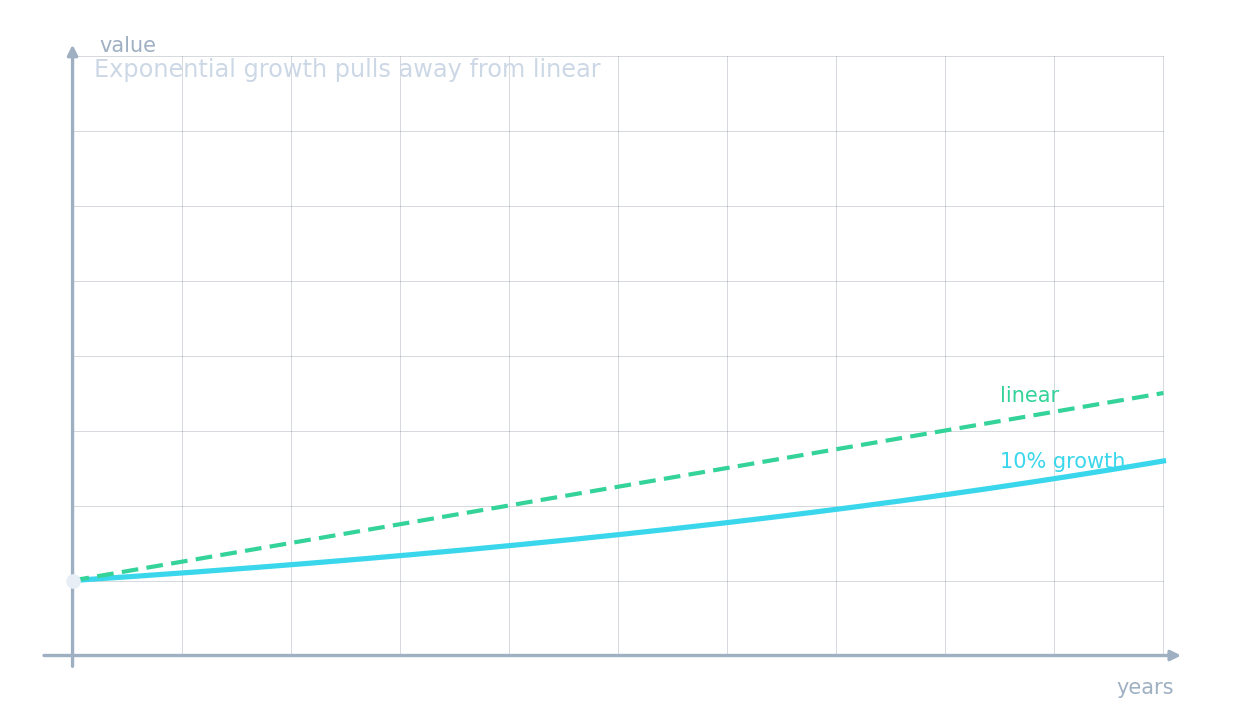
指数增长(曲线)开始缓慢但最终远远领先于线性增长(直线)。
Compound interest · 复利
Money grows by (1 + r) every year, so compound interest curves above simple interest. Drag the rate and the number of years. · 钱每年按 (1 + r) 增长,所以复利曲线高于单利。拖动利率和年数。
Exponential growth & decay · 指数增长与衰减
y = a·bˣ
Change the base b: b > 1 grows, 0 < b < 1 decays · 衰变 — useful for interest and populations. · 改变底数 b:b > 1 增长,0 < b < 1 衰减——对利息和人口有用。
A car loses 15% of its value each year. What yearly multiplier do you use? · 一辆车每年损失它价值的 15%。你使用什么年度乘数?
Losing 15% leaves 85%, so the multiplier is 0.85. · 损失 15% 剩下 85%,所以乘数是 0.85。
Depreciation of a car's value each year is an example of: · 一辆车价值每年的折旧是以下的一个例子:
Losing a fixed percentage each year is exponential decay (multiplier < 1, applied repeatedly). · 每年损失一个固定的百分数是指数衰减(乘数 < 1,反复应用)。
The compound growth formula is: final = P × (1 + ______)^t, where r is the percentage rate. · 复合增长公式是:最终 = P × (1 + ______)^t,其中 r 是百分率。
The rate r% must be converted to a decimal: r/100. So the multiplier is (1 + r/100). · 率 r% 必须被转换成一个小数:r/100。所以乘数是 (1 + r/100)。
Exponential decay and depreciation 折旧
- Decay works the same way with a multiplier below 1.
- A car worth 20 000 loses 15% each year → multiplier $0.85$.
- After 4 years: $20\,000 \times 0.85^4 = 20\,000 \times 0.5220 \approx 10\,440$.
Half-life 半衰期. A radioactive isotope decays 10% per year. Its "half-life" (time to halve) is $\dfrac{\ln 2}{\ln(1/0.9)} \approx 6.6$ years — you can find it by solving $0.9^t = 0.5$.
指数衰减与折旧
- 衰减(decay)以同样的方式用一个小于 1 的乘数工作。
- 一辆价值 20 000 的车每年损失 15% → 乘数 $0.85$。
- 4 年后:$20\,000 \times 0.85^4 = 20\,000 \times 0.5220 \approx 10\,440$。
半衰期。 一种放射性同位素每年衰减 10%。它的"半衰期"(减半的时间)是 $\dfrac{\ln 2}{\ln(1/0.9)} \approx 6.6$ 年——你能通过解 $0.9^t = 0.5$ 找到它。
A car worth 20000 depreciates 15% per year. Its value after 4 years (to the nearest 10) is: · 一辆价值 20000 的车每年折旧 15%。它 4 年后的值(到最近的 10)是:
20000 × 0.85⁴ = 20000 × 0.5220 ≈ 10440. · 20000 × 0.85⁴ = 20000 × 0.5220 ≈ 10440。
Worked example
- Population of 5000 grows 8% per year. After 6 years:
- $5000 \times 1.08^6 = 5000 \times 1.5869 \approx 7934$.
Compound ≠ simple. 8% per year for 6 years is not $8 \times 6 = 48\%$ total (that would give $5000 \times 1.48 = 7400$). Compounding gives $58.7\%$ total — almost 11% more, because each year's growth earns growth too.
例题
- 5000 的人口每年增长 8%。6 年后:
- $5000 \times 1.08^6 = 5000 \times 1.5869 \approx 7934$。
复合 ≠ 单纯。 每年 8% 持续 6 年不是总共 $8 \times 6 = 48\%$(那会给出 $5000 \times 1.48 = 7400$)。复合给出总共 $58.7\%$——几乎多 11%,因为每年的增长也赚取增长。
A population of 5000 grows 8% per year. What is the population after 6 years (nearest whole number)? · 5000 的人口每年增长 8%。6 年后的人口是多少(最近的整数)?
5000 × 1.08⁶ = 5000 × 1.5869 ≈ 7934. · 5000 × 1.08⁶ = 5000 × 1.5869 ≈ 7934。
8% growth per year for 6 years gives a total increase of exactly 48%. · 每年 8% 增长持续 6 年给出恰好 48% 的总增加。
Compounding gives 1.08⁶ ≈ 1.587, a 58.7% increase — more than 48% because growth earns growth. · 复合给出 1.08⁶ ≈ 1.587,58.7% 的增加——超过 48%,因为增长赚取增长。
Where exponential growth shows up
- Epidemics: early spread is often exponential (each infected person infects others).
- Investments: compound interest is exponential growth of your money.
- Technology: Moore's Law predicted computing power doubling every ~2 years for decades.
指数增长出现在哪里
- 流行病:早期传播常常是指数的(每个被感染的人感染其他人)。
- 投资:复利是你的钱的指数增长。
- 技术:摩尔定律预测计算能力数十年来每约 2 年翻倍。
You've got it
- exponential change uses the compound formula $P(1 + r/100)^t$
- growth = multiplier $> 1$; decay/depreciation = multiplier $< 1$
- a 15% yearly loss → multiplier $0.85$; after 4 years: $20\,000 \times 0.85^4 \approx 10\,440$
- exponential always beats linear eventually — compounding earns growth on growth
你掌握了
- 指数变化使用复合公式 $P(1 + r/100)^t$
- 增长 = 乘数 $> 1$;衰减/折旧 = 乘数 $< 1$
- 每年 15% 的损失 → 乘数 $0.85$;4 年后:$20\,000 \times 0.85^4 \approx 10\,440$
- 指数最终总是胜过线性——复合在增长上赚取增长