Surds · 无理数(根式)
| English | 中文 | Pinyin · 拼音 |
|---|---|---|
| surd/sɜːd/ | 根式 | gēn shì |
| irrational/ɪˈræʃənl/ | 无理数 | wú lǐ shù |
| rationalising/ˈræʃənəlaɪzɪŋ/ | 有理化 | yǒu lǐ huà |
The number that broke the Greeks
- The diagonal of a unit square is $\sqrt{2} \approx 1.41421356\dots$ — the digits never repeat and never end.
- No fraction equals it exactly. That's why we call it a surd 根式: an irrational 无理数 root that we leave in its exact form.
击垮希腊人的数
- 一个单位正方形的对角线是 $\sqrt{2} \approx 1.41421356\dots$——数字从不重复也从不结束。
- 没有分数精确地等于它。这就是为什么我们称它为一个根式(surd):一个我们保留其精确形式的无理根。
Surd simplification route · 根式化简路径
Break a surd into square factors and simplify it. · 将根式分解为平方因子并化简。
What is a surd?
- A surd is a root that cannot be simplified to a rational number.
- $\sqrt{5}$, $\sqrt{7}$, $\sqrt[3]{10}$ are surds — they are irrational.
- $\sqrt{4} = 2$ and $\sqrt[3]{27} = 3$ are not surds — they simplify to integers.
Surds come from diagonals: a $1 \times 1$ square has diagonal $\sqrt{2}$; a $2 \times 2$ square has diagonal $\sqrt{8} = 2\sqrt{2}$.
什么是根式?
- 一个根式是一个无法被简化为有理数的根。
- $\sqrt{5}$、$\sqrt{7}$、$\sqrt[3]{10}$ 是根式——它们是无理的。
- $\sqrt{4} = 2$ 和 $\sqrt[3]{27} = 3$ 不是根式——它们简化为整数。
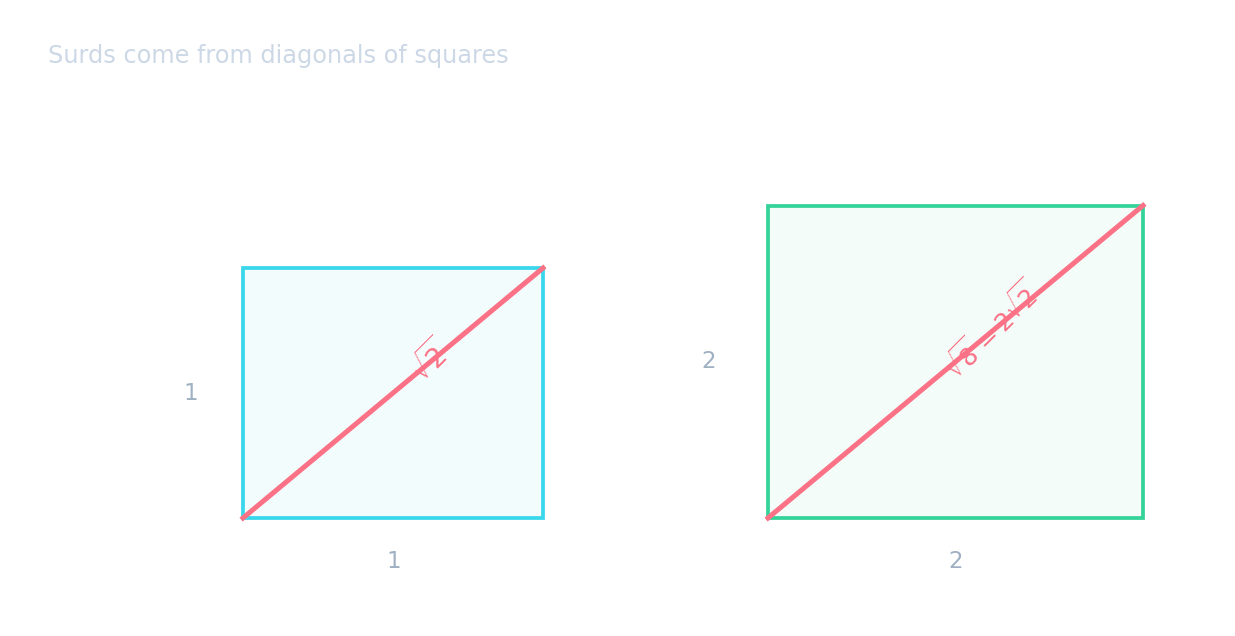
根式来自对角线:一个 $1 \times 1$ 的正方形有对角线 $\sqrt{2}$;一个 $2 \times 2$ 的正方形有对角线 $\sqrt{8} = 2\sqrt{2}$。
Surd rules
- $\sqrt{a} \times \sqrt{b} = \sqrt{ab}$ — combine under one root.
- $\dfrac{\sqrt{a}}{\sqrt{b}} = \sqrt{\dfrac{a}{b}}$ — divide under one root.
- Simplify by pulling out the largest perfect square factor:
Roots don't add. $\sqrt{a} + \sqrt{b} \neq \sqrt{a+b}$. For example, $\sqrt{9} + \sqrt{16} = 3 + 4 = 7$, but $\sqrt{25} = 5 \neq 7$.
根式规则
- $\sqrt{a} \times \sqrt{b} = \sqrt{ab}$——合并到一个根下。
- $\dfrac{\sqrt{a}}{\sqrt{b}} = \sqrt{\dfrac{a}{b}}$——在一个根下相除。
- 通过提取最大的完全平方因数来简化:
根不相加。 $\sqrt{a} + \sqrt{b} \neq \sqrt{a+b}$。例如,$\sqrt{9} + \sqrt{16} = 3 + 4 = 7$,但 $\sqrt{25} = 5 \neq 7$。
Simplify √20 into the form k√5. What is k? · 将 √20 化简为 k√5 的形式。k 是多少?
√20 = √(4×5) = √4 × √5 = 2√5, so k = 2. · √20 = √(4×5) = √4 × √5 = 2√5,因此 k = 2。
Which surd rule is correct? · 哪个根式规则是正确的?
√a × √b = √(ab); roots do not add like √a + √b = √(a+b). · √a × √b = √(ab);根号不能像加法那样合并,即 √a + √b ≠ √(a+b)。
Simplify √72 into the form k√2. What is k? · 将 √72 化简为 k√2 的形式。k 是多少?
√72 = √(36×2) = 6√2, so k = 6. · √72 = √(36×2) = 6√2,因此 k = 6。
√9 + √16 = √25.
√9 + √16 = 3 + 4 = 7, but √25 = 5. Roots do not add: √a + √b ≠ √(a+b). · √9 + √16 = 3 + 4 = 7,但 √25 = 5。根号不能直接相加:√a + √b ≠ √(a+b)。
Complete the rule: √a × √b = √(). · 补全规则:√a × √b = √()。
√a × √b = √(ab). You can combine two square roots into one by multiplying under the root. · √a × √b = √(ab)。你可以通过在根号内相乘将两个平方根合并为一个。
Rationalising 有理化 the denominator
- A fraction with a surd in the denominator is not in simplest form.
- Multiply top and bottom by the surd to remove it from the bottom:
$\dfrac{6}{\sqrt{3}} = \dfrac{6\sqrt{3}}{3} = 2\sqrt{3}$. Multiply by $\dfrac{\sqrt{3}}{\sqrt{3}} = 1$, then simplify.
分母有理化
- 一个分母中有一个根式的分数不是最简形式。
- 把分子和分母都乘以那个根式以把它从分母中移除:
$\dfrac{6}{\sqrt{3}} = \dfrac{6\sqrt{3}}{3} = 2\sqrt{3}$。乘以 $\dfrac{\sqrt{3}}{\sqrt{3}} = 1$,然后简化。
Rationalise 10/√5 into the form k√5. What is k? · 将 10/√5 有理化并化简为 k√5 的形式。k 是多少?
10/√5 × √5/√5 = 10√5/5 = 2√5, so k = 2. · 10/√5 × √5/√5 = 10√5/5 = 2√5,因此 k = 2。
Why keep surds exact?
- $\sqrt{2} \approx 1.414$ is an approximation; $\sqrt{2}$ is exact.
- In engineering and physics, rounding too early causes errors to accumulate — keeping surds preserves accuracy through long calculations.
为什么保持根式精确?
- $\sqrt{2} \approx 1.414$ 是一个近似值;$\sqrt{2}$ 是精确的。
- 在工程和物理中,过早舍入会导致误差累积——保持根式在漫长的计算中保留精度。
Like surds and two-term denominators
- Simplify each root first: $\sqrt{200}-\sqrt{32}=10\sqrt2-4\sqrt2=6\sqrt2$. Combine only matching surd parts.
- For $1/(\sqrt3-1)$ multiply by the conjugate $\sqrt3+1$: the denominator is $(\sqrt3-1)(\sqrt3+1)=3-1=2$. Thus the result is $(\sqrt3+1)/2$; the multiplying fraction equals 1.
同类根式与二项分母
- 先化简各根式:$\sqrt{200}-\sqrt{32}=10\sqrt2-4\sqrt2=6\sqrt2$。仅合并匹配的根式部分。
- 对于 $1/(\sqrt3-1)$,分子分母同乘共轭 $\sqrt3+1$:分母变为 $(\sqrt3-1)(\sqrt3+1)=3-1=2$。因此结果为 $(\sqrt3+1)/2$;所乘分数等于 1。
In √200 − √32 = k√2, find k. · 在√200 − √32 = k√2中,求k。
√200 = 10√2 and √32 = 4√2, so k = 6. · 因√200 = 10√2且√32 = 4√2,故k = 6。
You've got it
- a surd is an irrational root; keep it exact (don't approximate)
- simplify by the largest square factor: $\sqrt{20} = 2\sqrt{5}$, $\sqrt{72} = 6\sqrt{2}$
- rationalise the denominator by multiplying top and bottom by the surd
- $\sqrt{a} + \sqrt{b} \neq \sqrt{a+b}$ — roots don't add
你掌握了
- 一个根式是一个无理根;保持它精确(不要近似)
- 用最大的平方因数简化:$\sqrt{20} = 2\sqrt{5}$,$\sqrt{72} = 6\sqrt{2}$
- 通过把分子和分母乘以那个根式来有理化分母
- $\sqrt{a} + \sqrt{b} \neq \sqrt{a+b}$——根不相加