Logic expressions and circuits · 逻辑表达式与电路
| English | 中文 | Pinyin · 拼音 |
|---|---|---|
| logic circuit/ˈlɒdʒɪk ˈsɜːkɪt/ | 逻辑电路 | luó jí diàn lù |
| problem statement/ˈprɒbləm ˈsteɪtmənt/ | 问题陈述 | wèn tí chén shù |
| truth table/truːθ ˈteɪbl/ | 真值表 | zhēn zhí biǎo |
| logic expression/ˈlɒdʒɪk ekˈspreʃn/ | 逻辑表达式 | luó jí biǎo dá shì |
From statement to circuit
- Gates are combined into logic circuits 逻辑电路 to carry out a task.
- The same logic can be a problem statement 问题陈述, an expression, a circuit, or a truth table 真值表.
- You must move between all four.
从陈述到电路
- 门被组合成逻辑电路(logic circuits)来执行一个任务。
- 同样的逻辑能是一个问题陈述(problem statement)、一个表达式(expression)、一个电路(circuit),或一个真值表(truth table)。
- 你必须在所有四者之间转换。
Logic expressions 逻辑表达式
- A logic expression writes a circuit using letters and gate words.
- e.g.
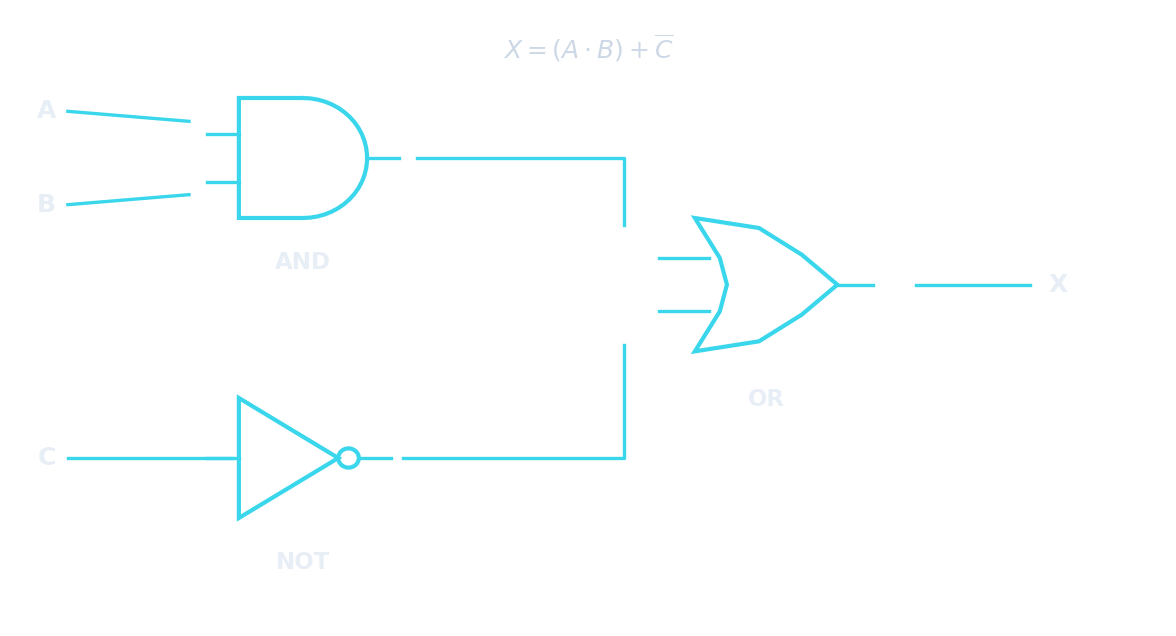
(A AND B) OR (NOT C)means: doA AND B, doNOT C, then OR the two results.
Logic gates are built from electronic circuits like this one.
OR outputs 1 when either input is 1
逻辑表达式
- 一个逻辑表达式(logic expression)用字母和门词写一个电路。
- 例如
(A AND B) OR (NOT C)意味着:做A AND B,做NOT C,然后对这两个结果 OR。

逻辑门由像这个一样的电子电路构建。
Logic expressions & circuits · 逻辑表达式与电路
gates combine into circuits · 门组合成电路
Each gate has a rule; combine them to build a circuit — explore one gate at a time. · 每个门有一个规则;组合它们来构建一个电路——一次探索一个门。
The expression (A AND B) OR (NOT C) means: · 表达式 (A AND B) OR (NOT C) 意味着:
Work out each part — (A AND B) and (NOT C) — then OR them together. · 算出每个部分——(A AND B) 和 (NOT C)——然后把它们 OR 在一起。
Logic circuits
- A logic circuit joins gates: the output of one gate becomes the input of another.
- At IGCSE a circuit has up to three inputs and one output.
逻辑电路
- 一个逻辑电路连接门:一个门的输出成为另一个门的输入。
- 在 IGCSE 一个电路最多有三个输入和一个输出。
For X = (A AND B) OR C with A=1, B=0, C=1, what is X? · 对于 X = (A AND B) OR C,A=1、B=0、C=1,X 是多少?
A AND B = 0; 0 OR C(=1) = 1, so X = 1. · A AND B = 0;0 OR C(=1) = 1,所以 X = 1。
From statement to truth table
- Problem → circuit: pick out the conditions and the logic words. "An alarm (X) sounds when the door is open (A) AND the system is on (B)" →
X = A AND B. - Completing a truth table: write all input combinations (3 inputs → 8 rows), work out each gate's output column in order, and the last column is the final output.
- Draw the circuit exactly as stated — don't simplify it.
The circuit for X = (A AND B) OR C: the AND gate's output becomes one input of the OR gate.
从陈述到真值表
- 问题 → 电路:挑出条件和逻辑词。"一个警报(X)在门开着(A)AND 系统开着(B)时响" →
X = A AND B。 - 完成一个真值表:写出所有输入组合(3 个输入 → 8 行),按顺序算出每个门的输出列,最后一列是最终输出。
- 完全按陈述画电路——不要简化它。

X = (A AND B) OR C 的电路:AND 门的输出成为 OR 门的一个输入。
Match each English phrase to its logic expression. · 把每个英语短语匹配到它的逻辑表达式。
Turn the words into gates: "and" → AND, "or" → OR, "not" → NOT, "exactly one" → XOR. · 把词变成门:"和" → AND,"或" → OR,"非" → NOT,"恰好一个" → XOR。
How many rows does a truth table have for a circuit with 3 inputs? · 一个有 3 个输入的电路的真值表有多少行?
Each input doubles the combinations: 2^3 = 8 rows (000 to 111). · 每个输入使组合翻倍:2^3 = 8 行(000 到 111)。
When drawing a circuit from a problem statement, you should: · 当从一个问题陈述画一个电路时,你应该:
At IGCSE you draw the circuit as described — simplification is not required. · 在 IGCSE 你按描述画电路——不要求简化。
You've got it
- a logic expression uses letters + AND/OR/NOT; a circuit chains gates (≤3 inputs, 1 output)
- turn a problem statement into an expression by spotting the logic words
- a truth table has $2^n$ rows ($n$ inputs); add a working column per gate
- draw the circuit exactly as stated, without simplifying
你掌握了
- 一个逻辑表达式使用字母 + AND/OR/NOT;一个电路串联门(≤3 个输入,1 个输出)
- 通过发现逻辑词把一个问题陈述变成一个表达式
- 一个真值表有 $2^n$ 行($n$ 个输入);每个门加一个工作列
- 完全按陈述画电路,不简化