| English | 释义 | 拼音 |
|---|---|---|
| interference/ˌɪntəˈfɪərəns/ | 干扰 | gān rǎo |
| check digit/tʃek ˈdɪdʒɪt/ | 校验码 | jiào yàn mǎ |
| parity check/ˈpærɪti tʃek/ | 奇偶校验 | jī ǒu jiào yàn |
| parity bit/ˈpærɪti bɪt/ | 奇偶校验位 | jī ǒu jiào yàn wèi |
| checksum/ˈtʃeksəm/ | 校验和 | jiào yàn hé |
| echo check/ˈekəʊ tʃek/ | 回送校验 | huí sòng jiào yàn |
| acknowledgement/əkˈnɒlɪdʒmənt/ | 确认 | què rèn |
| timeout/ˈtaɪmaʊt/ | 超时 | chāo shí |
| transposition/trænspəˈzɪʃn/ | 换位 | huàn wèi |
Checking for errors
- While data travels, interference 干扰 can change it — bits lost, gained or flipped.
- So the receiver checks the data arrived correctly.
- Several methods do this, plus a check digit 校验码 for typed-in numbers.
计算概念实验
Classify concrete examples by the computing idea they demonstrate.
Parity check 奇偶校验
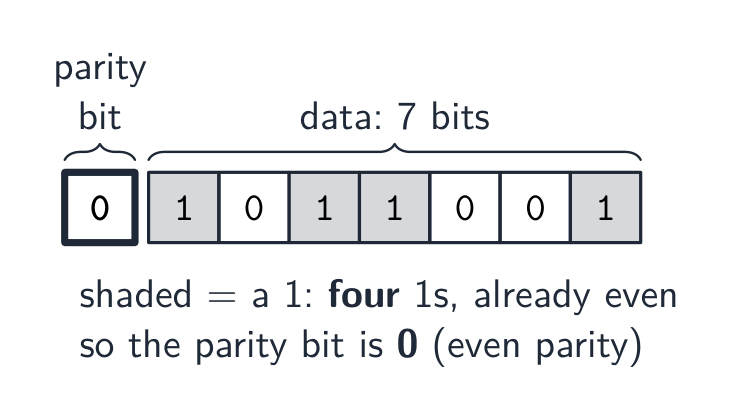
- A parity check adds one parity bit 奇偶校验位 to each byte.
- Even parity: the total number of 1s must be even; odd parity: it must be odd.
- The receiver counts the 1s; if the parity is wrong, an error occurred.
- It can't catch every error — if two bits flip, the count may still look correct.
In an even-parity system, the parity bit is set so that:
难度 1/5 · 今日首次完成可获 100 金币及少量额外奖励
Even parity makes the count of 1s even; the receiver re-counts to detect a single-bit error.
A parity check catches a single flipped bit, but if TWO bits flip the 1-count's parity can still look correct, hiding the error.
难度 1/5 · 今日首次完成可获 100 金币及少量额外奖励
That blind spot is why stronger checks (checksums, CRC) are used when reliability really matters.
Checksum 校验和, echo check 回送校验 and ARQ
- Checksum — a value calculated from the data before sending; the receiver recalculates it and compares. A mismatch → resend.
- Echo check — the receiver sends the data back; the sender compares it with the original (slow — data sent twice).
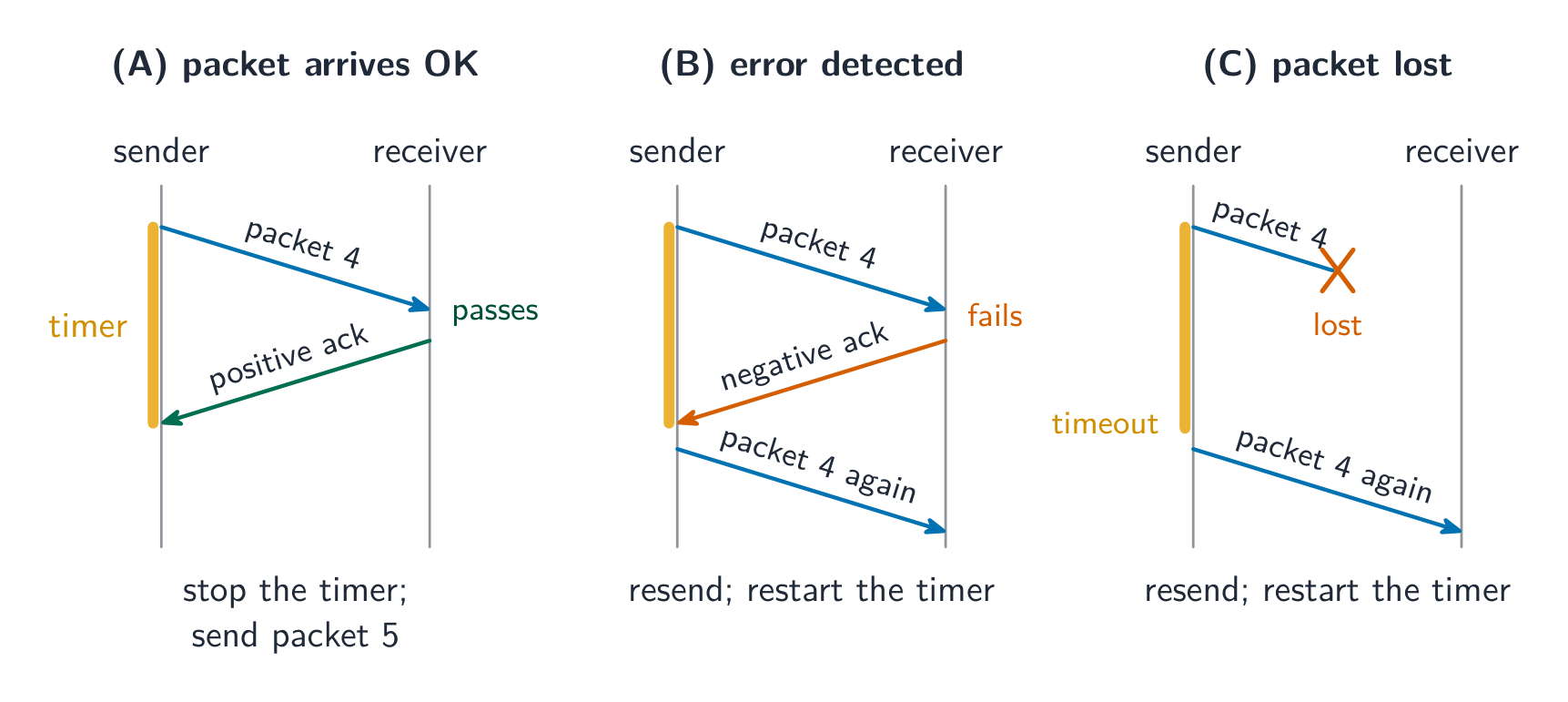
- ARQ (Automatic Repeat reQuest) — the receiver sends a positive/negative acknowledgement 确认; if no positive one arrives before a timeout 超时, the sender resends.
A checksum detects errors by:
难度 1/5 · 今日首次完成可获 100 金币及少量额外奖励
The receiver recomputes the checksum; if it differs from the sent one, the data is resent.
In ARQ, the sender resends a packet when:
难度 1/5 · 今日首次完成可获 100 金币及少量额外奖励
ARQ uses acknowledgements and a timeout timer; no positive ack in time → resend.
Check digit
- A check digit is an extra digit at the end of a number, worked out from the others — used for numbers that are typed in (barcodes, ISBNs).
- When entered, it is recalculated and compared.
- It catches an incorrect digit, a transposition 换位 (two digits swapped, 21→12), a missing/extra digit, and phonetic errors.
Match each error-detection method to how it works.
难度 2/5 · 今日首次完成可获 140 金币及少量额外奖励
Parity and checksums detect errors in transit; a check digit guards typed-in numbers; ARQ triggers the resend.
Worked example: is this byte correct?
A system uses even parity. The receiver gets 10110101. Has an error occurred? Then explain what happens if two bits flip.
- Count the 1s: 1, 1, 1, 1, 1, so there are five 1s. Five is odd, but even parity needs an even number, so an error is detected and the byte is sent again.
- If a correct byte
10110100(four 1s) has two bits flipped to11110000, it still has four 1s. The parity check passes and the error is missed, so a checksum or echo check may be used as well.
With odd parity, which parity bit is added to the 7 data bits 1100101?
难度 1/5 · 今日首次完成可获 100 金币及少量额外奖励
There are four 1s; a parity bit of 1 makes five, which is odd.
In an echo check, the receiver sends the data back and the sender compares it with the original.
难度 1/5 · 今日首次完成可获 100 金币及少量额外奖励
The sender does the comparison; if the copies differ, the data is sent again.
You've got it
- parity check = even/odd count of 1s via a parity bit; misses some 2-bit errors
- checksum = recalculate and compare; echo check = send the data back
- ARQ = acknowledgements + timeout resend
- a check digit catches typing mistakes (incorrect digit, transposition) in barcodes/ISBNs