Comparative film inquiry
引入| English | 释义 | 拼音 |
|---|---|---|
| comparative study | 比较研究 | bǐ jiào yán jiū |
| reception context | 接受背景 | jiē shòu bèi jǐng |
| production context | 制作背景 | zhì zuò bèi jǐng |
Sepia to colour, 1939
- In The Wizard of Oz (1939), Dorothy's Kansas is filmed in sepia tones. When she opens the farmhouse door in Oz, the film bursts into Technicolor — one of cinema's most famous transitions.
- In Spirited Away (2001), Hayao Miyazaki marks Chihiro's crossing into the spirit world with a dark tunnel, a wind that pulls her in, and the sudden quiet of an empty town. Both are journey films; comparing how they mark the journey is a comparative study 比较研究.
How does The Wizard of Oz mark Dorothy's arrival in Oz?
难度 1/5 · 今日首次完成可获 100 金币及少量额外奖励
Colour marks the crossing.
A focused comparison
- Choose two films from different cultural contexts and a topic linking them: "how the moment of crossing into another world is marked".
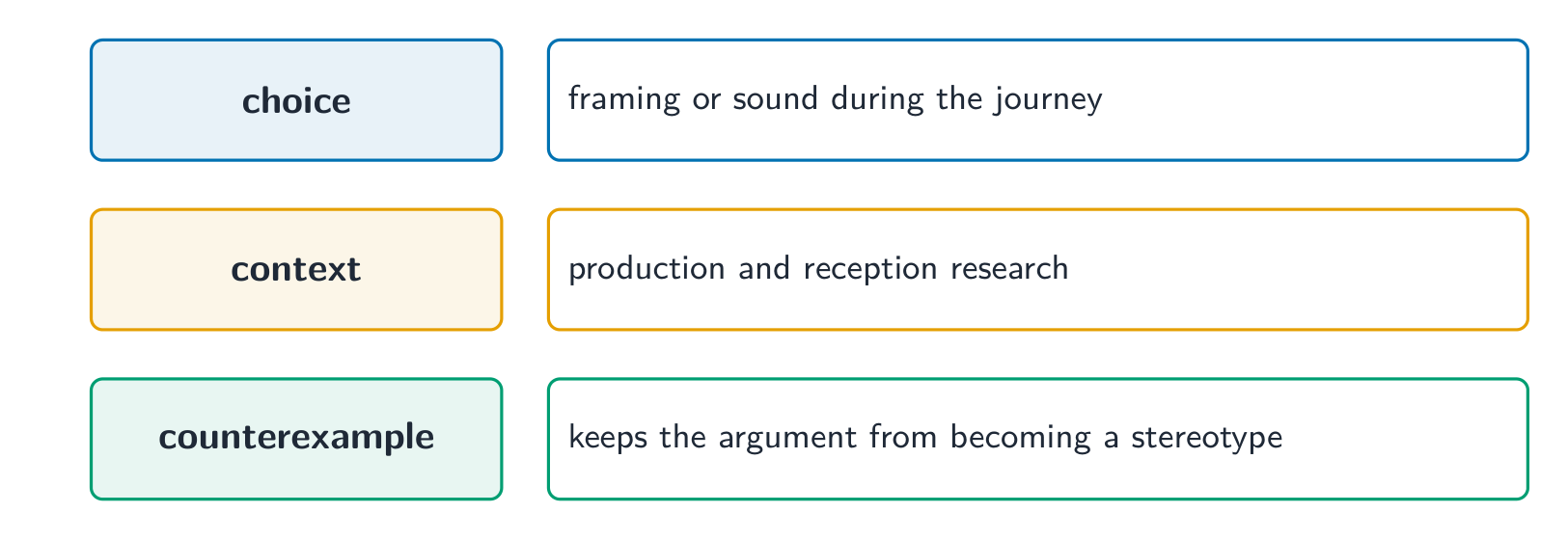
- Compare specific choices — framing, colour, sound — not whole plots.
Which is a focused comparative topic?
难度 1/5 · 今日首次完成可获 100 金币及少量额外奖励
A focused topic points to specific choices.
Production and reception context
- Production context 制作背景: who made the film, with what technology and industry. Oz was a Hollywood studio musical showing off new colour; Spirited Away came from Studio Ghibli's hand-drawn animation.
- Reception context 接受背景: how audiences responded. Spirited Away was Japan's highest-grossing film for nearly two decades and won the Oscar for best animated feature in 2003.
Match each piece of information to its context.
难度 2/5 · 今日首次完成可获 140 金币及少量额外奖励
Production is how it was made; reception is how it was received.
Worked example: building the argument
Topic: how the crossing into another world is marked.
- Oz: colour itself marks the crossing — sepia Kansas versus Technicolor Oz — so the new world is spectacular and desirable; the film still ends with "There's no place like home".
- Spirited Away: sound and space mark it — wind through the tunnel, then silence — so the new world feels uncanny and dangerous, and Chihiro must change to survive.
- Counterexample: it would be a stereotype to say "Western films want to return home, Japanese films want change". Chihiro also returns home, and Dorothy changes too. The difference is in method — spectacle versus unease — not in a simple cultural rule.
How does Spirited Away make the new world feel uncanny?
难度 1/5 · 今日首次完成可获 100 金币及少量额外奖励
Sound and space mark the crossing.
The counterexample shows that both heroines return home and change.
难度 1/5 · 今日首次完成可获 100 金币及少量额外奖励
The difference is in method, not a cultural rule.
Presenting the study
- The comparative study is a recorded multimedia presentation. Show the clips you analyse and point to the exact frames and sounds.
- Structure by points of comparison, moving between the films in each section.
The comparative study is a recorded multimedia presentation.
难度 1/5 · 今日首次完成可获 100 金币及少量额外奖励
Show clips and analyse them precisely.
Research
- Use reliable sources: interviews with the directors, production histories, critical reviews from different countries.
- Cite each source and keep claims about culture backed by evidence.
Avoid cultural stereotypes. "Japanese films are all about nature" or "Hollywood films are all spectacle" collapses two industries into slogans. Find a counterexample and argue from specific choices.
"Hollywood films are all spectacle" is a strong comparative claim.
难度 1/5 · 今日首次完成可获 100 金币及少量额外奖励
It is a stereotype.
A comparative study compares specific film-language choices in two films from different contexts, linked by a focused topic. Use production and reception context, test the argument with counterexamples to avoid stereotypes, and present clips with precise analysis.
Propose two films from different contexts and a focused topic, with one choice from each.
Films, topic, choices.