Production roles and reflective evidence
引入| English | 释义 | 拼音 |
|---|---|---|
| production role/prəˈdʌkʃn rəʊl/ | 制作岗位 | zhì zuò gǎng wèi |
| cinematographer | 摄影指导 | shè yǐng zhǐ dǎo |
| room tone/ruːm təʊn/ | 环境底噪 | huán jìng dǐ zào |
| intelligibility | 可懂度 | kě dǒng dù |
The first "sound designer", 1979
- For Apocalypse Now (1979), Walter Murch built the soundtrack from layers — helicopters, jungle, rain — and moved sounds around the cinema in surround. The film credited him as "sound designer", one of the first such credits.
- Murch later edited films too. In his book In the Blink of an Eye (1995) he ranked what makes a good cut: emotion first, then story, then rhythm. Every production role 制作岗位 makes decisions like these.
In Murch's ranking of what makes a good cut, what comes first?
难度 1/5 · 今日首次完成可获 100 金币及少量额外奖励
Emotion first, then story, then rhythm.
Production roles
- Key roles: director, cinematographer 摄影指导 (camera and light), editor, sound (recording and design), screenwriter.
- Each role has its own decisions and its own evidence: shot lists for the cinematographer, edit versions for the editor, sound recordings for the sound designer.
Match each role to typical evidence.
难度 2/5 · 今日首次完成可获 140 金币及少量额外奖励
Each role has its own evidence.
Showing your role's decisions
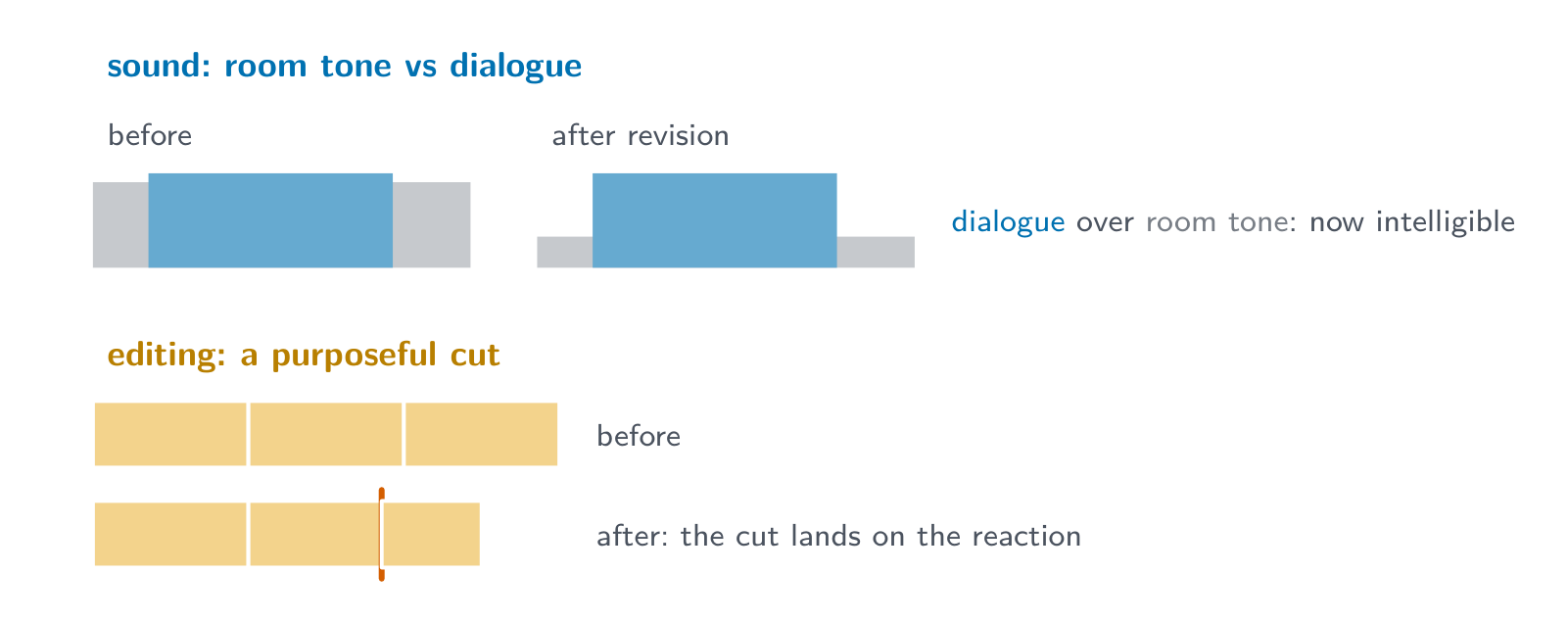
- Show a problem, the decision you made and the result: a sequence before and after a cut; a recording with room tone versus clean dialogue.
- Room tone 环境底噪 is the quiet background sound of a location. Recording it lets the editor smooth gaps between lines.
Room tone is the quiet background sound of a location.
难度 1/5 · 今日首次完成可获 100 金币及少量额外奖励
It helps smooth gaps in the edit.
Worked example: a sound revision
Problem: in a school film, a café conversation is hard to hear over clattering cups.
- Diagnosis: the dialogue was recorded with the camera's microphone, three metres away, so background noise is as loud as the voices.
- Revision: the scene is re-recorded with a boom microphone just out of frame; 30 seconds of the café's room tone is recorded separately and laid under the edit at low volume.
- Evidence: before-and-after clips show the dialogue now clear while the café still sounds busy — the revision improved intelligibility 可懂度 without losing atmosphere.
Why was the café dialogue hard to hear?
难度 1/5 · 今日首次完成可获 100 金币及少量额外奖励
Distance made noise as loud as the voices.
What did the sound revision include?
难度 2/5 · 今日首次完成可获 140 金币及少量额外奖励
The fix kept atmosphere and clarity.
Editing decisions
- A purposeful cut answers "why here?": to follow a look, to show a reaction, to change rhythm. Murch's rule puts emotion first.
- Show two versions of a sequence and explain what the final cut does better.
A purposeful cut answers the question "why here?"
难度 1/5 · 今日首次完成可获 100 金币及少量额外奖励
Every cut needs a reason.
Reflective evidence
- Keep dated evidence of your process: planning documents, test footage, versions and feedback.
- Reflect on what you learned in the role, using film terms: "holding the shot two seconds longer let the reaction land".
"I did the editing" is not evidence. Show specific decisions — before and after versions, reasons, results — so your contribution can be judged.
"I did the editing" is enough evidence of your contribution.
难度 1/5 · 今日首次完成可获 100 金币及少量额外奖励
Show specific decisions.
Each production role makes its own decisions and keeps its own evidence. Show a problem, your decision and the result — such as a sound revision for intelligibility or a purposeful cut — and reflect with dated evidence and precise film terms.
Describe one decision you could make in a production role, with a problem, a change and evidence.
Problem, decision, evidence.