Demand, supply and policy
引入| English | 释义 | 拼音 |
|---|---|---|
| demand/dɪˈmænd/ | 需求 | xū qiú |
| supply/səˈplaɪ/ | 供给 | gōng jǐ |
| market equilibrium/ˈmɑːkɪt ˌiːkwɪˈlɪbrɪəm/ | 市场均衡 | shì chǎng jūn héng |
| price elasticity of demand/praɪs ɪlæˈstɪsɪti ɒv dɪˈmænd/ | 需求价格弹性 | xū qiú jià gé tán xìng |
| price elasticity/praɪs ɪlæˈstɪsɪti/ | 价格弹性 | jià gé tán xìng |
| tax incidence/tæks ˈɪnsɪdəns/ | 税负归宿 | shuì fù guī sù |
| income elasticity/ˈɪŋkʌm ɪlæˈstɪsɪti/ | 收入弹性 | shōu rù tán xìng |
| price elasticity of supply/praɪs ɪlæˈstɪsɪti ɒv səˈplaɪ/ | 供给价格弹性 | gōng jǐ jià gé tán xìng |
| price ceiling/praɪs ˈsiːlɪŋ/ | 最高限价 | zuì gāo xiàn jià |
| price floor/praɪs flɔː/ | 最低限价 | zuì dī xiàn jià |
Mexico's soda tax, 2014
- In January 2014 Mexico added a tax of one peso per litre to sugary drinks, about 10 % of the price. In the first year, purchases fell by about 6 %, and by about 9 % among the poorest households.
- Who really paid the tax, and why did purchases fall only a little? Demand, supply and elasticity answer both questions.
Demand and supply
- Demand 需求 is the quantity buyers are willing and able to buy at each price; the curve slopes down. Supply 供给 is what sellers will offer; the curve slopes up.
- Where they cross is the market equilibrium 市场均衡. A change in price moves along a curve; a change in income, tastes, costs or technology shifts the whole curve.
Match each event to its effect on the market for bubble tea.
难度 2/5 · 今日首次完成可获 140 金币及少量额外奖励
Only a change in the good's own price moves along a curve.
Price elasticity of demand
- Price elasticity of demand 需求价格弹性 (PED) $= \dfrac{\%\Delta Q_d}{\%\Delta P}$. If $|PED| < 1$, demand is inelastic: quantity changes less than price.
- Demand is more inelastic for necessities, habits and goods with few substitutes, and when buyers have little time to adjust. Mexico's soda: a 10 % rise and a 6 % fall give $PED \approx -0.6$.
谁承担税负?
$P_b-P_s=t$
例题中买方价格由 10 升至 12,卖方所得由 10 降至 9。曲线陡峭程度改变税负分担。
The price of a bus fare rises by 20 % and journeys fall by 5 %. What is the PED?
难度 2/5 · 今日首次完成可获 140 金币及少量额外奖励
$\dfrac{-5}{20} = -0.25$, so demand is price inelastic.
Which good is likely to have the most price-inelastic demand?
难度 1/5 · 今日首次完成可获 100 金币及少量额外奖励
Petrol has few substitutes in the short run and is a necessity for commuters.
An indirect tax
- A specific tax shifts supply up by the tax per unit. The price buyers pay rises by less than the tax, and the price sellers keep falls; the gap is the tax wedge.
- Tax incidence 税负归宿 is how the burden is shared. The side that is less elastic — less able to escape — bears more.
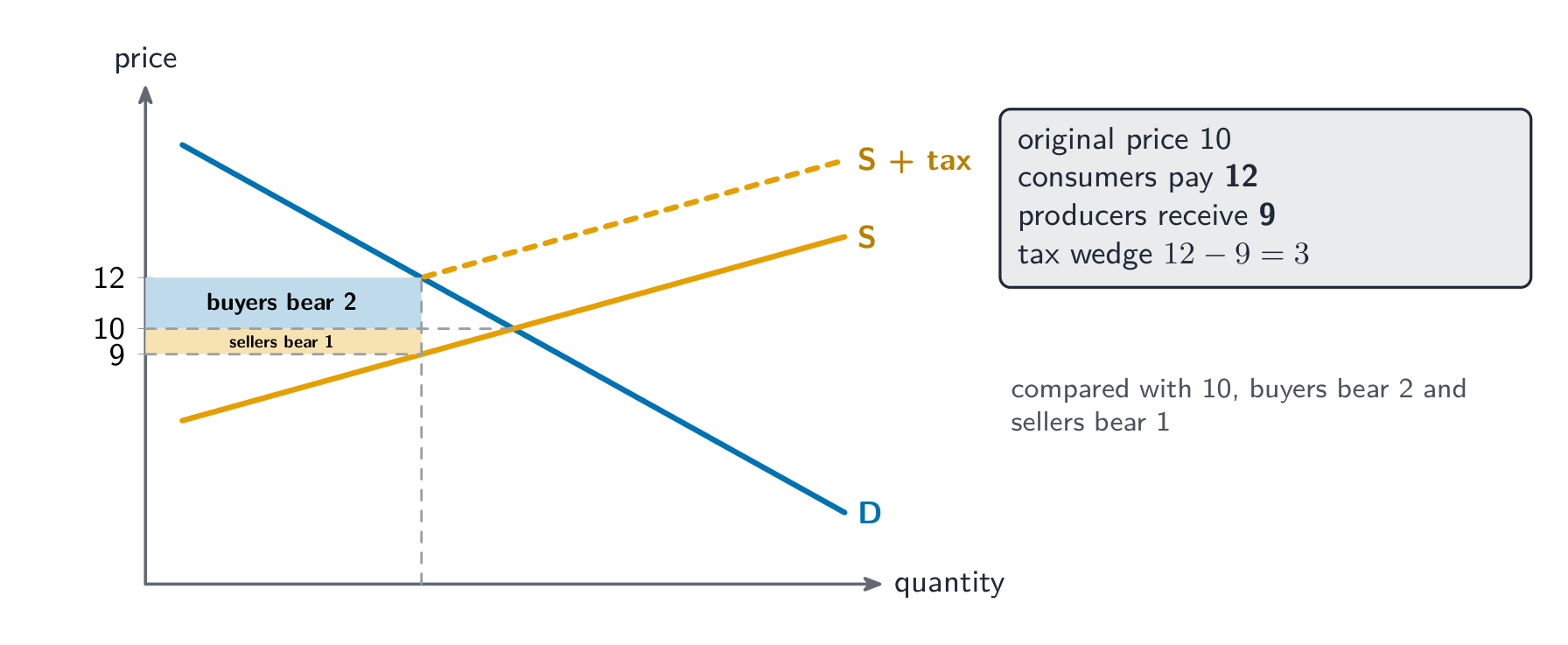
Worked example: who pays the tax?
Before a tax of 3 per unit, a drink sold for 10. After the tax, buyers pay 12 and sellers keep 9. Sales fall from 1000 to 900 units a week. Find the incidence and the tax revenue.
- Wedge: $12 - 9 = 3$, the tax per unit.
- Incidence: buyers pay $12 - 10 = 2$ more; sellers keep $10 - 9 = 1$ less. Buyers bear $\dfrac{2}{3}$ of the tax, because their demand is more inelastic than supply.
- Revenue: $3 \times 900 = 2700$ a week. Consumers pay $2 \times 900 = 1800$ of it and producers $1 \times 900 = 900$.
A tax of 2 per unit is placed on a good, and 5000 units are then sold. How much tax revenue is collected?
难度 2/5 · 今日首次完成可获 140 金币及少量额外奖励
Revenue = tax per unit × quantity after the tax = $2 \times 5000$.
Before a tax the price was 6. After a tax, buyers pay 8 and sellers receive 5. What fraction of the tax do buyers bear?
难度 2/5 · 今日首次完成可获 140 金币及少量额外奖励
该税收是 $8 - 5 = 3$. Buyers pay $8 - 6 = 2$ more, so $\dfrac{2}{3}$.
Other elasticities
- Income elasticity 收入弹性 $= \dfrac{\%\Delta Q_d}{\%\Delta Y}$: positive for normal goods, negative for inferior goods, above 1 for luxuries.
- Price elasticity of supply 供给价格弹性 $= \dfrac{\%\Delta Q_s}{\%\Delta P}$ is higher when firms have spare capacity, stocks or time to adjust.
When incomes rise by 10 %, demand for instant noodles falls by 4 %. What kind of good is this?
难度 1/5 · 今日首次完成可获 100 金币及少量额外奖励
Income elasticity is $\dfrac{-4}{10} = -0.4$; negative means inferior.
Price controls and subsidies
- A price ceiling 最高限价 below equilibrium, such as rent control, creates a shortage; a price floor 最低限价 above it, such as a minimum wage, can create a surplus.
- A subsidy shifts supply down and lowers the price. Evaluate any intervention by its effect on consumers, producers, government revenue, workers and the wider society.
A rent ceiling set below the equilibrium rent creates a surplus of flats.
难度 1/5 · 今日首次完成可获 100 金币及少量额外奖励
At the lower rent more people want flats and fewer are offered, so there is a shortage.
"The firm pays the tax, so the firm bears it" is wrong. The firm sends the money to the government, but if demand is inelastic it raises its price and passes most of the burden on. The legal payer and the economic burden are different things.
Demand and supply set equilibrium price and quantity; shifts come from changes other than price. Elasticities measure how strongly quantities respond. An indirect tax drives a wedge between what buyers pay and sellers keep, and the less elastic side bears more of it. Price controls cause shortages or surpluses.
Explain why a tax on cigarettes raises a lot of revenue but reduces smoking only a little. Comment on who bears the tax.
Use elasticity for both effects and add an evaluation.