Market failure and equity
引入| English | 释义 | 拼音 |
|---|---|---|
| market failure/ˈmɑːkɪt ˈfeɪlɪə/ | 市场失灵 | shì chǎng shī líng |
| common pool resource | 公共池塘资源 | gōng gòng chí táng zī yuán |
| externality/ekˈstɜːnælɪti/ | 外部性 | wài bù xìng |
| marginal social cost/ˈmɑːdʒɪnl ˈsəʊʃl kɒst/ | 边际社会成本 | biān jì shè huì chéng běn |
| welfare loss/ˈwelfeə lɒs/ | 福利损失 | fú lì sǔn shī |
| Pigouvian tax/pɪˈɡuːvɪən tæks/ | 庇古税 | bì gǔ shuì |
| public good/ˈpʌblɪk ɡʊd/ | 公共物品 | gōng gòng wù pǐn |
| free ride | 搭便车 | dā biàn chē |
| equity/ˈekwɪti/ | 公平 | gōng píng |
The cod that did not come back, 1992
- For 500 years the Grand Banks off Newfoundland were among the richest fisheries on Earth. By 1992 the cod stock had fallen to about 1 % of its old level, and Canada banned cod fishing. About 35 000 people lost their jobs.
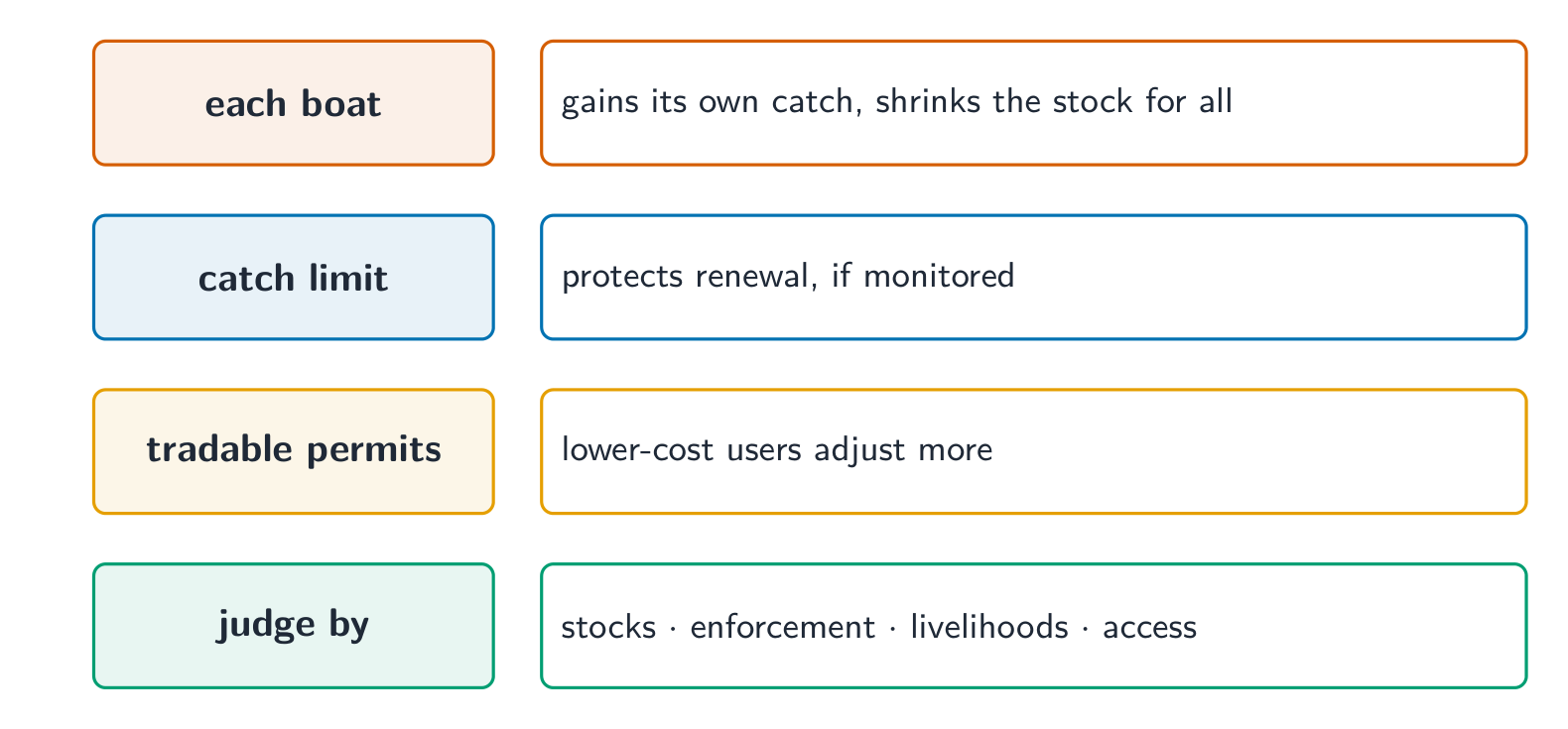
- Each boat gained from catching more; no one paid for the shrinking stock. This is market failure 市场失灵: the free market does not give the best outcome for society.
Common pool resources
- A common pool resource 公共池塘资源 such as a fishery or groundwater is rivalrous (my catch leaves less for you) but hard to exclude people from.
- Each user ignores the cost their use imposes on others, so the resource is overused — the "tragedy of the commons". The cod stock collapsed although every captain acted rationally.
Why are open fisheries over-fished?
难度 1/5 · 今日首次完成可获 100 金币及少量额外奖励
The resource is rivalrous but non-excludable, so each user imposes costs on others.
Externalities
- An externality 外部性 is a cost or benefit to a third party that is not reflected in the price. Pollution from a factory is a negative externality of production; vaccination gives a positive externality of consumption.
- With a negative externality, the marginal social cost 边际社会成本 is above the marginal private cost, so the market produces too much at too low a price, causing a welfare loss 福利损失.
Match each example to its externality.
难度 2/5 · 今日首次完成可获 140 金币及少量额外奖励
Ask who causes the effect (producer or consumer) and whether third parties gain or lose.
Worked example: a polluting factory
A chemical works sells at a price of 50 per tonne. Its private cost of the last tonne is 50, but the pollution damages farms by 20 per tonne. The market makes 1000 tonnes; the social optimum is 800 tonnes. What tax would correct this, and what is the welfare loss if the units from 800 to 1000 each had, on average, 10 more social cost than benefit?
- Tax: a Pigouvian tax 庇古税 equal to the external cost, 20 per tonne, makes the firm pay the full social cost.
- Welfare loss: $200 \text{ tonnes} \times 10 = 2000$ — the triangle between social cost and demand from 800 to 1000.
- Evaluation: the tax needs a good estimate of the damage; a tradable-permit scheme instead fixes the quantity and lets the market find the price.
The marginal private cost of a good is 40 and its pollution costs others 15 per unit. What Pigouvian tax per unit would correct the externality?
难度 2/5 · 今日首次完成可获 140 金币及少量额外奖励
The tax should equal the external cost at the optimum.
A market over-produces by 500 units, and on average each of those units has social cost 8 above its social benefit. What is the welfare loss?
难度 2/5 · 今日首次完成可获 140 金币及少量额外奖励
$500 \times 8 = 4000$.
Policy choices
- Taxes and tradable permits use prices; regulation and catch limits set quantities directly. After 1992, Canada used catch quotas, and Iceland's tradable fishing quotas (from 1990) kept its cod fishery working.
- Good policy needs measurement, enforcement and a fair deal for the people who lose their livelihoods.
Which policies limit over-use of a common fishery?
难度 2/5 · 今日首次完成可获 140 金币及少量额外奖励
Subsidies and removing rules increase fishing pressure.
Public goods and merit goods
- A public good 公共物品 is non-rivalrous and non-excludable — street lighting, a lighthouse, national defence — so people free ride 搭便车 and the market under-provides it; governments usually supply it.
- Merit goods such as education and healthcare are under-consumed because people underestimate their benefits; demerit goods such as cigarettes are over-consumed.
Which is a public good?
难度 1/5 · 今日首次完成可获 100 金币及少量额外奖励
Street lighting is non-rivalrous and non-excludable.
Equity and inequality
- Markets can be efficient and still unequal. Equity 公平 means fairness; inequality of income and wealth is measured with the Lorenz curve and the Gini coefficient (0 = perfect equality, 1 = one person has everything).
- Progressive taxes, transfer payments, minimum wages and free public services reduce inequality, but each has costs and side effects to evaluate.
A Gini coefficient of 0.6 shows more equality than one of 0.3.
难度 1/5 · 今日首次完成可获 100 金币及少量额外奖励
The higher the Gini coefficient, the more unequal the distribution.
"The market fails because firms are greedy" is wrong. Market failure happens because prices leave out external costs and benefits, or because goods cannot be sold to individuals. Perfectly honest firms still over-fish a common stock if nobody owns it.
Markets fail when prices miss external costs and benefits, when common resources are overused, and when public goods are not provided. Taxes, permits, regulation and direct provision can correct them, but each needs measurement and enforcement. Efficiency and equity are separate goals.
Evaluate a carbon tax as a way to reduce pollution from power stations.
Evaluation means weighing strengths and weaknesses, then reaching a conclusion.