Human resources and motivation
引入| English | 释义 | 拼音 |
|---|---|---|
| human resource planning | 人力资源规划 | rén lì zī yuán guī huà |
| hierarchy/ˈhaɪərɑːki/ | 等级结构 | děng jí jié gòu |
| span of control/spæn ɒv kənˈtrəʊl/ | 管理幅度 | guǎn lǐ fú dù |
| delegation/ˌdelɪˈɡeɪʃn/ | 授权 | shòu quán |
| motivation/ˌməʊtɪˈveɪʃn/ | 动机 | dòng jī |
| Maslow | 马斯洛 | mǎ sī luò |
| Herzberg | 赫茨伯格 | hè cí bó gé |
The lights at Hawthorne, 1924–1932
- At Western Electric's Hawthorne factory near Chicago, researchers changed the lighting to see if output would rise. Output rose when the lights were brighter — and also when they were dimmer.
- Elton Mayo concluded that the workers responded to being noticed and to their team. Pay and conditions matter, but so do recognition, belonging and control over one's work.
Human resource planning
- Human resource planning 人力资源规划 forecasts how many workers, with which skills, a business will need. Labour turnover $= \dfrac{\text{number who left}}{\text{average number employed}} \times 100\,\%$.
- Recruitment can be internal (promotion, cheaper, known staff) or external (new ideas, wider choice). Training can be on the job or off the job.
A firm employs an average of 250 people, and 30 leave in a year. What is the labour turnover?
难度 2/5 · 今日首次完成可获 140 金币及少量额外奖励
$\dfrac{30}{250} \times 100 = 12\,\%$.
Organisational structure
- A hierarchy 等级结构 has many levels; a span of control 管理幅度 is the number of people a manager directly supervises. Tall structures have narrow spans and many layers; flat structures have wide spans and quicker communication.
- Delegation 授权 passes authority to a subordinate. It motivates experienced staff and frees managers, but needs trust and training.
What is a likely effect of removing a layer of middle managers?
难度 1/5 · 今日首次完成可获 100 金币及少量额外奖励
A flatter structure has fewer layers, so each manager supervises more people.
Motivation theories
- Taylor (1911) saw workers as motivated by pay, so he used piece rates. Maslow 马斯洛 (1943) ranked needs from physiological and safety up to belonging, esteem and self-actualisation.
- Herzberg 赫茨伯格 (1959) separated hygiene factors — pay, conditions, security — whose absence causes dissatisfaction, from motivators — achievement, recognition, responsibility — which create satisfaction. Fixing hygiene stops complaints but does not motivate.
Classify each factor using Herzberg.
难度 2/5 · 今日首次完成可获 140 金币及少量额外奖励
Hygiene factors prevent dissatisfaction; motivators create satisfaction.
Put Maslow's needs in order, from the base of the pyramid to the top.
难度 3/5 · 今日首次完成可获 200 金币及少量额外奖励
Lower needs must be largely met before higher ones motivate.
Worked example: a shop with unhappy staff
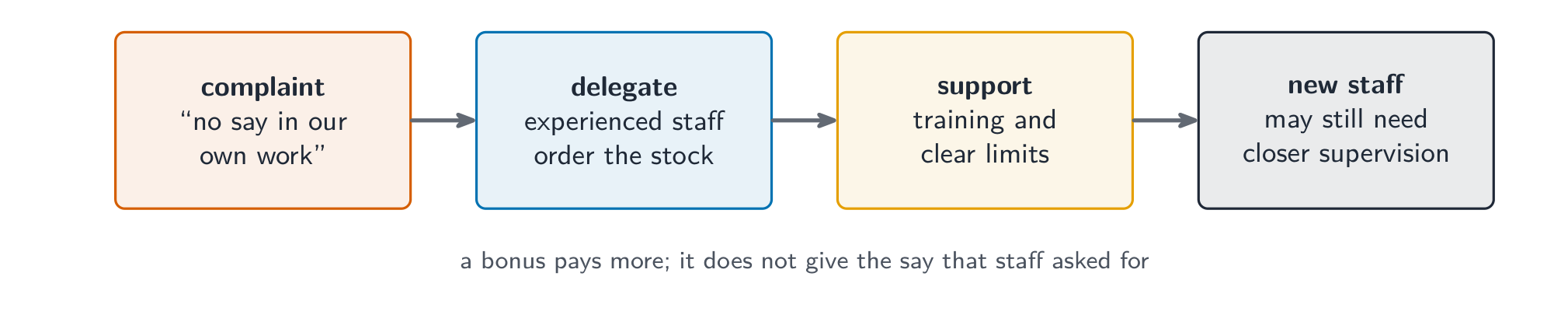
A supermarket branch has 40 staff; 14 left this year. Staff surveys say "we have no say in our own work". The manager offers a 5 % bonus. Use Herzberg to judge this, and calculate turnover.
- Turnover: $\dfrac{14}{40} \times 100 = 35\,\%$ — very high; each leaver costs recruiting and training.
- Herzberg: a bonus is a hygiene factor. Pay is not the complaint, so it will not fix it. The complaint is about responsibility, a motivator.
- Better plan: delegate stock ordering to experienced staff, with training and clear spending limits; keep closer supervision for new staff. Then measure turnover again next year.
Staff complain that their jobs are boring and repetitive. Which response best fits Herzberg's theory?
难度 1/5 · 今日首次完成可获 100 金币及少量额外奖励
Boredom is a lack of motivators; the other options are hygiene factors.
Leadership styles
- An autocratic leader decides alone — fast, useful in a crisis, but demotivating over time. A democratic leader consults staff — better ideas and commitment, but slower. A laissez-faire leader gives broad freedom to experts.
- Good leaders change style to fit the task, the team's experience and the time available.
Match each situation to the most suitable leadership style.
难度 2/5 · 今日首次完成可获 140 金币及少量额外奖励
The best style depends on urgency and the team's expertise.
Financial and non-financial rewards
- Financial rewards: salary, wages, commission, profit-related pay, performance-related pay and share ownership. Non-financial: job enrichment, job rotation, empowerment, teamwork and training.
- Piece rates can raise output but lower quality; profit sharing builds commitment but the link to each worker's effort is weak.
Piece-rate pay always improves both output and quality.
难度 1/5 · 今日首次完成可获 100 金币及少量额外奖励
Paying per item encourages speed, which can lower quality.
"More money always motivates staff" is wrong. Herzberg found pay is a hygiene factor: too little causes dissatisfaction, but more does not keep people motivated for long. When the problem is boredom or lack of control, job enrichment and delegation work better than a bonus.
Workforce planning, recruitment and structure set up the people a business needs. Motivation theories show that pay and conditions prevent dissatisfaction, while responsibility, recognition and achievement motivate. Leaders and reward systems should fit the task and the people, and turnover data show whether they work.
A call centre has 45 % labour turnover. Recommend how to reduce it, using a motivation theory.
A recommendation should be specific to the call centre.