Finance, accounts and appraisal
引入| English | 释义 | 拼音 |
|---|---|---|
| profit/ˈprɒfɪt/ | 利润 | lì rùn |
| fixed costs/fɪkst kɒsts/ | 固定成本 | gù dìng chéng běn |
| variable costs/ˈveərɪəbl kɒsts/ | 可变成本 | kě biàn chéng běn |
| statement of profit or loss | 损益表 | sǔn yì biǎo |
| statement of financial position/ˈsteɪtmənt ɒv faɪˈnænʃl pəˈzɪʃn/ | 财务状况表 | cái wù zhuàng kuàng biǎo |
| cash flow/kæʃ fləʊ/ | 现金流 | xiàn jīn liú |
| cash-flow forecast/kæʃ fləʊ ˈfɔːkæst/ | 现金流预测 | xiàn jīn liú yù cè |
| gross profit margin/ɡrəʊs ˈprɒfɪt ˈmɑːdʒɪn/ | 毛利率 | máo lì lǜ |
| liquidity/lɪˈkwɪdɪti/ | 流动性 | liú dòng xìng |
| current ratio/ˈkʌrənt ˈreɪʃɪəʊ/ | 流动比率 | liú dòng bǐ lǜ |
| payback period/ˈpeɪbæk ˈpɪərɪəd/ | 投资回收期 | tóu zī huí shōu qī |
| net present value/net ˈprezənt ˈvæljuː/ | 净现值 | jìng xiàn zhí |
Profitable on paper, bankrupt in cash, 2018
- Carillion was the UK's second-largest construction firm, building hospitals and railways. Its accounts showed profits, but it paid suppliers up to 120 days late and borrowed heavily against future contracts.
- On 15 January 2018 it ran out of cash and collapsed, with debts of about £7 billion and 43 000 jobs at risk. Profit and cash are not the same thing.
Sources of finance
- Internal: retained profit and selling assets. External: share capital, loans, overdrafts, trade credit, leasing, crowdfunding and venture capital.
- Match the source to the need: short-term needs (stock, wages) suit overdrafts and trade credit; long-term investment (a factory) suits loans or share capital.
Match each need to a suitable source of finance.
难度 2/5 · 今日首次完成可获 140 金币及少量额外奖励
Short-term needs suit short-term finance.
Costs, revenue and profit
- Fixed costs 固定成本 (rent, salaries) do not change with output; variable costs 可变成本 (materials) rise with each unit. Total revenue is price × quantity.
- Profit 利润 = total revenue − total costs. The statement of profit or loss 损益表 records profit over a year; the statement of financial position 财务状况表 (balance sheet) records assets and liabilities on one date.
A firm sells 2000 units at 15. Fixed costs are 8000 and variable cost is 9 per unit. What is the profit?
难度 2/5 · 今日首次完成可获 140 金币及少量额外奖励
Revenue 30 000; costs $8000 + 2000 \times 9 = 26\,000$; profit 4000.
Cash flow
- Cash flow 现金流 is money moving in and out. Net cash flow = receipts − payments; closing cash = opening cash + net cash flow. A firm can make a profit and still run out of cash if customers pay late.
- A cash-flow forecast 现金流预测 shows months when cash will run short, so the firm can arrange an overdraft, chase debtors, delay spending or negotiate longer credit from suppliers.
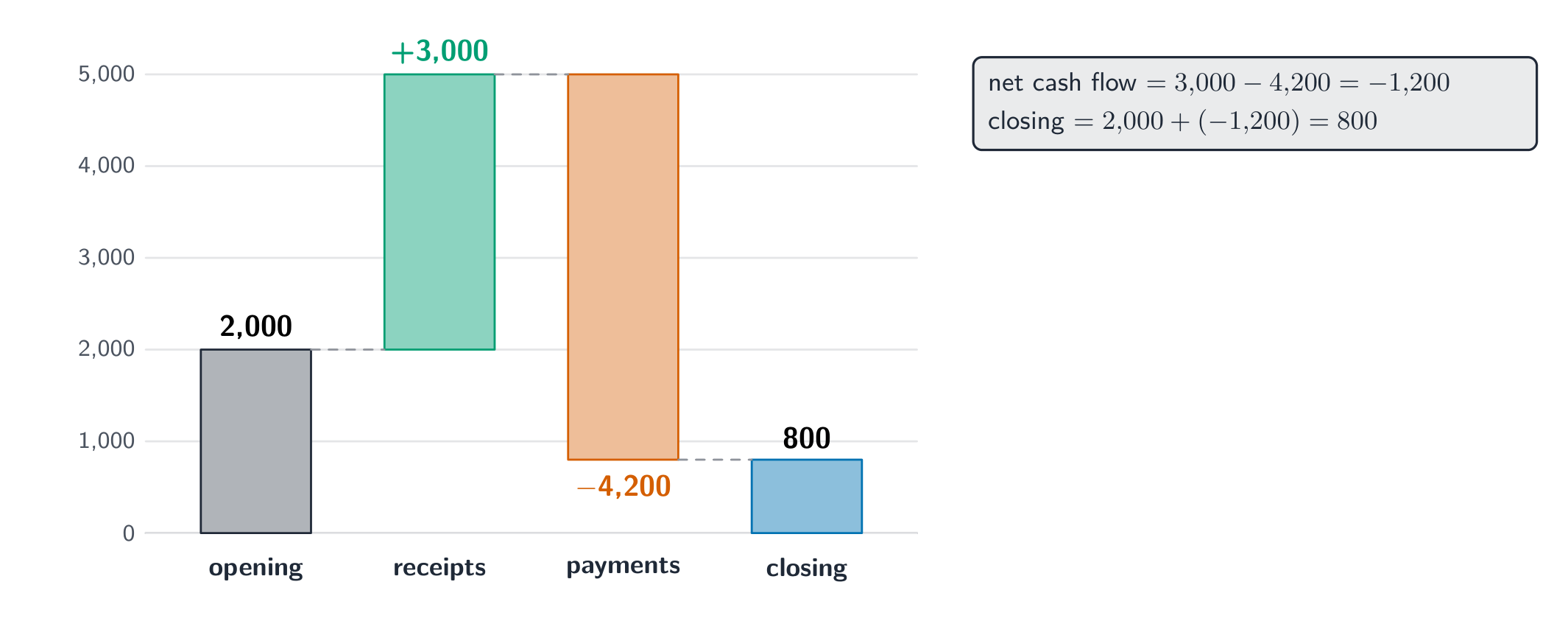
Worked example: a month's cash flow
A shop starts the month with 2000 cash. It receives 3000 from sales and pays 4200 for stock, rent and wages. Find the closing balance. Next month a 1500 payment is due and receipts are forecast at 1200.
- Net cash flow: $3000 - 4200 = -1200$.
- Closing cash: $2000 + (-1200) = 800$.
- Next month: $800 + 1200 - 1500 = 500$ — still positive, but thin. A late customer payment would push it negative, so the shop should arrange an overdraft facility now.
Opening cash is 5000, receipts 12 000 and payments 14 500. What is the closing cash balance?
难度 2/5 · 今日首次完成可获 140 金币及少量额外奖励
净现金流 $12\,000 - 14\,500 = -2500$; closing $5000 - 2500 = 2500$.
Which actions improve a firm's cash flow?
难度 2/5 · 今日首次完成可获 140 金币及少量额外奖励
Buying more stock early takes cash out sooner.
Ratio analysis
- Profitability: gross profit margin 毛利率 $= \dfrac{\text{gross profit}}{\text{sales revenue}} \times 100\,\%$ and profit margin $= \dfrac{\text{profit before interest and tax}}{\text{sales revenue}} \times 100\,\%$.
- Liquidity: the current ratio 流动比率 $= \dfrac{\text{current assets}}{\text{current liabilities}}$; about 1.5–2 is often seen as safe, and below 1 warns that short-term debts exceed the assets available to pay them.
Sales revenue is 80 000 and cost of sales is 50 000. What is the gross profit margin?
难度 2/5 · 今日首次完成可获 140 金币及少量额外奖励
Gross profit 30 000; $\dfrac{30\,000}{80\,000} \times 100 = 37.5\,\%$.
Investment appraisal
- The payback period 投资回收期 is how long an investment takes to repay its cost from net cash flows. The average rate of return (ARR) is average yearly profit ÷ initial cost × 100 %.
- Net present value 净现值 (HL) discounts future cash flows to today's value, because money now is worth more than money later. A positive NPV means the project earns more than the discount rate.
A machine costs 60 000 and gives net cash flow of 24 000 a year. What is the payback period, in years?
难度 2/5 · 今日首次完成可获 140 金币及少量额外奖励
$\dfrac{60\,000}{24\,000} = 2.5$ years.
"A profitable business cannot go bust" is wrong. Profit counts a sale when it is made; cash arrives only when the customer pays. Carillion booked profits on contracts while its bank balance drained. Most business failures are cash failures.
A business that makes a profit every year cannot run out of cash.
难度 1/5 · 今日首次完成可获 100 金币及少量额外奖励
If customers pay late or the firm invests heavily, cash can run out despite profits.
Choose finance to match how long the money is needed. Profit is revenue minus costs over a period; cash flow is the timing of money in and out, and a cash-flow forecast warns of shortfalls. Ratios judge profitability and liquidity, and payback, ARR and NPV compare investments.
A firm's current ratio has fallen from 1.8 to 0.9 in two years while profit has risen. Explain what this means and recommend action.
Link the ratio to cash, not to profit.