Business organization and stakeholders
引入| English | 释义 | 拼音 |
|---|---|---|
| objectives/ɒbˈdʒektɪvz/ | 具体目标 | jù tǐ mù biāo |
| entrepreneur/ˌɒntrɪprəˈnjʊə/ | 企业家 | qǐ yè jiā |
| sole trader/səʊl ˈtreɪdə/ | 独资经营者 | dú zī jīng yíng zhě |
| unlimited liability/ʌnˈlɪmɪtɪd ˌlaɪəˈbɪlɪti/ | 无限责任 | wú xiàn zé rèn |
| limited liability/ˈlɪmɪtɪd ˌlaɪəˈbɪlɪti/ | 有限责任 | yǒu xiàn zé rèn |
| aims/eɪmz/ | 目标 | mù biāo |
| corporate social responsibility/ˈkɔːpərət ˈsəʊʃl rɪˌspɒnsəˈbɪlɪti/ | 企业社会责任 | qǐ yè shè huì zé rèn |
| stakeholder/ˈsteɪkhəʊldə/ | 利益相关者 | lì yì xiāng guān zhě |
| mergers/ˈmɜːdʒəz/ | 合并 | hé bìng |
| economies of scale/ɪˈkɒnəmiz ɒv skeɪl/ | 规模经济 | guī mó jīng jì |
"Earth is now our only shareholder", 2022
- In September 2022 Yvon Chouinard, founder of the outdoor-clothing firm Patagonia, gave away the whole company — worth about 3 billion dollars — to a trust and a charity. Profits not reinvested now go to fighting climate change.
- Most firms aim for profit for their owners; Patagonia chose a different aim. A firm's legal form and objectives decide who controls it and who benefits.
What businesses do
- A business combines inputs — land, labour, capital and enterprise — to make goods or services. Sectors: primary (farming, mining), secondary (manufacturing), tertiary (services) and quaternary (knowledge and research).
- An entrepreneur 企业家 spots an opportunity and takes the risk of starting a business. Most new firms fail in their first few years, mainly through cash-flow problems and weak demand.
Match each business to its sector.
难度 2/5 · 今日首次完成可获 140 金币及少量额外奖励
Sectors move from raw materials to making, to services, to knowledge.
Legal forms
- A sole trader 独资经营者 owns the business alone and has unlimited liability 无限责任: their personal savings and home can be taken to pay its debts. Partnerships share ownership and usually liability too.
- A company has limited liability 有限责任: owners can lose only what they invested. Private companies sell shares privately; public companies sell them on a stock exchange, raising more capital but risking takeover. Non-profits and social enterprises reinvest their surplus.
A sole trader's shop fails with debts of 50 000. What is the risk to the owner?
难度 1/5 · 今日首次完成可获 100 金币及少量额外奖励
Sole traders have unlimited liability.
What are features of a public limited company?
难度 2/5 · 今日首次完成可获 140 金币及少量额外奖励
Public companies have many shareholders and separate ownership from management.
Aims and objectives
- Aims 目标 are long-term intentions; objectives 具体目标 are specific, measurable targets (SMART). Common objectives are profit, growth, market share, survival and, increasingly, ethical and environmental goals.
- Corporate social responsibility 企业社会责任 means acting in ways that benefit society beyond the law. It can attract customers and staff, but costs money.
Which is a SMART objective?
难度 1/5 · 今日首次完成可获 100 金币及少量额外奖励
It is specific, measurable and time-bound.
Worked example: choosing a price for a social café
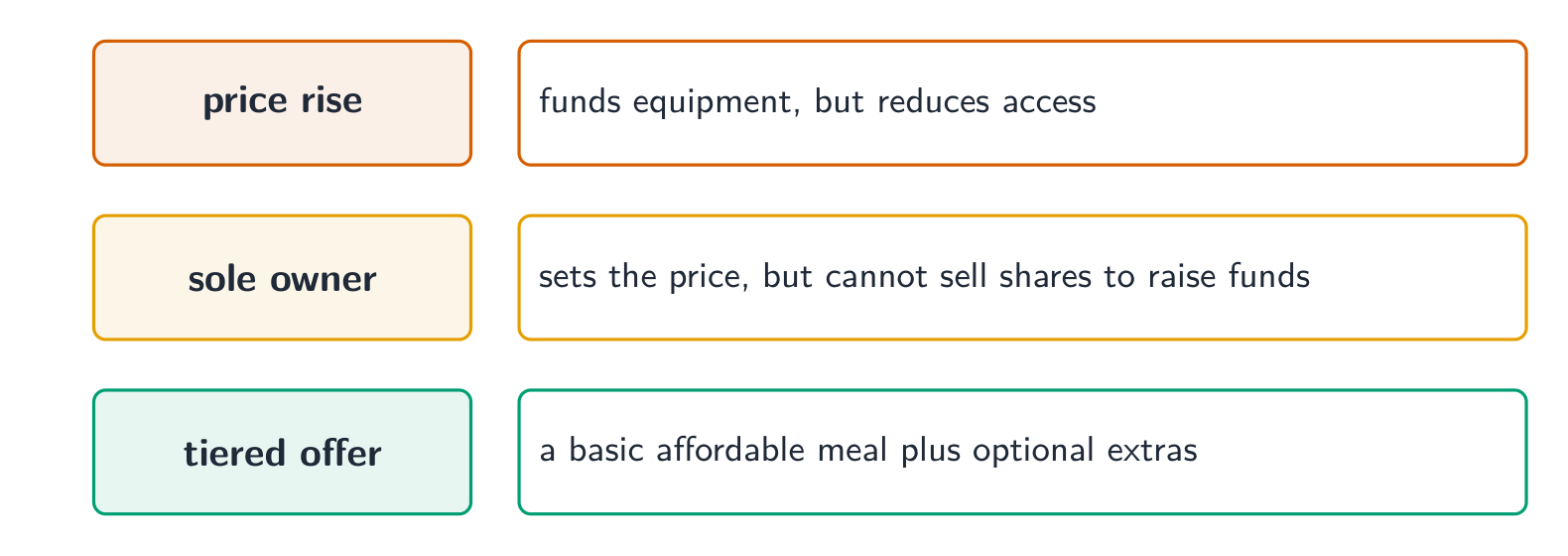
A sole trader runs a café whose aim is affordable meals for students. Costs are rising, and she needs 6000 a month more to buy a new oven. She sells 3000 meals a month at 8. Compare a price rise with a tiered offer.
- Price rise to 10: if sales fall to 2800, revenue goes from $3000 \times 8 = 24\,000$ to $2800 \times 10 = 28\,000$: 4000 more, not enough, and 200 students are priced out — against her aim.
- Tiered offer: the basic meal stays at 8; 1500 customers add an extra at 4 each, giving $1500 \times 4 = 6000$ more without losing access.
- Judgement: the tiered offer fits her objective. As a sole trader she can decide alone, but she also bears the risk if it fails.
A café raises its price from 8 to 9 and monthly sales fall from 2000 to 1900. By how much does monthly revenue change?
难度 2/5 · 今日首次完成可获 140 金币及少量额外奖励
$1900 \times 9 - 2000 \times 8 = 17\,100 - 16\,000 = 1100$.
Stakeholders
- Stakeholders 利益相关者 are groups affected by a business: internal (owners, managers, employees) and external (customers, suppliers, the community, government, lenders).
- Their interests conflict: shareholders want higher profit, workers higher pay, the community less pollution. Firms map stakeholders by their power and interest to decide whom to consult.
Shareholders and employees always want the same thing from a business.
难度 1/5 · 今日首次完成可获 100 金币及少量额外奖励
Higher wages raise costs and can reduce the profit shareholders receive.
Growth
- Firms grow internally (new products and markets) or externally through mergers 合并 and takeovers. Growth gives economies of scale 规模经济 — lower average costs from bulk buying, specialist staff and cheaper finance.
- Too much growth can cause diseconomies of scale: slow communication, weak motivation and loss of control. Small firms survive by serving niche markets and offering a personal service.
Match each effect to its type.
难度 2/5 · 今日首次完成可获 140 金币及少量额外奖励
Economies lower average cost; diseconomies raise it.
"Every business aims to maximise profit" is wrong. A new firm may aim simply to survive; a growing one may cut prices to win market share; social enterprises and firms like Patagonia put a mission first. Objectives depend on the owners, the stage of the business and its stakeholders.
A business's legal form decides who owns it, who carries the risk and how it can raise money. Its aims and SMART objectives guide decisions, and stakeholders with different interests must be balanced. Growth brings economies of scale but also risks of losing control.
A family bakery is deciding whether to become a private limited company. Discuss.
Apply the points to this business, then decide.