难怪 (no wonder)
引入您的已保存位置保留在此浏览器中。恢复操作不会完成课程或回答其中的问题。
So that's why!
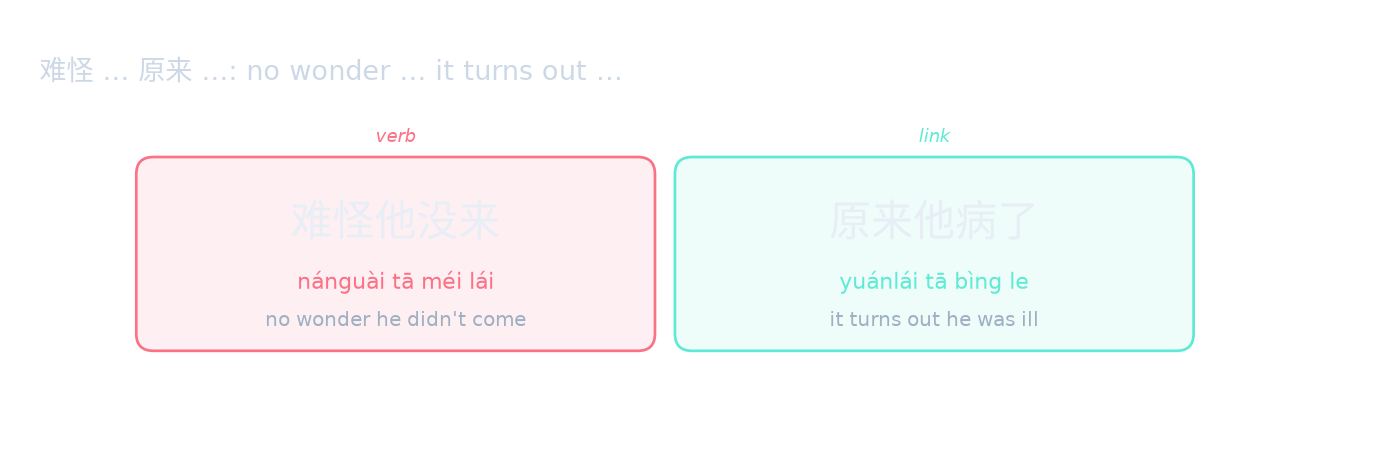
- Your friend missed class. Later you hear he was ill: no wonder难怪he他didn't come没来,it turns out原来he他illness / ill病(completed / change)了。 — "No wonder he didn't come — he was ill."
- Goal: react to something that now makes sense with no wonder难怪 ("no wonder"), often together with it turns out原来 ("so it turns out").
no wonder难怪 + what you noticed,it turns out原来 + the reason
- no wonder难怪 + result you noticed: now it makes sense. it turns out原来 + the reason you just learned. Either part can come first.
- it turns out原来you你at / in在to learn学piano钢琴,no wonder难怪finger手指so much这么flexible灵活。 — "So you're learning the piano. No wonder your fingers are so quick."
no wonder难怪he他didn't come没来,it turns out原来he他was ill病了。
Complete: “No wonder you're so tired — you worked all night.” ____你这么累,原来你工作了一个晚上。
难度 1/5 · 今日首次完成可获 100 金币及少量额外奖励
难怪 + what you noticed, 原来 + reason.
Match each part to its job.
难度 2/5 · 今日首次完成可获 140 金币及少量额外奖励
难怪 = no wonder; 原来 = it turns out / originally.
no wonder难怪 on its own
- As a short reply: A: he他to be / is是Beijing北京person人。 B: no wonder难怪! — "No wonder (his Mandarin is so good)!"
- no wonder!怪不得 means the same and is more spoken: no wonder!怪不得you你so much这么tired累。 — "No wonder you're so tired."
A: 他在中国住了十年。 B: 难怪! What does B mean?
难度 1/5 · 今日首次完成可获 100 金币及少量额外奖励
难怪! alone = that explains it.
怪不得 and 难怪 mean the same.
难度 1/5 · 今日首次完成可获 100 金币及少量额外奖励
怪不得 is a little more spoken.
The surprise comes before the reason
- no wonder难怪 goes with what you already noticed (he他didn't come没来), not with the reason: ✗ no wonder难怪he他illness / ill病(completed / change)了 when illness / ill病 is the new information.
- it turns out原来 also has another meaning: "originally, before" (I / me我it turns out原来to live (somewhere)住at / in在Shanghai municipality…上海 — "I used to live in Shanghai").
The streets are wet, then you learn it rained at night. Which is right?
难度 1/5 · 今日首次完成可获 100 金币及少量额外奖励
难怪 goes with what you noticed (wet streets); 原来 with the reason.
Recap
- no wonder难怪 / no wonder!怪不得 + what you noticed = no wonder …; it turns out原来 + reason = it turns out ….
- no wonder难怪! alone = That explains it!
Read the full reference: HSK 5 grammar — Verbs & comparisons.
Your neighbour's flat has been very quiet all week. Then you learn they went on holiday. React with 难怪 and 原来.
Your answer need not copy the model. A partner or teacher must hear the spoken response to comment on pronunciation.