Duration + 没 + Verb + 了 (how long you haven't …)
引入您的已保存位置保留在此浏览器中。恢复操作不会完成课程或回答其中的问题。
Three days without meat
- Your friend is on a vegetable diet and is starting to miss dumplings.
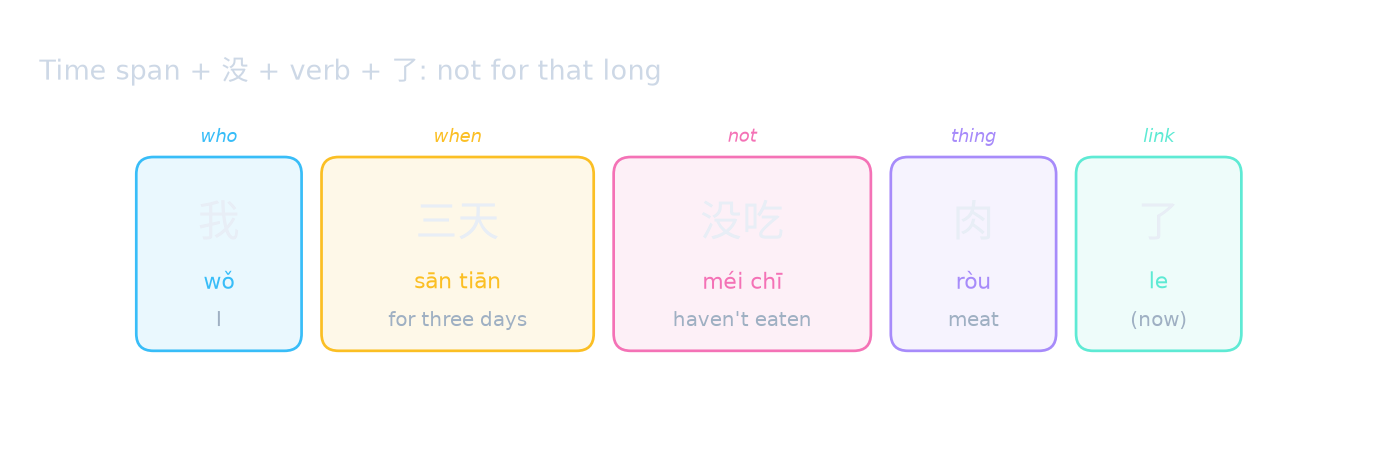
- I我three days三天not没eat吃meat肉(completed / change)了。 Wǒ sān tiān méi chī ròu le. — "I haven't eaten meat for three days."
- Goal: say how long you have not done something, ask about it, and keep it apart from a positive duration.
Duration + not没 + Verb + (completed / change)了
- Subject + duration + not没 + Verb (+ object) + (completed / change)了 = has not done something for that length of time.
- The duration comes before not没, unlike a positive duration, which follows the verb.
I我three days三天not没eat吃meat肉了。
Complete: “I haven't phoned home for a week.” 我一个星期没给家里打电话____。
难度 1/5 · 今日首次完成可获 100 金币及少量额外奖励
The final 了 shows the gap lasts until now.
Counting the gap up to now
- we我们a long time好久not没see见(completed / change)了! — "We haven't seen each other for ages!"
- he / him他两个week星期not没to come来to go to class上课(completed / change)了。 — "He hasn't come to class for two weeks."
we我们a long time好久not没see见了!
Build: “We haven't seen each other for ages!”
难度 3/5 · 今日首次完成可获 200 金币及少量额外奖励
Subject + duration + 没 + verb + 了.
Asking and answering
- A: you你how long多长时间not没go home回家(completed / change)了? Nǐ duō cháng shíjiān méi huí jiā le? — "How long is it since you went home?"
- B: half a year半年(completed / change)了。I我half a year半年not没go home回家(completed / change)了,degree / adjective linker很want / think / miss想I我mum; mother妈妈。 — "Half a year. I haven't been home for six months; I really miss my mum."
- The fixed greeting long time no see好久不见! — "Long time no see!" uses not不, but in your own sentences use not没: we我们a long time好久not没see见(completed / change)了.
you你how long多长时间not没go home回家了?
Build: “I haven't seen a film for a month.”
难度 3/5 · 今日首次完成可获 200 金币及少量额外奖励
Duration + 没 + verb + object + 了.
Two things that must stay
- Keep the final (completed / change)了 when the gap lasts up to now: I我three days三天not没eat吃meat肉(completed / change)了 means it is still true today.
- Put the duration before not没: three days三天not没eat吃meat肉(completed / change)了 is the standard order you should use.
Which says “He hasn't slept for two days.”?
难度 1/5 · 今日首次完成可获 100 金币及少量额外奖励
Duration + 没 + verb + 了.
Positive duration goes after the verb
- Positive: I我to learn学(completed / change)了two years两年Chinese中文。 — "I studied Chinese for two years." The duration follows the verb.
- Negative gap: I我two years两年not没speak说Chinese中文(completed / change)了。 — "I haven't spoken Chinese for two years." The duration moves to the front.
I我two years两年not没speak说Chinese中文了。
In 我学了两年中文, the duration comes after the verb because the sentence is positive.
难度 1/5 · 今日首次完成可获 100 金币及少量额外奖励
A positive duration follows the verb; a negative gap puts the duration before 没.
Recap
- Duration + not没 + Verb + (completed / change)了 = haven't done it for that long (up to now).
- Negative gap: duration before not没. Positive duration: after the verb (学了two years两年).
Read the full reference: HSK 3 grammar — Adverbs.
Your friend is on a vegetable diet and is starting to miss dumplings. Close the examples. Say a Mandarin response, then write it in Chinese. Explain briefly in English what the lesson’s pattern adds. Compare with the model, then change one detail and try again.
This is supported productive practice. Compare meaning and structure; your answer need not copy the model. A partner or teacher must hear the spoken response to comment on pronunciation.