测量负载、放大器增益与探测器响应
引入 6:08
测量负载、放大器增益与探测器响应
电压表会改变其测量的电路:其读数是一个分压器的输出,而非开路电压。本节计算电表负载效应,设定……
英文讲解 · 可切换中英文字幕
In this lesson
| English | 释义 | 拼音 |
|---|---|---|
| loading/ˈləʊdɪŋ/ | 负载效应 | fù zài xiào yìng |
| dead time/ded taɪm/ | 死时间 | sǐ shí jiān |
| cutoff frequency/ˈkʌtɒf ˈfriːkwənsi/ | 截止频率 | jié zhǐ pín lǜ |
The meter changes the circuit
- A 1 MΩ voltmeter across a 10 V source with 100 kΩ internal resistance reads 9.09 V: not because it is broken, but because it forms a voltage divider.
- GRE laboratory questions test meter loading 负载效应, amplifier gains, RC filters, detector efficiency and dead time 死时间.
Meter loading
- Reading $= V_{\text{th}}\dfrac{R_m}{R_m + R_{\text{th}}}$. A 12 V source with 200 kΩ, read by 1 MΩ: 10.0 V.
- Higher input resistance (or a 10× probe, which also divides the signal by 10) reduces the bias. For an error below 1%, the meter needs $R_m \gtrsim 100R_{\text{th}}$.
- To find $R_{\text{th}}$ of a divider, replace the source by a wire: the two resistors appear in parallel. An ammeter has the opposite problem: its small resistance adds in series, so it should be much less than the circuit's.
9 V source with 500 kΩ internal resistance, read by a 1 MΩ meter. Reading in V?
难度 2/5 · 今日首次完成可获 140 金币及少量额外奖励
The meter and source resistance form a divider: $9 \times 1/(1 + 0.5) = 6$ V.
A source has Thevenin resistance 10 kΩ. Smallest meter resistance (kΩ) that reads within 1% of the true voltage?
难度 2/5 · 今日首次完成可获 140 金币及少量额外奖励
$R_m/(R_m + 10) = 0.99$ gives $R_m = 990$ kΩ: about 100 times the source resistance.
Op-amps and filters
- Ideal op-amp rules: no current into the inputs, and with feedback the two inputs sit at the same voltage. These give the gains: non-inverting $1 + R_2/R_1$; inverting $-R_2/R_1$ (the minus sign is a 180° phase flip).
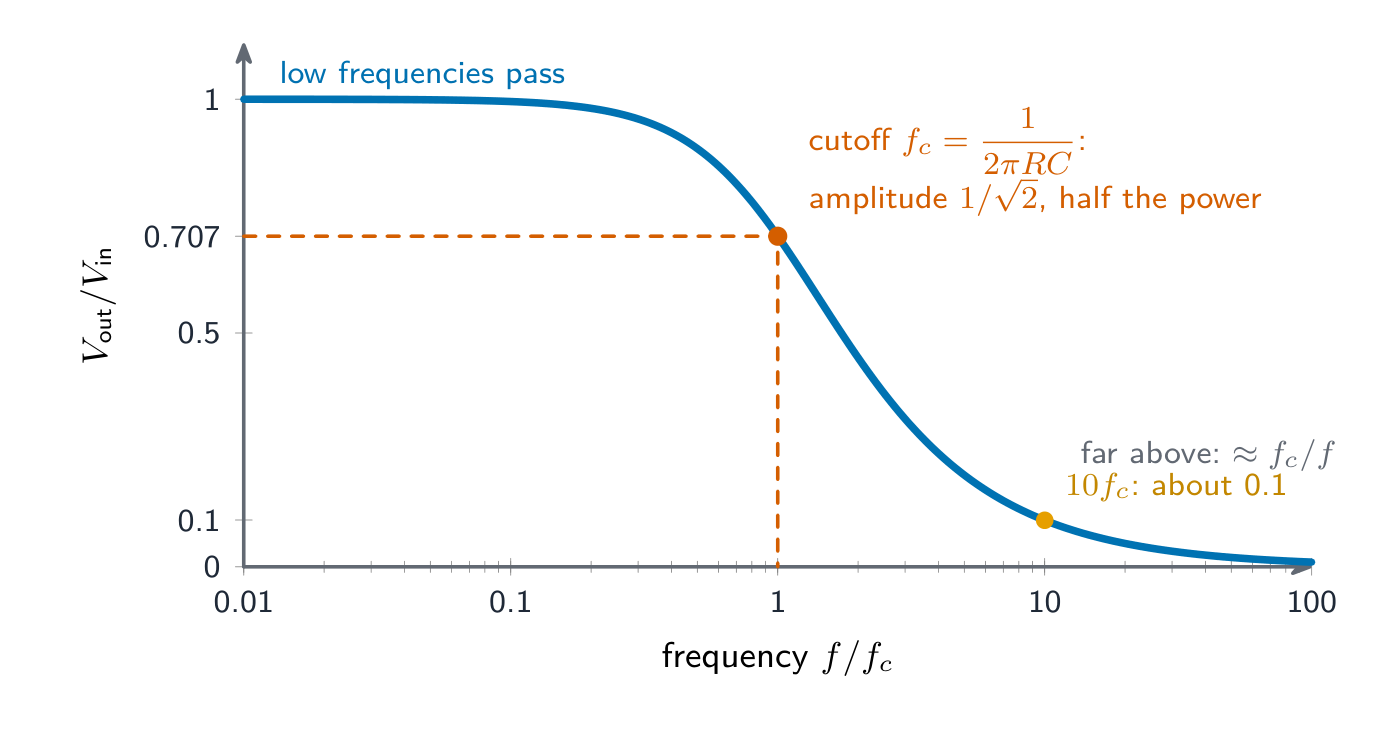
- RC low-pass cutoff frequency 截止频率 $f_c = \dfrac{1}{2\pi RC}$, amplitude $\dfrac{1}{\sqrt{1 + (f/f_c)^2}}$, phase $-\arctan(f/f_c)$. At $f_c$: $1/\sqrt2$ (half the power, −3 dB), not $\tfrac12$. Far above $f_c$ the amplitude falls as $f_c/f$: ten times less per decade. Swap $R$ and $C$ and it becomes a high-pass filter.
Non-inverting amplifier with $R_2 = 9$ kΩ, $R_1 = 1$ kΩ. Gain?
难度 1/5 · 今日首次完成可获 100 金币及少量额外奖励
A non-inverting amplifier has gain $1 + R_2/R_1 = 1 + 9 = 10$.
Inverting amplifier with $R_2 = 100$ kΩ and $R_1 = 10$ kΩ. Gain (with sign)?
难度 2/5 · 今日首次完成可获 140 金币及少量额外奖励
$-R_2/R_1 = -10$: ten times larger and inverted.
$R = 2$ kΩ, $C = 50$ nF. Cutoff frequency in Hz (nearest whole)?
难度 2/5 · 今日首次完成可获 140 金币及少量额外奖励
$f_c = 1/(2\pi RC) = 1/(2\pi \times 2000 \times 50\times10^{-9}) = 1/(2\pi\times10^{-4}) = 1592$ Hz.
Amplitude ratio of an RC low-pass filter at $f = 3f_c$ (three decimal places)?
难度 2/5 · 今日首次完成可获 140 金币及少量额外奖励
$1/\sqrt{1 + 9} = 1/\sqrt{10} = 0.316$.
At the cutoff frequency, an RC low-pass filter passes half the input power.
难度 1/5 · 今日首次完成可获 100 金币及少量额外奖励
True. The amplitude ratio is $1/\sqrt2 \approx 0.707$, so the power ratio is ½ (the −3 dB point).
Detectors
- Efficiency = detected / incident. Energy resolution = FWHM / $E$ (13.2 keV at 662 keV ≈ 2%). Report both.
- Non-paralyzable dead time $\tau$: recorded $m = \dfrac{n}{1 + n\tau}$, so $n = \dfrac{m}{1 - m\tau}$.
$\tau = 10$ μs, true rate $10^4$/s: $m = 10^4/1.1 \approx 9091$/s. Recorded 8000/s with $\tau = 20$ μs: $n = 8000/0.84 \approx 9524$/s.
True rate $2\times10^4$/s, non-paralyzable dead time 5 μs. Recorded rate per second (nearest whole)?
难度 2/5 · 今日首次完成可获 140 金币及少量额外奖励
For a non-paralysable counter, recorded rate $= n/(1 + n\tau) = 2\times10^4/(1 + 0.1) = 18182$ per second.
Calibration
- A linear calibration fixes offset and scale; it does not remove noise or nonlinearity. Averaging fixes random noise, not bias.
什么决定了它?
将每个测量问题与其解决方法相匹配。
Worked GRE question: reading a divider
Two 1 MΩ resistors in series form a divider across an ideal 10 V supply. A voltmeter with input resistance 1 MΩ is connected across the lower resistor. It reads about
- (A) 2.5 V
- (B) 3.3 V
- (C) 5.0 V
- (D) 6.7 V
- (E) 10 V
Fast route. Thevenin: 5 V behind $1\parallel1 = 0.5$ MΩ. Reading $= 5 \times \dfrac{1}{1 + 0.5} = 3.3$ V. (Or: the meter and lower resistor make 0.5 MΩ, which takes a third of 10 V.) Answer (B).
Traps. (C) is the ideal-meter answer. (A) halves twice.
Worked GRE question: correcting for dead time
A counter with non-paralyzable dead time 50 μs records 10 000 counts per second. The true rate is about
- (A) 5000 /s
- (B) 10 000 /s
- (C) 15 000 /s
- (D) 20 000 /s
- (E) 40 000 /s
Fast route. $m\tau = 10^4 \times 5\times10^{-5} = 0.5$: the counter is dead half the time. $n = m/(1 - m\tau) = 10^4/0.5 = 2\times10^4$ /s. Answer (D).
Traps. (C) uses the small-loss approximation $m(1 + m\tau)$, which fails when $m\tau$ is not small. (A) corrects in the wrong direction: the true rate is always higher.
Common errors
- Assuming an ideal meter. Compare $R_m$ with the source's Thevenin resistance.
- Amplitude $\tfrac12$ at the cutoff. It is $1/\sqrt2$; the power is halved.
- Dropping the minus sign of an inverting amplifier.
- Correcting dead time downward. Recorded counts are always fewer than true counts.
Recap
- Meter reading = divider output; raise $R_m$ to reduce loading.
- $f_c = 1/2\pi RC$; amplitude $1/\sqrt2$ there.
- $n = m/(1 - m\tau)$ for non-paralyzable dead time.
- dead time: The time after each count during which a detector cannot record another.
- loading: The change a measuring instrument makes to the circuit it measures.
- cutoff frequency: The frequency at which a filter passes 1 over root 2 of the input amplitude.