| English | 释义 | 拼音 |
|---|---|---|
| simple sentence/ˈsɪmpl ˈsentəns/ | 简单句 | jiǎn dān jù |
| compound sentence/ˈkɒmpaʊnd ˈsentəns/ | 并列句 | bìng liè jù |
| complex sentence/ˈkɒmpleks ˈsentəns/ | 复合句 | fù hé jù |
| connectives/kəˈnektɪvz/ | 连接词 | lián jiē cí |
| subordination/ˌsʌbɔːdɪˈneɪʃn/ | 从属关系 | cóng shǔ guān xì |
| run-on sentence/rʌn ɒn ˈsentəns/ | 连写句 | lián xiě jù |
A panda that eats, shoots and leaves, 2003
- In 2003 Lynne Truss's book on punctuation, Eats, Shoots & Leaves, became an unexpected bestseller. Its title joke: a panda "eats, shoots and leaves" — fires a gun and walks out — when the writer meant "eats shoots and leaves", a diet of plants.
- Small marks and joining words change meaning. Clear writing chooses between the simple sentence 简单句, the compound sentence 并列句 and the complex sentence 复合句, joined by the right connectives 连接词.
In "eats, shoots and leaves", the commas turn shoots and leaves into actions.
难度 1/5 · 今日首次完成可获 100 金币及少量额外奖励
Punctuation changes meaning.
Simple and compound sentences
- Simple: one main clause. "The hall is closed."
- Compound: two main clauses joined by and, but, or, so — with a comma before the joining word. "The hall is closed, so the talk is in Room 4."
Which is a compound sentence?
难度 1/5 · 今日首次完成可获 100 金币及少量额外奖励
Two main clauses with so.
Complex sentences and subordination
- A complex sentence has a main clause and a dependent clause starting with because, although, when, if, unless.
- Subordination 从属关系 shows which idea is the main one: "Although the room is small, the talk will go ahead."
Which word starts a dependent clause?
难度 1/5 · 今日首次完成可获 100 金币及少量额外奖励
It subordinates one idea.
The connector must fit the facts
- because = reason; but / although = contrast; so = result; if = condition.
- "The room has eight seats because ten students may come" is wrong: ten students are not the reason for eight seats. The facts contrast, so use but.
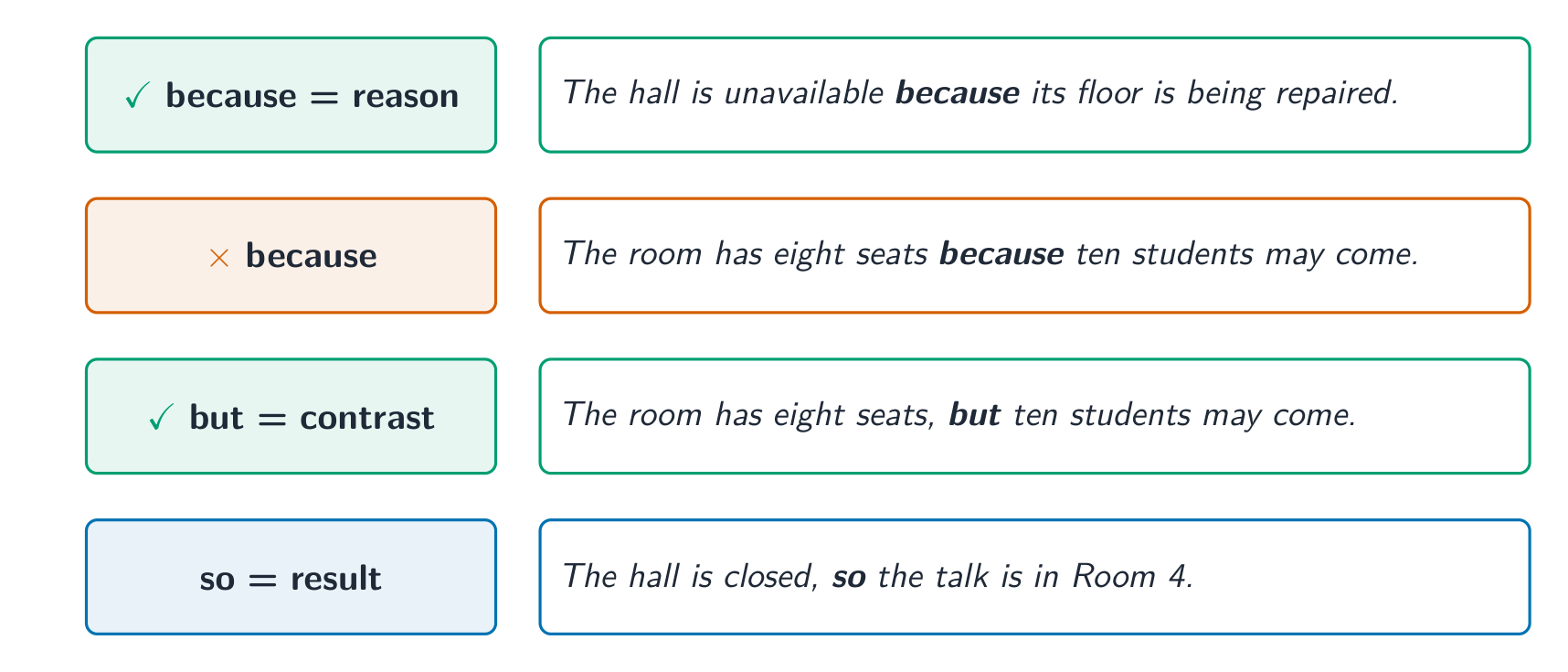
Match each connective to its relationship.
难度 2/5 · 今日首次完成可获 140 金币及少量额外奖励
Choose by logic.
Choose the correct sentence.
难度 1/5 · 今日首次完成可获 100 金币及少量额外奖励
The facts contrast.
Worked example: fixing a run-on
"The library closes at eight I could not finish my essay I will go back tomorrow."
- Problem: a run-on sentence 连写句 joins three main clauses with no punctuation or connectives.
- Relationships: closing at eight → cause; going back → result.
- Fix: "Because the library closes at eight, I could not finish my essay, so I will go back tomorrow."
"The library closes at eight I could not finish" is a run-on sentence.
难度 1/5 · 今日首次完成可获 100 金币及少量额外奖励
Two main clauses with nothing between them.
Comma splices
- A comma alone cannot join two main clauses: "The bus was late, I missed the lecture" is a comma splice.
- Fix with a full stop, a semicolon, or a connective: "The bus was late, so I missed the lecture."
Which fixes "The bus was late, I missed the lecture"?
难度 1/5 · 今日首次完成可获 100 金币及少量额外奖励
Add a connective.
Do not choose a connective for variety. "Furthermore" or "however" must match the logical link; a wrong connector changes your meaning.
Use simple, compound and complex sentences for clarity. Choose connectives by the real relationship (reason, contrast, result, condition), and fix run-ons and comma splices with punctuation or connectives.
Join these ideas into one or two clear sentences: "The lab is being cleaned. The practical is moved to Thursday. Bring your goggles."
Relationship decides the joiner.