Narrative tenses · 叙事时态
Telling a story
- Good storytelling uses several past tenses together.
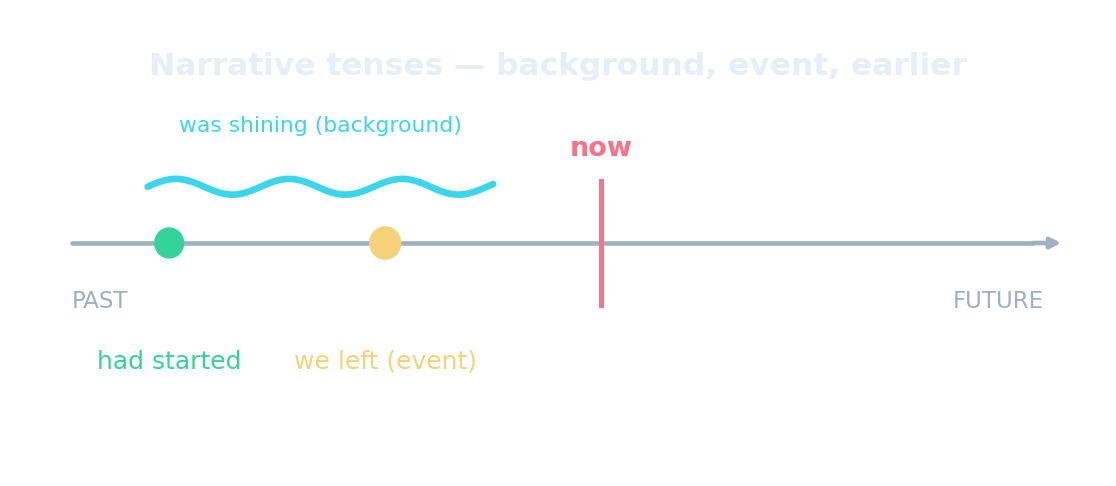
- Past simple (events), past continuous (background), past perfect (the earlier past).
- Each tense plays a different role in the timeline.
While I was looking for my notes, I realised the dog had been studying them.
讲一个故事
- 讲好故事要把几种过去时态配合使用。
- 一般过去时(事件)、过去进行时(背景)、过去完成时(更早的过去)。
- 每种时态在时间线上扮演不同角色。
我正找笔记时,发现狗早就替我「研究」过了。
Events and background
- Past simple = the main events, one after another.
- Past continuous = what was already happening (the scene).
- The sun was shining when we left. She was cooking when the phone rang.
事件与背景
- 一般过去时 = 一件接一件的主要事件。
- 过去进行时 = 当时正在发生的事(场景)。
- (冠词)The 太阳sun (过去进行)was 照耀shining 当...时when 我们we 出发left.(我们出发时阳光灿烂。)
What is each tense doing in the story? · 故事里每个时态在做什么?
Past simple = events; past continuous = background; past perfect = earlier. · 一般过去时 = 事件;过去进行时 = 背景;过去完成时 = 更早。
Choose the background action: The sun ___ when we left. · 选出「背景」动作:The sun ___ when we left。
Background scene → past continuous: “was shining”. · 背景场景 → 过去进行时:was shining。
The earlier past
- Past perfect (had + past participle) = something that happened before.
- When we arrived, the film had already started.
- It shows which event came first.
更早的过去
- 过去完成时(had + 过去分词)= 在那之前发生的事。
- 当...时When 我们we 到达arrived (冠词), the 电影film (过去完成)had 开始started.(我们到时电影已经开始了。)
- 它表明哪件事先发生。
Complete: When we arrived, the film had already ___ (start). · 填空:When we arrived, the film had already ___ (start)。
Earlier action → past perfect: had + started. · 更早的动作 → 过去完成时:had + started。
Putting them together
- Background → past continuous; events → past simple; earlier → past perfect.
- Together they make the order of a story clear.
把它们用在一起
- 背景 → 过去进行时;事件 → 一般过去时;更早 → 过去完成时。
- 三者配合,故事的先后就清楚了。
Do we use the past continuous for the background scene of a story? · 我们用过去进行时来描述故事的背景场景,对吗?
Yes — past continuous sets the scene; past simple gives the events. · 对 —— 过去进行时设置场景,一般过去时讲述事件。
Translate into English: 我们到时,电影已经开始了。 · 翻译成英语:我们到时,电影已经开始了。
Earlier action → past perfect: “… the film had already started.” · 更早的动作 → 过去完成时:… the film had already started。
Common mistakes
- ❌ When the phone rang, she cooked dinner. (she was mid-task) → ✓ she was cooking dinner.
- ❌ She had finished the report, then she had sent it. → in-order events → past simple.
- ❌ It was the first time I saw snow. → ✓ …the first time I had seen snow.
常见错误
- ❌ When the phone rang, she cooked dinner.(想说"正在做")→ ✓ she was cooking dinner。—— 否则意思变成"响了之后才开始做"。
- ❌ She had finished the report, then she had sent it. → 按顺序讲的事用一般过去时;过去完成时只用于倒叙。
- ❌ It was the first time I saw snow. → ✓ …the first time I had seen snow。—— 过去叙事里的"第一次"。
Match the storytelling job to its tense. · 把叙事功能和时态配对。
was doing sets the scene, did drives the plot, had done jumps back, had been doing stresses duration. · was doing 铺背景,did 推情节,had done 倒叙,had been doing 强调持续。
Complete: The sun ___ shining when we left. (be) · 填空:The sun ___ shining when we left.(be)
Background weather → past continuous: was shining. · 背景天气 → 过去进行时:was shining。
- Past simple = events; past continuous = background scene.
- Past perfect = the earlier of two past actions.
- Mix them to tell a clear, layered story.
- 一般过去时 = 事件;过去进行时 = 背景场景。
- 过去完成时 = 两个过去动作中更早的那个。
- 混合使用,讲出层次清晰的故事。
Begin a short story. Write one sentence that uses two past tenses (for example, past continuous + past simple). · 开始一个小故事。写一句话,用上两种过去时态(例如过去进行时 + 一般过去时)。
Example: “I was walking home when I saw an old friend.” · 例如:I was walking home when I saw an old friend。