Your learning plan · Continue · Review →
Past perfect — the past before the past
IntroducedYour saved position stays in this browser. Resuming does not complete the lesson or answer its questions.
Which happened first?
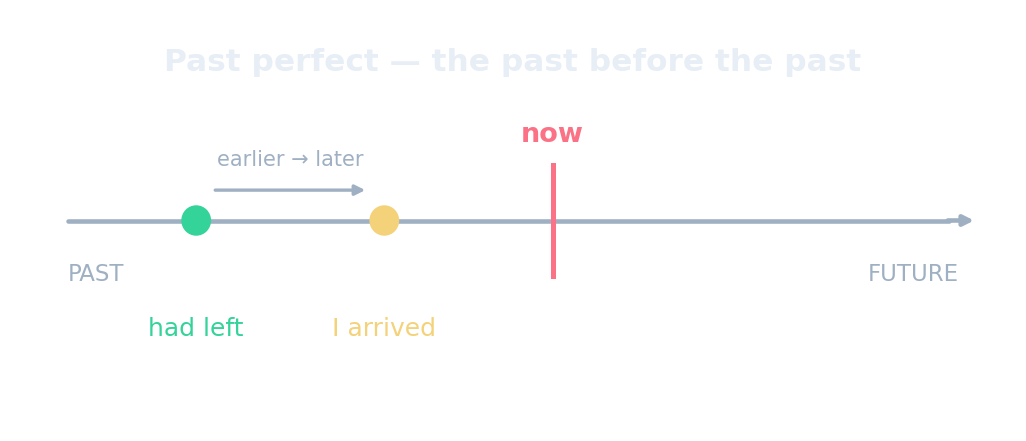
- The past perfect looks back from a reference point in the past. It often explains what had happened before another past event; the diagram shows one such example.
- When I arrived, the train had already left.
- It puts two past events in order.
Your goal: find the past reference point, explain the sequence without inventing details, and write a short report. Start with past simple and present perfect.
By the time I reached the station, the train had started its own adventure.
Form: had + past participle
- had + past participle, the same for every subject.
- I had finished. She had gone. They had eaten.
- Short form: I'd, she'd, they'd.
Complete: When we got home, the guests had already ___ (leave).
Difficulty 1/5 · 100 coins + a small bonus on first completion today
had + past participle: leave → left.
Which happened first?
- In this two-event example, past perfect (had done) marks the earlier event and past simple (did) gives the later reference point.
- The film had started when we arrived. (started first)
Two past events, in order
In this example, the train leaves before our later arrival.
Which happened FIRST? “When I arrived, the train had left.”
Difficulty 1/5 · 100 coins + a small bonus on first completion today
“had left” (past perfect) is the earlier action — it happened first.
In When I arrived, the train had left, does had left locate the departure before my arrival?
Difficulty 1/5 · 100 coins + a small bonus on first completion today
Yes. In this sentence my arrival is the past reference point, and had left looks back to the departure. This is a contextual interpretation, not a rule that every report may contain only one past-perfect event.
Translate into English: 我到的时候,火车已经开走了。
Difficulty 3/5 · 200 coins + a small bonus on first completion today
Earlier action → past perfect: “When I arrived, the train had left.”
When you need it
- Use it when the order matters or could be confusing.
- A simple story in order can stay in the past simple.
Common mistakes
- For a simple sequence, He left, then I cleaned the room is enough. This does not mean only one verb in a whole report may have had: By noon, he had left and I had cleaned the room looks back at both events from noon.
- I had seen this film needs a past reference, but that reference may be in the previous sentence or question. It is not automatically wrong as a short reply.
- By the time often supplies a useful reference point. Explain the timeline instead of choosing a tense from the phrase alone.
Which option explicitly looks back to a start before our arrival? By the time we arrived, the film ___.
Difficulty 1/5 · 100 coins + a small bonus on first completion today
Had started explicitly places the start before the past arrival. Has started looks back from now. A past-simple story can be grammatical when its context already makes order clear, so this question asks for the explicit look-back viewpoint.
Two past actions told in the order they happened — do you NEED the past perfect?
Difficulty 1/5 · 100 coins + a small bonus on first completion today
No. A clear sequence can use past simple for each action. Past perfect is useful for looking back from a later past point, but it is not compulsory merely because two past events exist.
- Past perfect = had + past participle = the past before the past.
- Find the past reference point before deciding what an earlier event explains.
- A clear in-order sequence can use past simple; do not add had to every past verb.
Write one sentence about two past events, using the past perfect for the one that happened first.
Difficulty 3/5 · 200 coins + a small bonus on first completion today
Example: “The class had started when I arrived.”
Three worked viewpoints
Look back to explain a problem. The library closed at 6. Jo reached it at 6:10. “When Jo arrived, the library had closed.” Jo's arrival is our reference point; the closing explains why Jo could not go in. “The library was closing” would describe an action in progress then, which does not match these times.
Keep a simple sequence simple. “We checked the address, walked to the building and rang the bell.” The past-simple verbs tell the events in order. We do not need to add had just because one happened first. If we start with the arrival, we can look back: “When we reached the building, we had already checked the address.”
Use the reference supplied by the conversation. “Was the route new to you on that trip?” “No, I had taken it before.” The question supplies the past trip. The reply does not need to repeat it. Compare “I have taken it before,” which looks back from now rather than specifically from that trip.
If you speak Chinese, start by locating the reference time in the whole message, not by matching a word such as already to a single Chinese aspect marker. A tense choice shows a viewpoint; context still supplies details. That is a checking strategy for any learner, not a diagnosis based on first language.
The bus left at 7 and I arrived at 7:10. Which sentence explicitly looks back from my arrival?
Difficulty 1/5 · 100 coins + a small bonus on first completion today
Had already left looks back from the 7:10 arrival to the 7 o’clock departure. Was leaving would put the departure in progress then; would leave later puts it after arrival. Mark the two times before choosing.
Use had + past participle: They had ___ home before the storm began.
Difficulty 1/5 · 100 coins + a small bonus on first completion today
Gone is the past participle after had. Went is past simple; going would need a different continuous pattern. Say had gone, then locate it before the storm.
At the past moment when the manager returned, the work was not complete. Which sentence expresses that?
Difficulty 1/5 · 100 coins + a small bonus on first completion today
Had not finished describes the incomplete work at that past reference. Had finished says the opposite; have finished looks back from now and does not fit this past when-clause. The sentence does not tell us when completion later happened.
When I opened the fridge, the cake had disappeared. Which happened first?
Difficulty 1/5 · 100 coins + a small bonus on first completion today
Had disappeared places the disappearance before opening the fridge. The sentence neither makes them simultaneous nor reverses them. It does not identify who took the cake.
Put had before the subject to ask about a past-perfect event. Which question has that form?
Difficulty 1/5 · 100 coins + a small bonus on first completion today
Had you locked uses the standard question order. The first can be an echo question but does not use the requested inversion; did you had combines auxiliaries incorrectly. Practise Had + subject + participle.
The events are already in order: I got home, made tea and called Sam. Do I have to add had to the first verb?
Difficulty 1/5 · 100 coins + a small bonus on first completion today
A clear sequence can use past simple throughout. Neither being first nor having three past events makes had compulsory. Use past perfect when you choose to look back from a later past point.
The question supplies a past trip: Was the island new to you on that visit? Is No, I had visited it before a possible reply?
Difficulty 1/5 · 100 coins + a small bonus on first completion today
The question establishes the past visit, so the reply can look back from it. The reference need not be in the same sentence, and had visited does not describe a future visit. Read the exchange together.
By 9, Nina had washed the cups and had cleaned the table. Why can both verbs have had?
Difficulty 1/5 · 100 coins + a small bonus on first completion today
Both events are earlier than the reference at 9, so both past-perfect forms can work. There is no one-had-per-sentence rule, and the sentence does not put their starts exactly at 9. Use the reference point, not a verb count.
In I’d finished before the class began, what does I’d expand to?
Difficulty 1/5 · 100 coins + a small bonus on first completion today
Finished is the participle in this past-perfect pattern, so I’d means I had. I would needs a base verb such as finish, and did is not contracted to ’d here. Expand the phrase to check the structure.
Which sentence looks back from a past deadline rather than from now?
Difficulty 1/5 · 100 coins + a small bonus on first completion today
By Friday supplies a past reference for had sent in the stated task. Have sent links to now; am sending presents activity now. Decide which time the report asks you to stand at.
Interpret fresh reports
Try the next twenty decisions without returning to the worked examples. Some ask you to interpret a timeline; others ask for a specified form. Check which job the question asks you to do. Where several English sentences could be grammatical, choose the one that explicitly expresses the stated viewpoint, not a rule you invented from one word.
After feedback, draw a quick timeline and explain one detail the report does not tell you. Split the practice over two sessions if useful. These are learning tasks, not a proficiency test or proof that you have mastered all past-time meanings.
When the plumber arrived, water had already spread across the floor. What does the sentence establish?
Difficulty 1/5 · 100 coins + a small bonus on first completion today
Had already spread places the water on the floor before arrival. It does not say who caused the leak, and it does not put the spreading after arrival. Separate time order from a claim about cause.
Mara had checked the map before the group entered the forest. Which statement is supported?
Difficulty 1/5 · 100 coins + a small bonus on first completion today
The sentence gives the order of checking and entering. It does not establish the map’s accuracy or what happened later. Keep your answer within the stated timeline.
I had not booked a room when the hotel closed for the night. What is known at the closing time?
Difficulty 1/5 · 100 coins + a small bonus on first completion today
Had not booked describes the absence of my booking by the past reference point. It supplies no later booking time or number of rooms. Add a separate sentence if later events matter.
Use the past-perfect form of write: Jo had ___ the address on a card.
Difficulty 1/5 · 100 coins + a small bonus on first completion today
Had takes written, the past participle. Wrote is the past-simple form; writing would need a continuous structure. Repair to had written.
The test was at 11. Rob booked his place at 9. Which report explicitly looks back from the test?
Difficulty 1/5 · 100 coins + a small bonus on first completion today
Had booked looks back from the test to the earlier booking. The other reports contradict the supplied times. Keep the booking and test on the same timeline.
They had lived there for ten years when the new road opened. Must they have moved away as soon as it opened?
Difficulty 1/5 · 100 coins + a small bonus on first completion today
The sentence measures their earlier residence up to a past reference. It does not establish a move afterward. Do not turn a time viewpoint into a claim about when the situation ended.
Choose the standard inverted past-perfect question.
Difficulty 1/5 · 100 coins + a small bonus on first completion today
Had the lecture begun uses had before the subject and the participle begun. The other options combine the auxiliary or participle incorrectly. Check question order and verb form separately.
When the alarm rang, I had already put the samples in the fridge. Which event is the past reference?
Difficulty 1/5 · 100 coins + a small bonus on first completion today
The alarm ringing is the past reference supplied by the when-clause. Had put looks back from it to the samples going into the fridge. Do not invent a third event to supply the reference.
Noor had not read the notes when I asked for a summary. What does that tell us?
Difficulty 1/5 · 100 coins + a small bonus on first completion today
Had not read does not establish completed reading by the request. Noor might have started reading; what happened later and when I wrote the notes are not given. Keep the negative claim within its past reference.
Was the town familiar when you moved there in 2021? Yes, I had worked there before. Where is the past reference supplied?
Difficulty 1/5 · 100 coins + a small bonus on first completion today
The question supplies the past move, and the reply looks back from it to earlier work. Before alone does not name the move, and no future visit is mentioned. Read both speakers’ lines.
We parked the car, crossed the square and entered the café. Which explanation is accurate?
Difficulty 1/5 · 100 coins + a small bonus on first completion today
The order is already clear in this ordinary sequence. Past perfect is not compulsory just because one event came first. Add a later viewpoint only if the message needs it.
At yesterday’s inspection, the forms were still unsigned. Which sentence explicitly describes that earlier status from the inspection point?
Difficulty 1/5 · 100 coins + a small bonus on first completion today
Had not signed looks back from the inspector’s past arrival to the unsigned status then. The other sentences describe future or present action, not that inspected status. Keep the requested past viewpoint.
Choose the past-perfect negative form: We ___ before the long meeting.
Difficulty 1/5 · 100 coins + a small bonus on first completion today
Eaten is the participle after hadn’t. Ate is past simple and eat is the base form, so neither fits after had in this pattern. Expand to had not eaten.
By midnight, I had set the alarm and had packed my bag. Which interpretation fits?
Difficulty 1/5 · 100 coins + a small bonus on first completion today
Both actions can be viewed from midnight. Two past-perfect forms are possible; neither places alarm-setting after the reference. The sentence does not specify which preparation happened first.
Someone asks Did you recognise the tune at last night’s concert? You reply I had heard it before. Is the reply missing a necessary reference just because it has one clause?
Difficulty 1/5 · 100 coins + a small bonus on first completion today
The concert in the question supplies the reference. A second clause is not compulsory in the reply, and had heard looks back rather than forward. Judge the conversation, not an isolated line.
In She’d left before the rain started, which expansion fits She’d?
Difficulty 1/5 · 100 coins + a small bonus on first completion today
Left is the participle in this past-perfect pattern, so She’d is She had. Would needs a base verb such as leave, and did is not the expansion here. Expand the contraction before comparing forms.
After she checked the address, she posted the parcel. Is past perfect compulsory for checked?
Difficulty 1/5 · 100 coins + a small bonus on first completion today
After makes the sequence clear, so past simple can work. A past-perfect form is also possible for a look-back viewpoint, but the word after does not make it compulsory. Distinguish possible from required.
When I needed the card, I realised I had left it at home. Which statement goes beyond the sentence?
Difficulty 1/5 · 100 coins + a small bonus on first completion today
Forever is not established. Had left places the earlier event before the realisation, but later recovery is unknown. Do not add a permanent consequence to a past-time report.
Before she heard the news that afternoon, Lia had never flown in a plane. What period does had never flown cover?
Difficulty 1/5 · 100 coins + a small bonus on first completion today
The past afternoon is the reference, so had never flown concerns the earlier period. It does not tell us what Lia did later or describe a future plan. Use a new sentence for later experience.
The tutor asked whether we had understood the instructions. Which explanation fits the tense choice?
Difficulty 1/5 · 100 coins + a small bonus on first completion today
Had understood looks back from the tutor’s past question. It does not establish impossibility or supply a future lesson. Separate the reported question’s reference time from its answer.
Transfer to a practical report
Write three or four sentences for a colleague. The meeting began at 10. You arrived at 10:15 because you discovered at 9:30 that you had left your pass at home and went back for it. Make the order clear without claiming that every past verb needs had. Then compare with the model and checklist. Another coherent report can work too.
The two transfer decisions below use different situations from these worked examples.
Facts: the shop shut at 5; Ana arrived at 5:20. Which note clearly explains the problem without adding an unsupported claim?
Difficulty 1/5 · 100 coins + a small bonus on first completion today
The second note matches both supplied times and uses had shut to look back from arrival. Dislike is invented; the last note changes the closure time and order. Preserve the facts when revising a report.
Facts: the technician reset the device at 2; the test at 3 failed. Which report accurately looks back without claiming the reset caused the failure?
Difficulty 1/5 · 100 coins + a small bonus on first completion today
Had reset places the reset before the test, and but reports the outcome without inventing a cause. The other choices add unsupported causation or reverse the order. Time order alone is not proof of cause.
Write three or four sentences for a colleague. The meeting began at 10. You arrived at 10:15 because at 9:30 you discovered that you had left your pass at home and went back for it. Make the order clear, then compare with the model.
Compare the chronology and explanation, then revise one unclear link. A model may have more than one past-perfect event viewed from a common later reference. Other coherent reports can meet the checklist; this is self-review, not an automatic score.
Retrieve the viewpoint later
Tomorrow, try the review questions before opening the examples. Find the past reference point and say what the earlier event explains. Then write a new short report about a situation you choose.
For later-recall evidence, an objective needs an earlier successful answer on the same content version at least a day before. Merely opening a review link does not demonstrate recall. After feedback, try a fresh context before claiming independent transfer.
Next: former habits and states. If the reference point remains unclear, revisit the conversation in step 7; if the form is difficult, practise had + past participle with a known past reference before writing a longer report.
Grammar guidance checked 2026-10-19: British Council, past perfect. The reports, questions, feedback and productive model in this extension are originally authored.
When the visitors reached the gallery, the staff had already moved the painting. Which happened first?
Difficulty 1/5 · 100 coins + a small bonus on first completion today
Had already moved looks back from the visitors’ arrival. The arrival is later; simultaneity is not stated. Identify the reference, then place the earlier event on a timeline.
Last night’s concert was my second visit to that hall. I had been there once before. Is the first sentence a possible reference for had been?
Difficulty 1/5 · 100 coins + a small bonus on first completion today
The concert supplies the past reference across the sentence boundary. Had been looks back to an earlier visit; it is not a present-habit form. Read connected sentences together.