Wages, skills and labour-market shifts
引入| English | 释义 | 拼音 |
|---|---|---|
| derived demand/dɪˈraɪvd dɪˈmænd/ | 派生需求 | pài shēng xū qiú |
| trade union/treɪd ˈjuːnɪən/ | 工会 | gōng huì |
The autoworkers' strike, 2023
- In September 2023 the United Auto Workers union called strikes at Ford, General Motors and Stellantis at the same time. After six weeks, members won pay rises of 25% over four and a half years. Workers acting together can bargain for more.
- Wages differ between jobs for reasons of demand, supply and bargaining power.
Derived demand
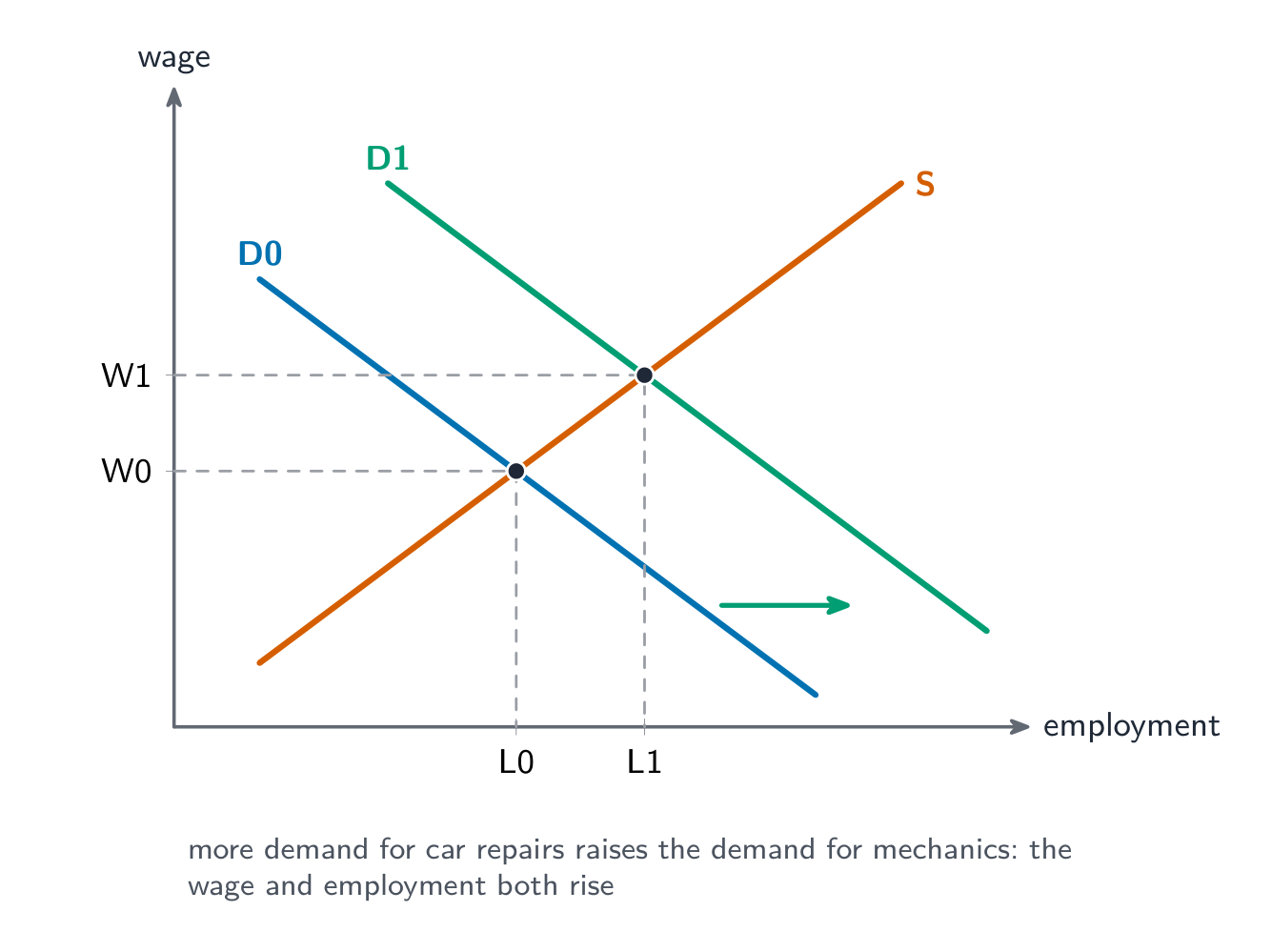
- Labour has derived demand 派生需求: firms want workers because consumers want the products they make.
- More cars on the road means more demand for mechanics.
Demand for builders rises because
难度 1/5 · 今日首次完成可获 100 金币及少量额外奖励
Derived demand.
Why wages differ
- Jobs that need rare skills or long training have low supply, so they pay more: surgeons, pilots.
- Jobs many people can do, with short training, have high supply and lower pay.
Why do surgeons earn more than cleaners?
难度 2/5 · 今日首次完成可获 140 金币及少量额外奖励
Place of work is not the reason.
Worked example: mechanics
At 150 yuan a day, 60 mechanics are wanted and 60 are available. Car sales rise, and at 150 yuan garages now want 80.
- At 150 yuan: a shortage of $80 - 60 = 20$ mechanics.
- Wage: garages compete, and the wage rises.
- Cause: nothing changed in the labour market itself — the shift came from demand for cars.
At 180 yuan a day, 45 welders are available and firms want 70. What is the shortage?
难度 2/5 · 今日首次完成可获 140 金币及少量额外奖励
70 − 45.
Trade unions
- A trade union 工会 is an organization of workers that bargains with employers over pay and conditions.
- Unions can strike, which stops production and costs the firm money.
What is the main purpose of a trade union?
难度 1/5 · 今日首次完成可获 100 金币及少量额外奖励
Collective bargaining.
Effects of union pay rises
- Members gain higher pay and better conditions.
- But if wages rise above what firms can pay, firms may hire fewer workers or use more machines.
A large union pay rise may lead firms to replace some workers with machines.
难度 1/5 · 今日首次完成可获 100 金币及少量额外奖励
Labour becomes dearer.
Higher pay does not always mean more jobs. A union-won pay rise is a movement up the demand curve: firms may want fewer workers at the higher wage, unless demand for the product grows too.
A union-won pay rise always increases the number of jobs.
难度 1/5 · 今日首次完成可获 100 金币及少量额外奖励
Firms may hire fewer at the higher wage.
Demand for labour is derived from demand for products. Wages are higher where skills are scarce. Trade unions bargain for members; higher wages help members but can reduce the number of jobs.
Evaluate whether the 2023 autoworkers' strike was good for car workers in the long run.
Trade unions.