Minimum wages and competition rules
引入| English | 释义 | 拼音 |
|---|---|---|
| minimum wage/ˈmɪnɪməm weɪdʒ/ | 最低工资 | zuì dī gōng zī |
| non-binding/nɒn ˈbaɪndɪŋ/ | 非约束性 | fēi yuē shù xìng |
Britain's first minimum wage, 1999
- In April 1999 the UK introduced a national minimum wage of £3.60 an hour for adults. Some people feared it would destroy jobs; studies since then found little loss of employment at the levels set.
- Governments set rules for labour markets and for competition between firms.
The minimum wage
- A minimum wage 最低工资 is the lowest hourly pay employers may legally offer.
- To have an effect it must be set above the market wage.
Binding or not
- A minimum wage below the market wage is non-binding 非约束性: firms already pay more, so nothing changes.
- Above the market wage, it raises pay but may cut the hours firms want.
The market wage is 25 yuan an hour. Which minimum wage is non-binding?
难度 1/5 · 今日首次完成可获 100 金币及少量额外奖励
It is below the market wage.
Worked example: a floor of 24 yuan
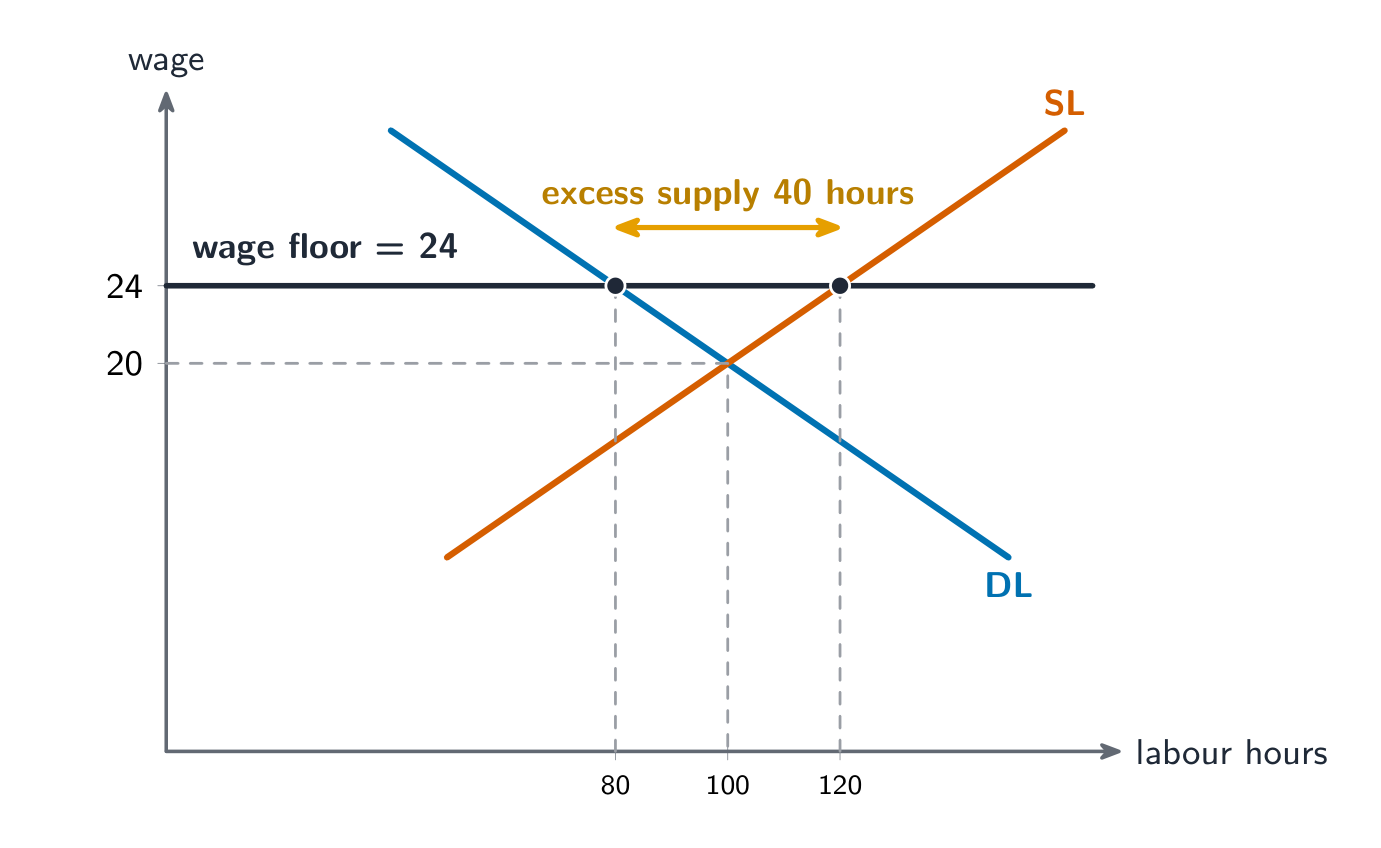
The market wage is 20 yuan an hour, with 100 hours worked. A minimum wage of 24 yuan is set.
- Hours demanded fall to 80; hours supplied rise to 120.
- Excess supply: $120 - 80 = 40$ hours of people who want work but cannot get it.
- Pay: those still working earn more — 80 hours at 24 yuan is 1920 yuan, against 100 hours at 20 yuan, or 2000 yuan, before.
A minimum wage above equilibrium
The market clears at 20 yuan with 100 hours. A minimum wage of 24 cuts hours demanded to 80 and raises hours supplied to 120: an excess supply of 40 hours, and only 80 are worked.
At a minimum wage, 150 hours are supplied and 110 demanded. What is the excess supply of labour?
难度 2/5 · 今日首次完成可获 140 金币及少量额外奖励
150 − 110.
At a minimum wage of 24 yuan, 80 hours are worked. What is the total wage bill?
难度 2/5 · 今日首次完成可获 140 金币及少量额外奖励
24 × 80.
Competition rules
- Governments ban practices that harm consumers: price fixing, abusing a dominant position, and mergers that would create a monopoly.
- In April 2021, China's market regulator fined Alibaba 18.2 billion yuan for forcing merchants not to sell on rival platforms.
Which do competition rules usually ban?
难度 2/5 · 今日首次完成可获 140 金币及少量额外奖励
Advertising is allowed.
Weighing the policies
- A minimum wage raises low pay and reduces poverty, but may cost some jobs.
- Competition rules protect consumers, but firms argue large size brings economies of scale.
A minimum wage above the market wage can reduce the hours firms want.
难度 1/5 · 今日首次完成可获 100 金币及少量额外奖励
Labour becomes dearer.
A minimum wage does not raise every wage. If it is set at 18 yuan when the market wage is 20, it changes nothing. It only matters when it is above the market wage.
A minimum wage always raises pay for low-paid workers.
难度 1/5 · 今日首次完成可获 100 金币及少量额外奖励
Not if it is below the market wage.
A binding minimum wage raises pay for those in work but can create excess supply of labour. A floor below the market wage has no effect. Competition rules stop collusion and abuse of monopoly power.
Evaluate the case for raising the minimum wage, using a labour-market diagram.
Minimum wage.