| English | 释义 | 拼音 |
|---|---|---|
| monopoly/məˈnɒpəli/ | 垄断 | lǒng duàn |
| monopoly power/məˈnɒpəli ˈpaʊə/ | 垄断势力 | lǒng duàn shì lì |
| economic profit/ˌiːkəˈnɒmɪk ˈprɒfɪt/ | 经济利润 | jīng jì lì rùn |
| welfare loss/ˈwelfeə lɒs/ | 福利损失 | fú lì sǔn shī |
| dynamic efficiency/daɪˈnæmɪk ɪˈfɪʃənsi/ | 动态效率 | dòng tài xiào lǜ |
The diamond seller
- For most of the 20th century De Beers controlled around 80–90% of the world's rough diamonds.
- It held stocks back to keep prices high and ran advertising — "A diamond is forever" — to protect demand.
- A firm with that much control is close to a monopoly 垄断: a single seller with monopoly power 垄断势力.
How a monopoly chooses
- Its demand curve is the market demand curve, sloping down, so $\text{MR} < P$.
- It maximises profit where $\text{MR} = \text{MC}$, then charges the highest price buyers will pay for that output, read from the demand curve.
- High barriers to entry protect its economic profit 经济利润 in the long run.
Worked example: monopoly output and welfare
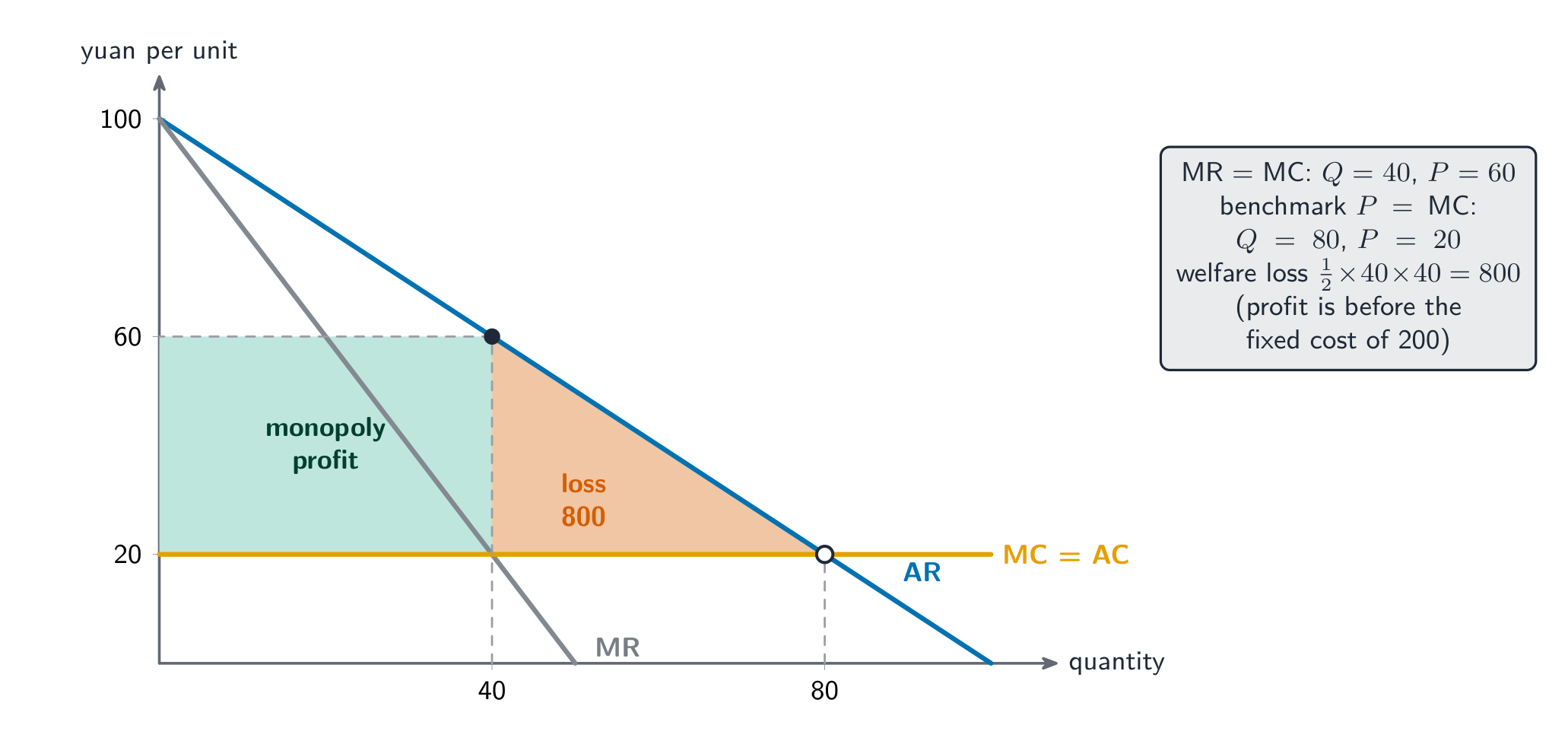
Demand $P = 100 - Q$, $\text{MR} = 100 - 2Q$, $\text{MC} = 20$, fixed cost 200.
- MR = MC: $100 - 2Q = 20$ gives $Q = 40$, $P = 60$. Profit $= 2400 - (200 + 800) = 1400$.
- Competitive benchmark ($P = \text{MC}$): $Q = 80$, $P = 20$.
- Welfare loss 福利损失 $= \dfrac{1}{2} \times (80 - 40) \times (60 - 20) = 800$: units worth more than they cost are not produced.
Where marginal revenue meets marginal cost
Point MR at Q = 40 is 100 − 2Q = 20, the lesson's marginal cost, so a 41st unit adds about 19 to revenue but 20 to cost. That is why the monopoly stops at 40 units and a price of 60.
$P = 120 - 2Q$, so $\text{MR} = 120 - 4Q$. MC is 40. What output maximises profit?
难度 2/5 · 今日首次完成可获 140 金币及少量额外奖励
$120 - 4Q = 40$, so $Q = 20$.
What price does the monopoly charge?
难度 2/5 · 今日首次完成可获 140 金币及少量额外奖励
$P = 120 - 2 \times 20 = 80$.
The competitive output is 40 (where P = MC = 40). What is the welfare loss?
难度 2/5 · 今日首次完成可获 140 金币及少量额外奖励
$\dfrac{1}{2} \times (40 - 20) \times (80 - 40) = 400$.
Who loses?
- Consumers pay more and buy less: consumer surplus falls from $\dfrac{1}{2} \times 80 \times 80 = 3200$ to $\dfrac{1}{2} \times 40 \times 40 = 800$.
- Part of the loss is transferred to the monopolist as profit; the triangle of 800 is lost to everyone.
Under monopoly compared with competition, consumer surplus
难度 1/5 · 今日首次完成可获 100 金币及少量额外奖励
Higher price and lower output reduce consumer surplus.
Possible benefits
- Economies of scale can give lower costs than many small firms could reach.
- Supernormal profit can fund research: dynamic efficiency. Patents create temporary monopolies precisely to reward invention.
Which are possible benefits of monopoly?
难度 2/5 · 今日首次完成可获 140 金币及少量额外奖励
Monopoly sets P above MC.
A monopoly does not charge "the highest possible price". Demand limits it: a higher price means fewer sales. It chooses the price that maximises profit, at the output where MR = MC.
A monopoly can charge any price it likes without losing sales.
难度 1/5 · 今日首次完成可获 100 金币及少量额外奖励
Demand slopes down; a higher price means fewer sales.
A monopoly sets MR = MC and prices from the demand curve, so P > MC and output is lower than in competition. This causes a welfare loss and transfers surplus from consumers to the firm. Economies of scale and research spending can offset some of the cost.
Explain why a monopoly creates a welfare loss.
Compare with the competitive output.