| English | 释义 | 拼音 |
|---|---|---|
| monopolistic competition/məˈnɒpəlɪstɪk ˌkɒmpəˈtɪʃn/ | 垄断竞争 | lǒng duàn jìng zhēng |
| product differentiation/ˈprɒdʌkt ˌdɪfəˌrenʃɪˈeɪʃn/ | 产品差异化 | chǎn pǐn chā yì huà |
| excess capacity/ekˈses kəˈpæsɪti/ | 过剩产能 | guò shèng chǎn néng |
A milk-tea shop on every corner
- Chinese cities have hundreds of thousands of milk-tea shops. Each sells a slightly different drink, brand and atmosphere.
- A new shop can open quickly. When one brand earns high profits, copies soon appear nearby — and many shops close within a year or two.
- This is monopolistic competition 垄断竞争.
Features
- Many firms and free entry, as in perfect competition.
- Product differentiation 产品差异化: each firm's product is a little different, so it has some control over price. Its demand curve slopes down.
Which are features of monopolistic competition?
难度 2/5 · 今日首次完成可获 140 金币及少量额外奖励
Entry is free.
Worked example: the short run
Demand is $P = 20 - Q$, so $\text{MR} = 20 - 2Q$. Costs are $\text{TC} = 16 + 4Q + Q^2$, so $\text{MC} = 4 + 2Q$.
- MR = MC: $20 - 2Q = 4 + 2Q$ gives $Q = 4$, $P = 16$.
- TC $= 16 + 16 + 16 = 48$, so $\text{AC} = 12$.
- Profit $= (16 - 12) \times 4 = 16$: supernormal profit in the short run.
A short-run profit in monopolistic competition
Demand P = 20 − Q and TC = 16 + 4Q + Q² give MR = 20 − 2Q and MC = 4 + 2Q. They meet at Q 4: price 16, AC 12, profit 16. Entry later shifts demand left until price equals AC.
$\text{MR} = 30 - 2Q$ and $\text{MC} = 6 + Q$. What output maximises profit?
难度 2/5 · 今日首次完成可获 140 金币及少量额外奖励
$30 - 2Q = 6 + Q$, so $Q = 8$.
At that output the price is 22 and AC is 17. What is the firm's profit?
难度 2/5 · 今日首次完成可获 140 金币及少量额外奖励
$(22 - 17) \times 8 = 40$.
The long run
- Supernormal profit attracts new firms with similar products. Each firm's demand shifts left and becomes more elastic.
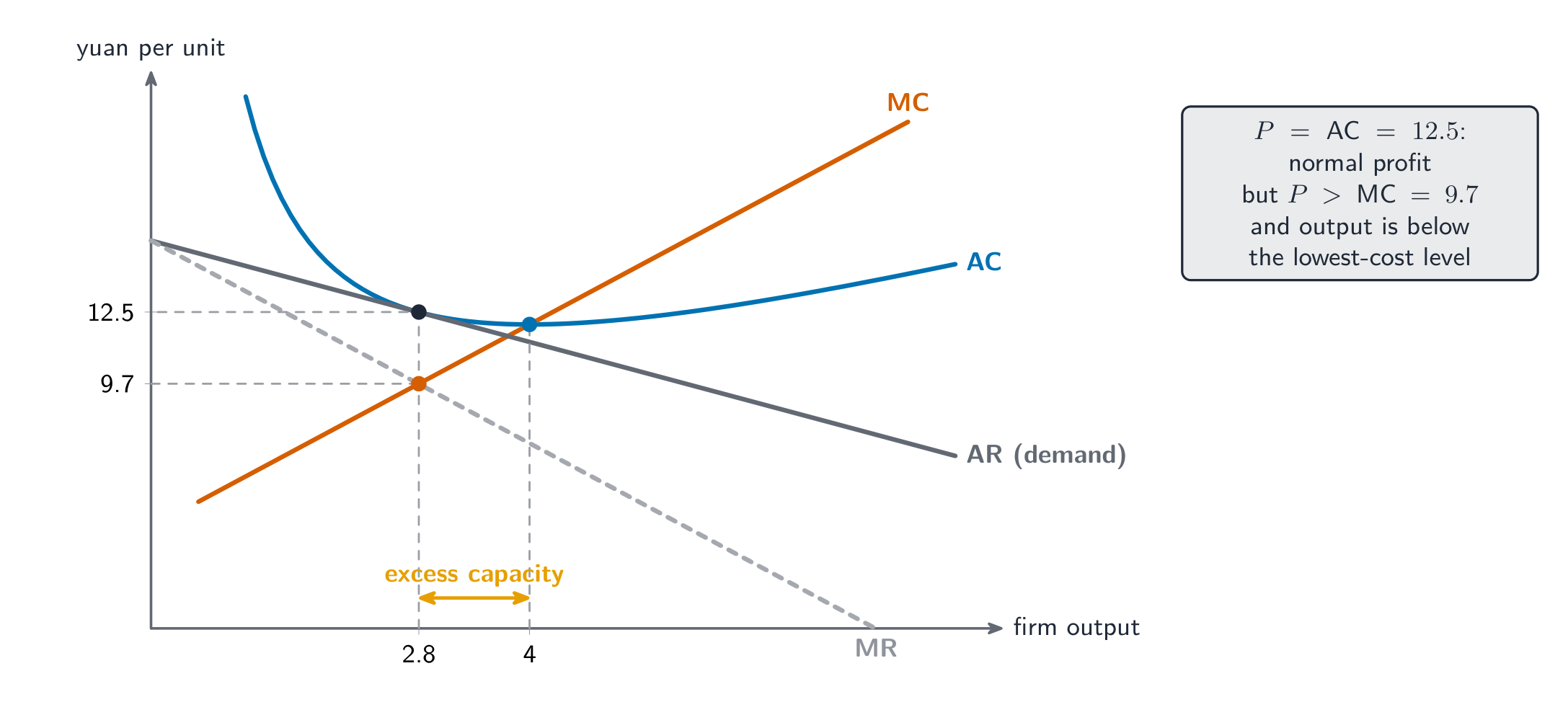
- Entry stops when the demand curve just touches the AC curve: $P = \text{AC}$ and firms earn normal profit.
What happens in the long run?
难度 1/5 · 今日首次完成可获 100 金币及少量额外奖励
Free entry removes supernormal profit.
Excess capacity
- At the tangency point, the firm produces on the falling part of its AC curve, below the output with minimum cost.
- This gap is excess capacity 过剩产能: half-empty cafés at many times of day. Price is also above MC.
In long-run equilibrium, a firm in monopolistic competition produces at the lowest point of its AC curve.
难度 1/5 · 今日首次完成可获 100 金币及少量额外奖励
It produces to the left of the minimum — excess capacity.
Normal profit in the long run does not make the firm efficient. Because the demand curve slopes down, it touches AC to the left of its lowest point: the firm is neither productively nor allocatively efficient. The benefit to consumers is variety.
Match each market to its long-run result.
难度 2/5 · 今日首次完成可获 140 金币及少量额外奖励
Both earn normal profit; only one is efficient.
Monopolistic competition has many firms, free entry and differentiated products. Firms can earn supernormal profit in the short run, but entry reduces it to normal profit in the long run. They operate with excess capacity and P > MC, in return for product variety.
Evaluate whether monopolistic competition is good for consumers.
Weigh variety against efficiency.