| English | 释义 | 拼音 |
|---|---|---|
| average fixed cost/ˈævrɪdʒ fɪkst kɒst/ | 平均固定成本 | píng jūn gù dìng chéng běn |
| marginal cost/ˈmɑːdʒɪnl kɒst/ | 边际成本 | biān jì chéng běn |
A plane costs the same, full or half empty
- An airline pays the same lease, crew and landing fees for a flight whether 100 or 180 seats are sold. Only meals and a little extra fuel rise with each passenger.
- So the cost per passenger falls sharply as the plane fills up.
- Firms track several cost measures, and each answers a different question.
Total, average and marginal
- $\text{TC} = \text{TFC} + \text{TVC}$: total cost is fixed plus variable cost.
- Average fixed cost 平均固定成本 $\text{AFC} = \dfrac{\text{TFC}}{Q}$, $\text{AVC} = \dfrac{\text{TVC}}{Q}$, and $\text{ATC} = \text{AFC} + \text{AVC}$.
- Marginal cost 边际成本 $\text{MC} = \dfrac{\Delta \text{TC}}{\Delta Q}$. Fixed costs do not change, so MC depends only on variable cost.
Worked example: reading a cost table
TFC $= 60$. At $Q = 10$, TVC $= 140$; at $Q = 12$, TVC $= 168$.
- At $Q = 10$: TC $= 200$, AFC $= 6$, AVC $= 14$, ATC $= 20$.
- At $Q = 12$: TC $= 228$, AFC $= 5$, AVC $= 14$, ATC $= 19$.
- MC $= \dfrac{228 - 200}{12 - 10} = 14$. Because the extra units cost 14 — less than the average of 20 — ATC falls.
Average and marginal cost from a table
$ATC=AFC+AVC;\quad MC=\dfrac{\Delta TC}{\Delta Q}$
TFC 60. At Q 10, TVC 140 gives ATC 20; at Q 12, TVC 168 gives ATC 19. The interval MC is (228 − 200) ÷ 2 = 14, below ATC, so ATC falls.
TFC is 200 and TVC is 600 at 40 units. What is ATC?
难度 2/5 · 今日首次完成可获 140 金币及少量额外奖励
$\dfrac{800}{40} = 20$.
In that example, what is AFC?
难度 2/5 · 今日首次完成可获 140 金币及少量额外奖励
$\dfrac{200}{40} = 5$.
TC is 800 at 40 units and 870 at 45 units. What is MC per unit over this range?
难度 2/5 · 今日首次完成可获 140 金币及少量额外奖励
$\dfrac{70}{5} = 14$.
The shapes of the curves
- AFC falls steadily as fixed cost is spread over more units.
- MC first falls, then rises because of diminishing returns. AVC and ATC are U-shaped.
- MC cuts AVC and ATC at their lowest points.
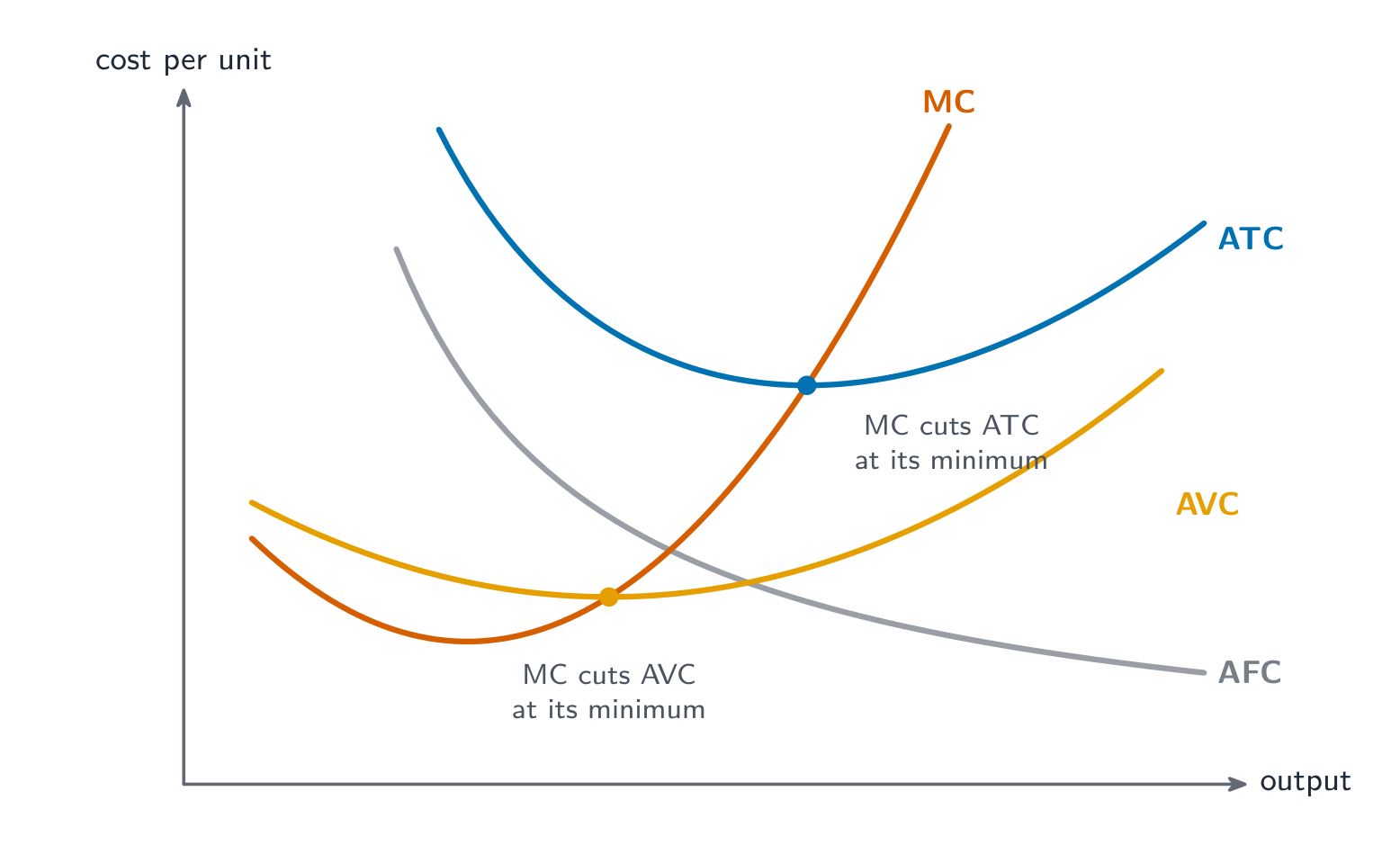
Match each curve to its shape.
难度 2/5 · 今日首次完成可获 140 金币及少量额外奖励
Spreading fixed cost and diminishing returns explain the shapes.
Why MC cuts the average at its minimum
- Think of exam marks. If your next test score is below your average, the average falls; if above, it rises.
- In the same way, when MC is below ATC, ATC falls; when MC is above ATC, ATC rises. So they meet at the bottom of ATC.
MC is 14 and ATC is 20. What happens to ATC as output rises?
难度 1/5 · 今日首次完成可获 100 金币及少量额外奖励
A margin below the average pulls the average down.
Fixed costs do not affect marginal cost. A rise in rent raises AFC and ATC, but the cost of making one more unit is unchanged — so it does not change the profit-maximising output where MR = MC.
A rise in rent raises the firm's marginal cost.
难度 1/5 · 今日首次完成可获 100 金币及少量额外奖励
Rent is fixed; it raises AFC and ATC, not MC.
TC = TFC + TVC; ATC = AFC + AVC; MC is the change in TC from one more unit. AFC always falls; AVC and ATC are U-shaped. MC cuts both averages at their minimum, because a margin below the average pulls the average down.
Explain why the MC curve cuts the ATC curve at its minimum point.
Use the margin-and-average idea.