| English | 释义 | 拼音 |
|---|---|---|
| satisficing/ˈsætɪsfɪsɪŋ/ | 满意化决策 | mǎn yì huà jué cè |
| divorce of ownership and control/dɪˈvɔːs ɒv ˈəʊnəʃɪp ænd kənˈtrəʊl/ | 所有权与控制权分离 | suǒ yǒu quán yǔ kòng zhì quán fēn lí |
| principal-agent problem/ˈprɪnsɪpl ˈeɪdʒənt ˈprɒbləm/ | 委托代理问题 | wěi tuō dài lǐ wèn tí |
3.5 million fake accounts
- In 2016 Wells Fargo, a large US bank, admitted that staff had opened about 3.5 million accounts customers never asked for.
- Managers had set high sales targets and paid bonuses for them. The bank was fined billions of dollars.
- Owners want long-run profit; the people who run a firm may chase other goals.
Possible objectives
- Profit maximisation: the largest $\text{TR} - \text{TC}$, where $\text{MR} = \text{MC}$.
- Revenue maximisation: the largest total revenue, where $\text{MR} = 0$.
- Sales maximisation: the most units sold without making a loss, where $\text{TR} = \text{TC}$ (or $\text{AR} = \text{AC}$).
- Satisficing 满意化决策: reaching a "good enough" level on several goals instead of the most of one.
Match each objective to its condition.
难度 2/5 · 今日首次完成可获 140 金币及少量额外奖励
Each goal gives a different output.
A family firm aims for "enough profit to keep the shareholders happy while keeping all staff employed". This is
难度 1/5 · 今日首次完成可获 100 金币及少量额外奖励
It accepts a satisfactory level on several goals.
Worked example: three goals, three outputs
Demand is $P = 100 - Q$, so $\text{TR} = 100Q - Q^2$ and $\text{MR} = 100 - 2Q$. Costs are $\text{TC} = 200 + 20Q$, so $\text{MC} = 20$.
- Profit max: $100 - 2Q = 20$ gives $Q = 40$, $P = 60$; profit $= 2400 - 1000 = 1400$.
- Revenue max: $100 - 2Q = 0$ gives $Q = 50$, $P = 50$; TR $= 2500$, profit $= 2500 - 1200 = 1300$.
- Sales max: $100Q - Q^2 = 200 + 20Q$ gives $Q \approx 77.4$, $P \approx 22.6$, profit $= 0$.
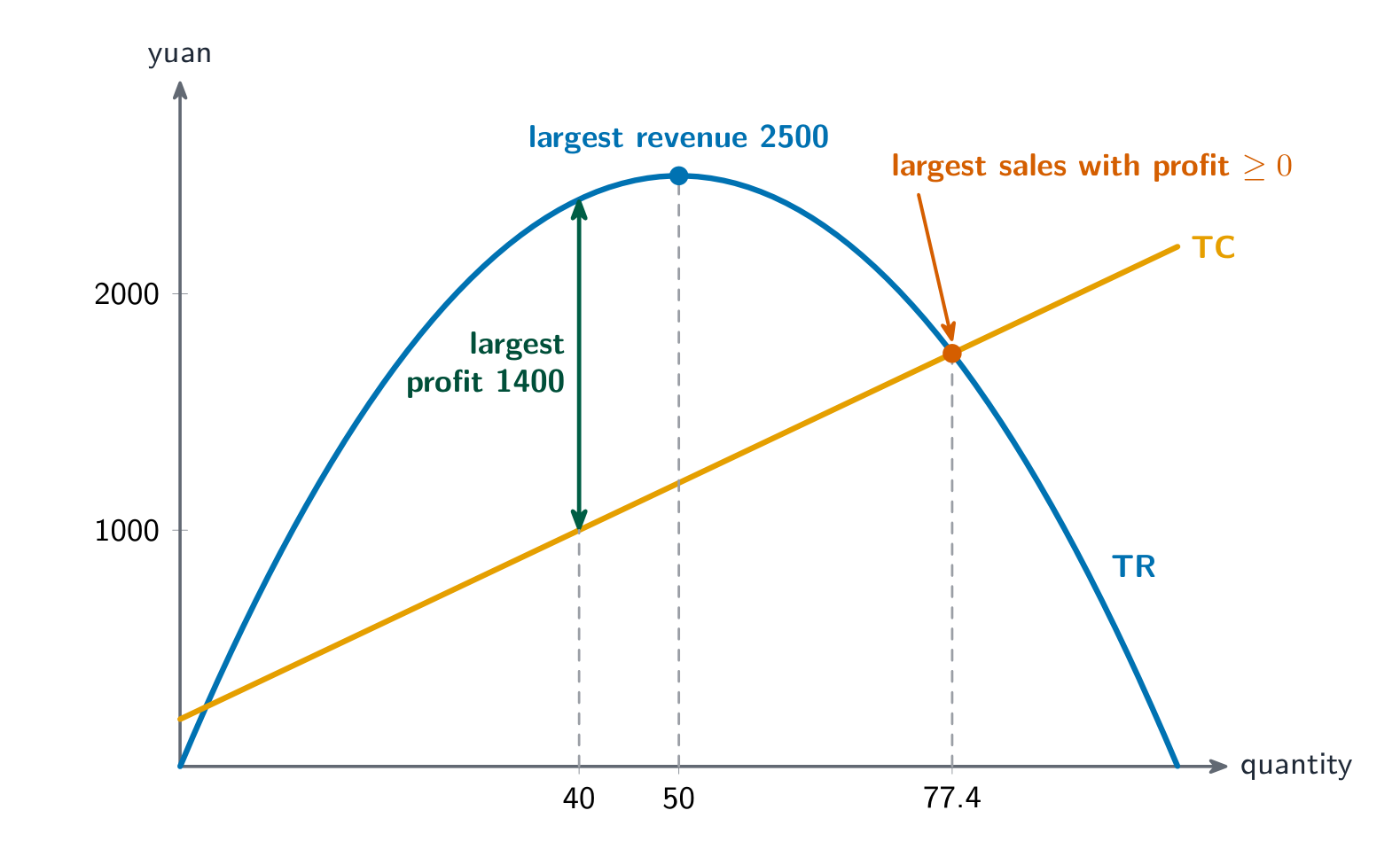
Different objectives choose different outputs
With P = 100 − Q and TC = 200 + 20Q, profit is greatest where MR = MC, at Q 40 (price 60, profit 1400). Revenue peaks where MR = 0, at Q 50 (profit 1300). Sales maximisation subject to zero economic profit pushes output to about Q 77.4.
Demand is $P = 120 - Q$ and MC is constant at 40. What output maximises profit?
难度 2/5 · 今日首次完成可获 140 金币及少量额外奖励
$\text{MR} = 120 - 2Q = 40$, so $Q = 40$.
For the same demand curve, what output maximises revenue?
难度 2/5 · 今日首次完成可获 140 金币及少量额外奖励
$120 - 2Q = 0$, so $Q = 60$.
Owners and managers
- In large companies, shareholders own the firm but managers control it: a divorce of ownership and control.
- This creates a principal-agent problem 委托代理问题: the agent (manager) may pursue pay, power or sales instead of the principal's (owner's) profit.
In the principal-agent problem, the managers are the principals.
难度 1/5 · 今日首次完成可获 100 金币及少量额外奖励
Owners are principals; managers are agents.
Reducing the problem
- Pay managers partly in shares, so they gain when profit rises.
- Independent directors and audits check managers' decisions. But badly designed targets — like Wells Fargo's — can create new problems.
Which can reduce the principal-agent problem?
难度 2/5 · 今日首次完成可获 140 金币及少量额外奖励
Sales-only bonuses can make the problem worse.
$\text{MR} = \text{MC}$ is profit maximisation, not revenue maximisation. Revenue is greatest where $\text{MR} = 0$, which is a higher output and lower price. Students often mix up the two conditions.
Firms may maximise profit (MR = MC), revenue (MR = 0) or sales (TR = TC), or satisfice. When managers control a firm that owners own, the principal-agent problem can push the firm away from profit maximisation; incentives and oversight reduce it.
Explain why managers of a large company might not maximise profit.
Use principal and agent.