| English | 释义 | 拼音 |
|---|---|---|
| fiscal policy/ˈfɪskl ˈpɒlɪsi/ | 财政政策 | cái zhèng zhèng cè |
| reflationary policy/rɪˈfleɪʃənəri ˈpɒlɪsi/ | 扩张性需求政策 | kuò zhāng xìng xū qiú zhèng cè |
| deflationary policy | 紧缩性需求政策 | jǐn suō xìng xū qiú zhèng cè |
| automatic stabilisers | 自动稳定器 | zì dòng wěn dìng qì |
| crowding out/ˈkraʊdɪŋ aʊt/ | 挤出效应 | jǐ chū xiào yìng |
A cut in VAT
- In December 2008 the UK cut VAT from 17.5% to 15% for 13 months to support spending in the financial crisis.
- In 2009 the US passed a stimulus of about $800 billion in tax cuts and spending.
- Both are fiscal policy 财政政策: using government spending and taxes to manage aggregate demand.
Two directions
- Reflationary policy 扩张性需求政策 raises AD: more spending or lower taxes, used when there is a negative output gap.
- Deflationary policy 紧缩性需求政策 lowers AD: less spending or higher taxes, used to reduce inflation.
- Direct taxes fall on income and profit; indirect taxes such as VAT fall on spending and also change prices.
Match each measure to its type.
难度 2/5 · 今日首次完成可获 140 金币及少量额外奖励
Reflationary raises AD; deflationary lowers it.
Worked example: spending versus a tax cut
In a simple closed economy the MPC is 0.75, so the multiplier is $\dfrac{1}{1 - 0.75} = 4$.
- G rises by 20: the first round adds 20 to demand. Final rise in income $= 4 \times 20 = 80$.
- Taxes cut by 20: households spend $0.75 \times 20 = 15$ and save 5. Final rise $= 4 \times 15 = 60$.
- Both G and taxes up by 20: first-round change $= 20 - 15 = 5$; final rise $= 4 \times 5 = 20$.
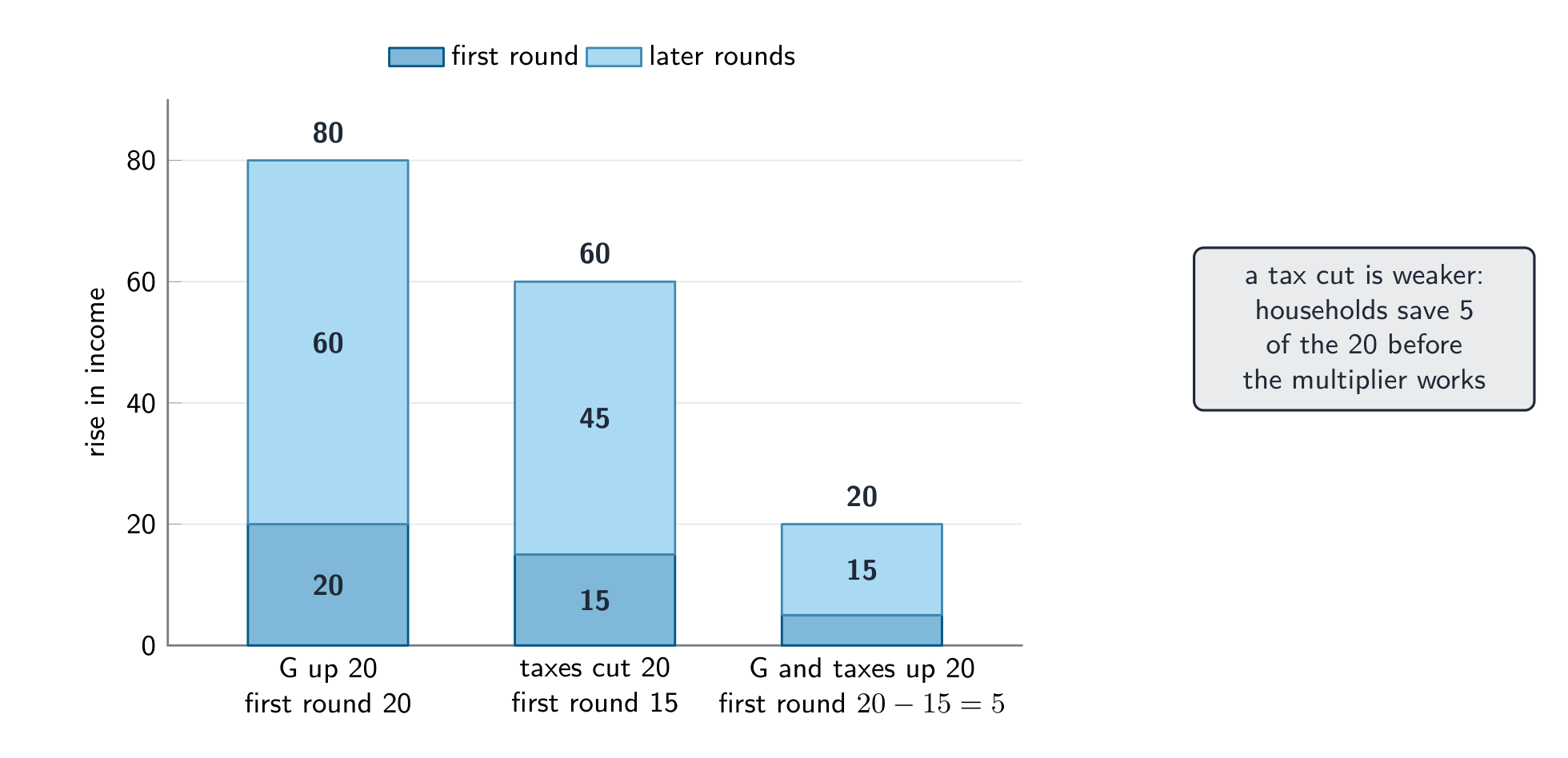
A rise in G of 20 with MPC 0.75
$\Delta Y=k\Delta G,\quad k=\dfrac{1}{1-MPC}$
In the closed fixed-price model the multiplier is 1/(1 − 0.75) = 4, so 20 more government spending raises income by 80 over the rounds. Each round is 0.75 of the one before.
The multiplier is 2.5. G rises by ¥40 bn. What is the final rise in income?
难度 2/5 · 今日首次完成可获 140 金币及少量额外奖励
$2.5 \times 40 = ¥100$ bn.
MPC = 0.6, so the multiplier is 2.5. Taxes are cut by ¥40 bn. What is the final rise in income?
难度 2/5 · 今日首次完成可获 140 金币及少量额外奖励
Households spend $0.6 \times 40 = 24$; $2.5 \times 24 = ¥60$ bn.
Automatic stabilisers
- In a recession, tax revenue falls and benefit spending rises without any new decision. This supports demand.
- In a boom the opposite happens. These automatic stabilisers 自动稳定器 differ from discretionary policy, where the government chooses a new measure.
Which is an automatic stabiliser?
难度 1/5 · 今日首次完成可获 100 金币及少量额外奖励
Benefit spending rises without a new decision.
Limits of fiscal policy
- Time lags: deciding, passing and spending take months.
- Debt: borrowing raises debt and interest payments; it may push up interest rates and reduce private investment (crowding out 挤出效应).
- Capacity: near full employment, stimulus mostly raises prices.
Crowding out means government borrowing may raise interest rates and reduce private investment.
难度 1/5 · 今日首次完成可获 100 金币及少量额外奖励
Public borrowing competes for savings.
Which reduce the effect of fiscal stimulus on real output?
难度 2/5 · 今日首次完成可获 140 金币及少量额外奖励
Spare capacity lets output respond.
A tax cut and a spending rise of the same size do not have the same effect. Government purchases enter AD in full; a tax cut works only through the part households spend. Imports and saving reduce both.
Fiscal policy uses spending and taxes to raise or lower AD. A rise in G has a larger first-round effect than an equal tax cut. Automatic stabilisers work without decisions. Lags, debt, crowding out and capacity limit fiscal policy.
Explain why a ¥20 bn rise in government spending may raise national income by more than a ¥20 bn tax cut.
The difference is in the first round.