| English | 释义 | 拼音 |
|---|---|---|
| stagflation/stæɡˈfleɪʃn/ | 滞胀 | zhì zhàng |
| short-run Phillips curve/ʃɔːt rʌn ˈfɪlɪps kɜːv/ | 短期菲利普斯曲线 | duǎn qī fēi lì pǔ sī qū xiàn |
| policy conflict/ˈpɒlɪsi ˈkɒnflɪkt/ | 政策目标冲突 | zhèng cè mù biāo chōng tū |
A curve from 100 years of data
- In 1958 Bill Phillips plotted UK wage growth against unemployment from 1861 to 1957. When unemployment was low, wages rose fast.
- In the 1970s the pattern broke: oil shocks brought high inflation and high unemployment together — stagflation 滞胀.
- Many objectives can pull against each other. The Phillips curve is the best-known case.
Stagflation means high inflation together with high unemployment.
难度 1/5 · 今日首次完成可获 100 金币及少量额外奖励
The 1970s oil shocks caused both.
The short-run Phillips curve
- The short-run Phillips curve 短期菲利普斯曲线 shows an inverse link between inflation and unemployment, with expectations and costs fixed.
- When AD rises, firms hire more workers, unemployment falls, and wages and prices rise faster.
- A change in AD moves the economy along the curve. A change in expected inflation or supply costs shifts it.
Worked example: movement and shift
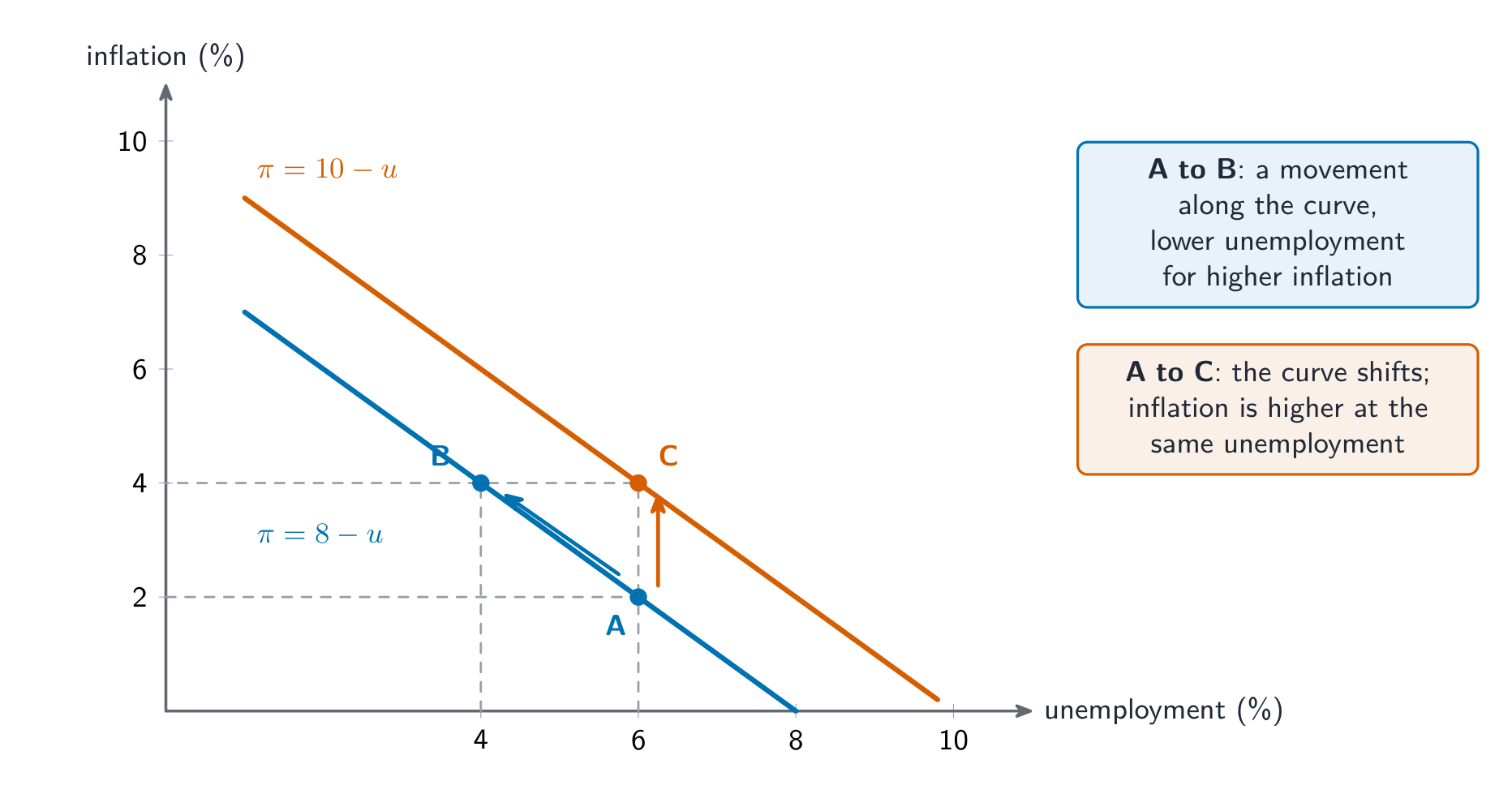
A short-run curve is $\pi = 8 - u$ ($\pi$ is inflation in %, $u$ unemployment in %).
- At $u = 6$: $\pi = 8 - 6 = 2\%$. At $u = 4$: $\pi = 8 - 4 = 4\%$ — a movement along the curve.
- Costs rise and the curve shifts to $\pi = 10 - u$. At $u = 6$, inflation is now $10 - 6 = 4\%$.
- Inflation is higher at the same unemployment rate: the old trade-off no longer holds.
Movement along the curve or a shift of it
On the illustrative curve π = 8 − u, unemployment falling from 6% to 4% raises inflation from 2% to 4%: a movement along the curve. If expectations or supply costs shift it to π = 10 − u, inflation at 6% unemployment is 4%: the old curve no longer applies.
A short-run curve is $\pi = 9 - u$. What is inflation when unemployment is 5%?
难度 2/5 · 今日首次完成可获 140 金币及少量额外奖励
$9 - 5 = 4\%$.
Which would SHIFT the short-run Phillips curve upward?
难度 1/5 · 今日首次完成可获 100 金币及少量额外奖励
Changes in AD move the economy along the curve.
Three other conflicts
- Growth vs the environment: more output can mean more pollution and use of resources.
- Inflation vs the current account: if domestic prices rise faster than other countries', exports become less competitive.
- Growth vs equality: gains may go mostly to owners of capital, skilled workers or richer regions.
Match each conflict to its mechanism.
难度 2/5 · 今日首次完成可获 140 金币及少量额外奖励
Each conflict needs a mechanism.
Growth that widens a gap
- Owners' income rises from 80 to 100 and workers' from 20 to 22. Both gain.
- But the ratio rises from $\dfrac{80}{20} = 4$ to $\dfrac{100}{22} \approx 4.55$: inequality has widened.
The top group's income rises from 90 to 120 and the bottom group's from 30 to 33. What is the new top-to-bottom ratio, to 2 d.p.?
难度 2/5 · 今日首次完成可获 140 金币及少量额外奖励
$\dfrac{120}{33} \approx 3.64$, up from 3.
A policy conflict is not a law of nature. Clean technology can raise output and cut emissions; productivity growth can raise output without raising inflation. Always explain the mechanism that causes a conflict, and when it may not apply.
Which policy could raise growth AND reduce the conflict with the environment?
难度 1/5 · 今日首次完成可获 100 金币及少量额外奖励
Clean technology lowers emissions per unit of output.
In the short run, higher AD can lower unemployment but raise inflation — a movement along the Phillips curve. Supply shocks and expectations shift the curve. Growth can also conflict with the environment, the current account and equality, though the right policies can reduce each conflict.
Explain why a government that raises spending to cut unemployment may cause higher inflation.
Trace the move along the curve.