| English | 释义 | 拼音 |
|---|---|---|
| regulation/ˌreɡjʊˈleɪʃn/ | 监管 | jiān guǎn |
| state provision/steɪt prəˈvɪʒn/ | 国家供给 | guó jiā gōng jǐ |
| information gap | 信息缺口 | xìn xī quē kǒu |
Shanghai sorts its rubbish
- From July 2019 Shanghai required every household to sort rubbish into four types, with fines for those who did not.
- Within months the share of kitchen waste separated for recycling rose sharply.
- This was not a tax or a subsidy. It was a regulation 监管 — a rule backed by penalties.
State provision
- State provision 国家供给 means the government supplies a good directly, paid for from taxes: defence, flood defences, street lighting, often schools and healthcare.
- It solves the free-rider problem for public goods, and it can raise consumption of merit goods by making them free at the point of use.
- Risks: without competition and profit, state providers may be inefficient, and taxes have an opportunity cost.
Why is state provision used for national defence?
难度 1/5 · 今日首次完成可获 100 金币及少量额外奖励
Non-excludability lets people free ride, so the state provides it and funds it from taxes.
Regulation
- Regulation sets rules that limit or require behaviour: emission limits, bans on smoking indoors, minimum safety standards, compulsory sorting.
- It is simple to understand and can act fast against serious harm.
- Problems: it needs inspectors and penalties, firms may lobby for weak rules, and a fixed limit gives no reward for cutting harm below the limit.
Which are problems with regulation?
难度 2/5 · 今日首次完成可获 140 金币及少量额外奖励
Regulation does not raise revenue unless fines are collected.
Providing information
- Many market failures come from information gaps: people undervalue exercise, or do not know the harm of smoking.
- Governments can require warning labels, nutrition labels and energy ratings, or run campaigns.
- Information leaves people free to choose, but it changes behaviour only if people notice and act on it.
Match each policy to the tool.
难度 2/5 · 今日首次完成可获 140 金币及少量额外奖励
Rules, direct supply and information are three separate tools.
Worked example: is a campaign worth it?
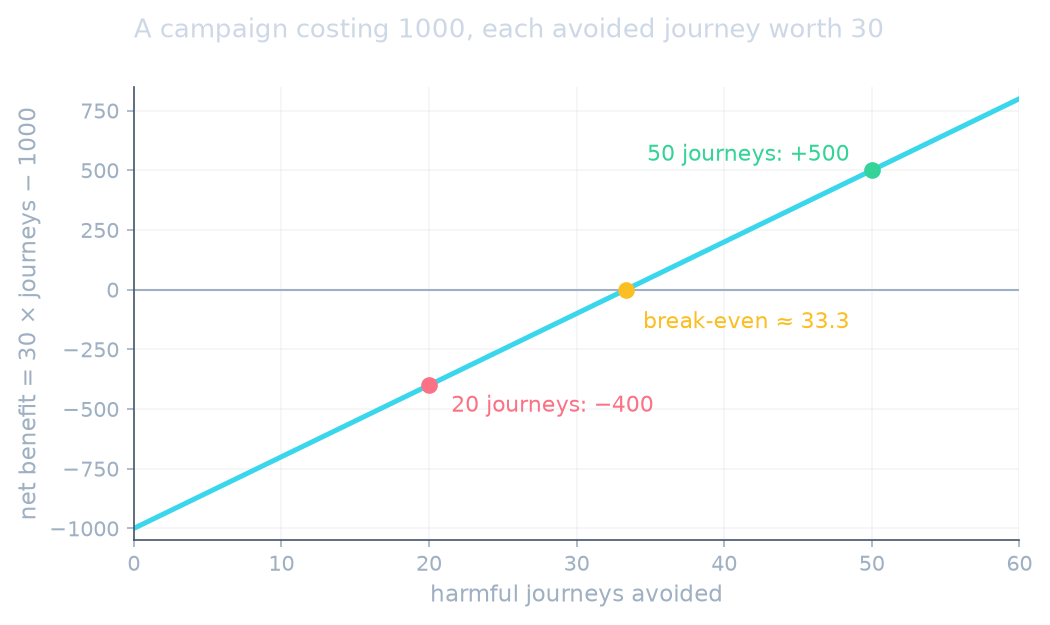
A campaign to get people cycling costs ¥1000. Each extra cycling journey it causes is worth ¥30 to society.
- Net benefit $= 30 \times \text{journeys} - 1000$.
- 20 extra journeys: $30 \times 20 - 1000 = -¥400$ — not worth it. 50 journeys: $30 \times 50 - 1000 = +¥500$.
- Break-even: $30J = 1000$ gives $J \approx 33.3$, so the campaign needs at least 34 extra journeys.
A health campaign costs ¥2400. Each extra person who quits smoking is worth ¥80 to society. How many must quit for the campaign to break even?
难度 2/5 · 今日首次完成可获 140 金币及少量额外奖励
$80N = 2400$ gives $N = 30$.
If the campaign causes 45 people to quit, what is its net benefit?
难度 2/5 · 今日首次完成可获 140 金币及少量额外奖励
$80 \times 45 - 2400 = 3600 - 2400 = ¥1200$.
Regulation is not automatically better than a tax because it is "stricter". A ban cuts harm to zero even where some of the activity is worth more than its cost, and a limit gives firms no reason to do better than the limit. Choose the tool by its effect, its cost and the information it needs.
Providing information always changes behaviour, because people then know the true costs.
难度 1/5 · 今日首次完成可获 100 金币及少量额外奖励
Habit and other behavioural factors mean many people ignore labels and campaigns.
The state can provide goods directly, regulate behaviour with rules and penalties, or provide information so that people choose better. Each tool fits some failures better than others: provision for public goods, regulation for serious or hard-to-price harm, information for information gaps. Each has its own costs.
Assess whether regulation or a tax is better for reducing plastic bag use.
Compare the tools on effect, cost and side effects.