Recombinant DNA, GMOs and microarrays
引入 10:16
单元 5:呼吸、内环境、协调与基因技术
冲刺赶公交车时,身体宛如演奏交响乐:肌肉加速消耗葡萄糖,心输出量翻倍,通气加深,开始出汗,肾脏……
英文讲解 · 可切换中英文字幕
本课内容
| English | 释义 | 拼音 |
|---|---|---|
| reverse transcriptase/rɪˈvɜːs trænˈskrɪpteɪs/ | 逆转录酶 | nì zhuǎn lù méi |
| restriction enzyme/rɪˈstrɪkʃn ˈenzaɪm/ | 限制性内切酶 | xiàn zhì xìng nèi qiè méi |
| sticky ends/ˈstɪki endz/ | 黏性末端 | nián xìng mò duān |
| ligase/ˈlɪɡeɪs/ | 连接酶 | lián jiē méi |
| plasmid/ˈplæzmɪd/ | 质粒 | zhì lì |
| marker gene/ˈmɑːkə dʒiːn/ | 标记基因 | biāo jì jī yīn |
| genetically modified organism/dʒɪˈnetɪkli ˈmɒdɪfaɪd ˈɔːɡənɪzəm/ | 转基因生物 | zhuǎn jī yīn shēng wù |
| microarray/ˈmaɪkrəʊəreɪ/ | 微阵列 | wēi zhèn liè |
| hybridisation/ˌhaɪbrɪdaɪˈzeɪʃn/ | 杂交 | zá jiāo |
| Bioinformatics/ˌbaɪəʊɪnfɔːˈmætɪks/ | 生物信息学 | shēng wù xìn xī xué |
Insulin from bacteria
- Until the 1980s, people with diabetes injected insulin taken from the pancreases of pigs and cows. Some patients reacted badly to it.
- Today almost all insulin is human insulin made by bacteria that carry the human gene. This lesson shows how the gene gets there, and how scientists find out which genes are active.
Getting the gene
- One way: extract the mRNA for insulin from pancreas cells and use reverse transcriptase 逆转录酶 to copy it into complementary DNA (cDNA). This copy has no introns, so bacteria can use it.
- Another way: cut the gene out of DNA with a restriction enzyme 限制性内切酶, which cuts at one specific base sequence (its recognition site).
Why is insulin cDNA made from mRNA, rather than taken straight from human DNA, before putting it into bacteria?
难度 1/5 · 今日首次完成可获 100 金币及少量额外奖励
Bacteria have no splicing machinery, so the gene must have no introns.
Sticky ends and ligase
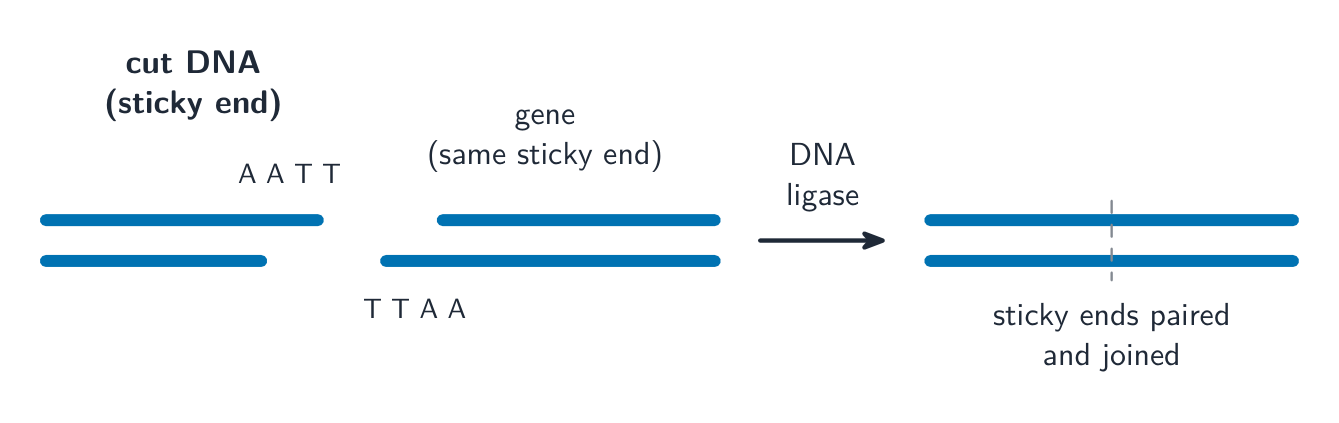
- Many restriction enzymes make a staggered cut, leaving short single-stranded sticky ends 黏性末端. Cut the gene and the plasmid 质粒 with the same enzyme and their sticky ends are complementary.
- The bases pair by hydrogen bonds, and DNA ligase 连接酶 seals the sugar-phosphate backbone. The result is recombinant DNA.
Getting the DNA into cells
- Plasmids carry the gene into bacteria; viruses can carry genes into animal cells; liposomes (fatty spheres) fuse with cell membranes.
- For plants, a gene gun fires DNA-coated gold particles into cells, or the bacterium Agrobacterium transfers it. For animal eggs, DNA is injected directly (microinjection).
Match each method to the cells it is mainly used for.
难度 2/5 · 今日首次完成可获 140 金币及少量额外奖励
The method suits the type of cell and its wall.
Finding the cells that took the gene up
- Only a small fraction of bacteria take up the plasmid. A marker gene 标记基因 on the plasmid, such as antibiotic resistance or a fluorescent protein, shows which ones did.
- Grow the bacteria on the antibiotic: only transformed cells survive. These are then grown in large fermenters, and the insulin is extracted and purified.
Worked example: how many cells were transformed? 2.0 × 10⁸ bacteria were mixed with plasmids and spread on an antibiotic plate. 400 colonies grew.
- Transformation rate = 400 ÷ (2.0 × 10⁸) = 2.0 × 10⁻⁶.
- That is 2 bacteria in every million: the marker gene is essential to find them.
Put the steps of making human insulin in bacteria in order.
难度 3/5 · 今日首次完成可获 200 金币及少量额外奖励
Make the gene, build the plasmid, transform, select, then scale up.
5.0 × 10⁷ bacteria were spread on an antibiotic plate and 150 colonies grew. How many were transformed per million bacteria?
难度 2/5 · 今日首次完成可获 140 金币及少量额外奖励
150 ÷ (5.0 × 10⁷) = 3.0 × 10⁻⁶, which is 3 per million.
Genetically modified crops and animals
- A genetically modified organism 转基因生物 (GMO) carries a gene from another organism. Examples: crops resistant to insect pests or herbicides, and sheep or goats that make human proteins in their milk.
- Benefits: higher yields, less pesticide, cheaper medicines. Concerns: genes spreading to wild plants, pests becoming resistant, and farmers depending on seed companies.
Which are concerns about GM crops?
难度 2/5 · 今日首次完成可获 140 金币及少量额外奖励
Using less pesticide is a benefit.
Microarrays: which genes are switched on?
- A microarray 微阵列 is a chip with thousands of DNA probes, one spot per gene. mRNA from a sample is copied into labelled cDNA and added to the chip.
- Each cDNA binds by hybridisation 杂交 to its complementary probe. Spots that glow show which genes were being transcribed — for example in a cancer cell compared with a normal cell.
A glowing spot on a microarray shows that the gene was being transcribed in the sample.
难度 1/5 · 今日首次完成可获 100 金币及少量额外奖励
Labelled cDNA from the sample's mRNA hybridised to that probe.
Bioinformatics
- Bioinformatics 生物信息学 uses computers to store and compare huge amounts of DNA and protein sequence data.
- Comparing sequences shows how closely species are related, and helps find genes linked to diseases.
Use the same restriction enzyme for the gene and the plasmid. Different enzymes leave different sticky ends, and these will not pair. Ligase joins the backbone; it does not make the bases pair.
A gene is obtained as cDNA (from mRNA by reverse transcriptase) or cut out with a restriction enzyme. The same enzyme cuts the plasmid, the sticky ends pair, and ligase seals them. Vectors carry the gene into cells, and marker genes identify the transformed ones. Microarrays show which genes are active, and bioinformatics compares sequences.
Explain why the gene and the plasmid must be cut with the same restriction enzyme.
Link the enzyme to the sticky ends.
出了什么问题?只有网站团队能看到这些信息。