The nervous system, receptors and the brain
引入 10:16
单元 5:呼吸、内环境、协调与基因技术
冲刺赶公交车时,身体宛如演奏交响乐:肌肉加速消耗葡萄糖,心输出量翻倍,通气加深,开始出汗,肾脏……
英文讲解 · 可切换中英文字幕
本课内容
| English | 释义 | 拼音 |
|---|---|---|
| reflex arc/ˈriːfleks ɑːk/ | 反射弧 | fǎn shè hú |
| Habituation/ˌhæbɪtʃuːˈeɪʃn/ | 习惯化 | xí guàn huà |
| Cerebral hemispheres/ˈserɪbrəl ˈhemɪsfɪəz/ | 大脑半球 | dà nǎo bàn qiú |
| Cerebellum/ˌserɪˈbeləm/ | 小脑 | xiǎo nǎo |
| Hypothalamus/ˌhaɪpəʊˈθælæməs/ | 下丘脑 | xià qiū nǎo |
| pituitary/pɪˈtjuːɪtəri/ | 垂体 | chuí tǐ |
| dopamine/ˈdɒpəmiːn/ | 多巴胺 | duō bā àn |
Why you see shapes but no colours at night
- In a dark room you can find the door, but you cannot tell a red book from a blue one.
- Two kinds of light receptor in your eye do different jobs. This lesson looks at how receptors, nerves and the brain fit together.
How the nervous system is organised
- The central nervous system is the brain and spinal cord. The peripheral nervous system is every nerve outside them.
- The somatic system controls voluntary movement of skeletal muscle. The autonomic system works without thinking: sympathetic nerves prepare the body for action, parasympathetic nerves calm it.
The reflex arc
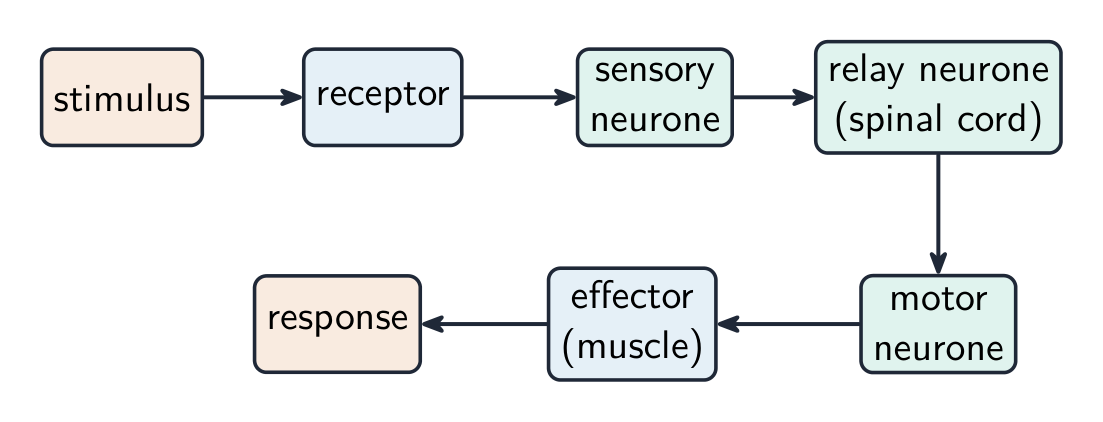
- In a reflex arc 反射弧, the impulse goes from receptor → sensory neurone → relay neurone in the spinal cord → motor neurone → effector.
- The brain is not needed for the response, so it is fast and automatic. It protects the body, for example by pulling the hand from heat or closing the pupil in bright light.
Put the parts of a reflex arc in order.
难度 3/5 · 今日首次完成可获 200 金币及少量额外奖励
The relay neurone is in the CNS; the brain is not needed for the response.
Rods: seeing in dim light
- Rod cells contain rhodopsin. Light splits rhodopsin into retinal and opsin. Na⁺ channels close, so the rod hyperpolarises and stops releasing its inhibitory transmitter (glutamate).
- The bipolar neurone is no longer inhibited, so it depolarises and passes the signal to a ganglion cell, whose axon is in the optic nerve. Several rods share one bipolar cell, so weak light adds up: rods are sensitive but give a blurred image.
What happens to a rod cell when light hits it?
难度 1/5 · 今日首次完成可获 100 金币及少量额外奖励
Less inhibitory transmitter means the bipolar neurone depolarises.
Cones: colour and detail
- Cones contain iodopsin and come in three types for red, green and blue light. They need bright light.
- Each cone usually has its own bipolar cell, so the brain can tell neighbouring points apart: cones give sharp, coloured vision, mostly at the fovea.
Match each receptor to its feature.
难度 2/5 · 今日首次完成可获 140 金币及少量额外奖励
Convergence adds up weak signals but loses detail.
Habituation
- Habituation 习惯化 is a decreasing response to a stimulus that is repeated and is harmless. A snail that is touched again and again stops pulling back into its shell.
- At the synapse, Ca²⁺ channels in the presynaptic neurone become less responsive, so less transmitter is released. The animal saves energy for stimuli that matter.
Worked example: reading habituation data. A snail withdrew for 8 s on the first touch, 5 s on the fifth, and 2 s on the tenth.
- Fall from touch 1 to touch 10 = 8 − 2 = 6 s; percentage fall = 6 ÷ 8 × 100 = 75 %.
- If a new stimulus (a different spot) gives an 8 s response again, the snail had habituated — it was not simply tired.
A response fell from 10 s on the first stimulus to 4 s on the twelfth. What is the percentage fall?
难度 2/5 · 今日首次完成可获 140 金币及少量额外奖励
(10 − 4) ÷ 10 × 100 = 60 %.
Parts of the brain
- Cerebral hemispheres 大脑半球: thinking, memory, vision and voluntary movement. Cerebellum 小脑: balance and coordination of movement.
- Hypothalamus 下丘脑: temperature and water balance, controlling the pituitary 垂体. Medulla oblongata: heart rate and breathing.
Match each part of the brain to its job.
难度 2/5 · 今日首次完成可获 140 金币及少量额外奖励
These four come up in almost every brain question.
Looking inside the living brain
- CT scans use X-rays to show structure; MRI uses magnetic fields to show soft tissue in more detail, for example a tumour.
- fMRI shows which areas are active, because active areas take in more oxygenated blood. PET follows radioactive tracers to show activity and chemistry.
fMRI shows which brain areas are active because active areas receive more oxygenated blood.
难度 1/5 · 今日首次完成可获 100 金币及少量额外奖励
MRI shows structure; fMRI adds activity.
A critical period for vision
- Experiments on kittens and monkeys showed that if one eye is covered just after birth, the visual cortex for that eye does not develop, even when the cover is removed later.
- The brain must receive stimulation during a critical period. Such animal studies raise ethical questions, which you may be asked to discuss.
Brain chemistry and medicines
- Parkinson's disease is caused by the loss of neurones that release dopamine 多巴胺. L-dopa crosses into the brain and is turned into dopamine, which reduces the symptoms.
- Low serotonin is linked to depression. Knowing the human genome helps design drugs and match them to people's genes.
Rods do not depolarise in light: they hyperpolarise. Light stops a rod releasing its inhibitory transmitter, and that is what lets the bipolar neurone depolarise.
The CNS is the brain and spinal cord; the autonomic system works without thought. A reflex arc goes receptor → sensory → relay → motor → effector. Rods share bipolar cells (sensitive, blurred); cones have their own (colour, detail). Habituation reduces the response to a harmless repeated stimulus. CT, MRI, fMRI and PET show the brain's structure and activity; L-dopa treats Parkinson's by replacing dopamine.
Explain how L-dopa reduces the symptoms of Parkinson's disease.
Name the missing transmitter and how the drug replaces it.
出了什么问题?只有网站团队能看到这些信息。