| English | 释义 | 拼音 |
|---|---|---|
| pressure/ˈpreʃə/ | 压强 | yā qiáng |
| compression/kəmˈpreʃn/ | 压缩 | yā suō |
200 atmospheres
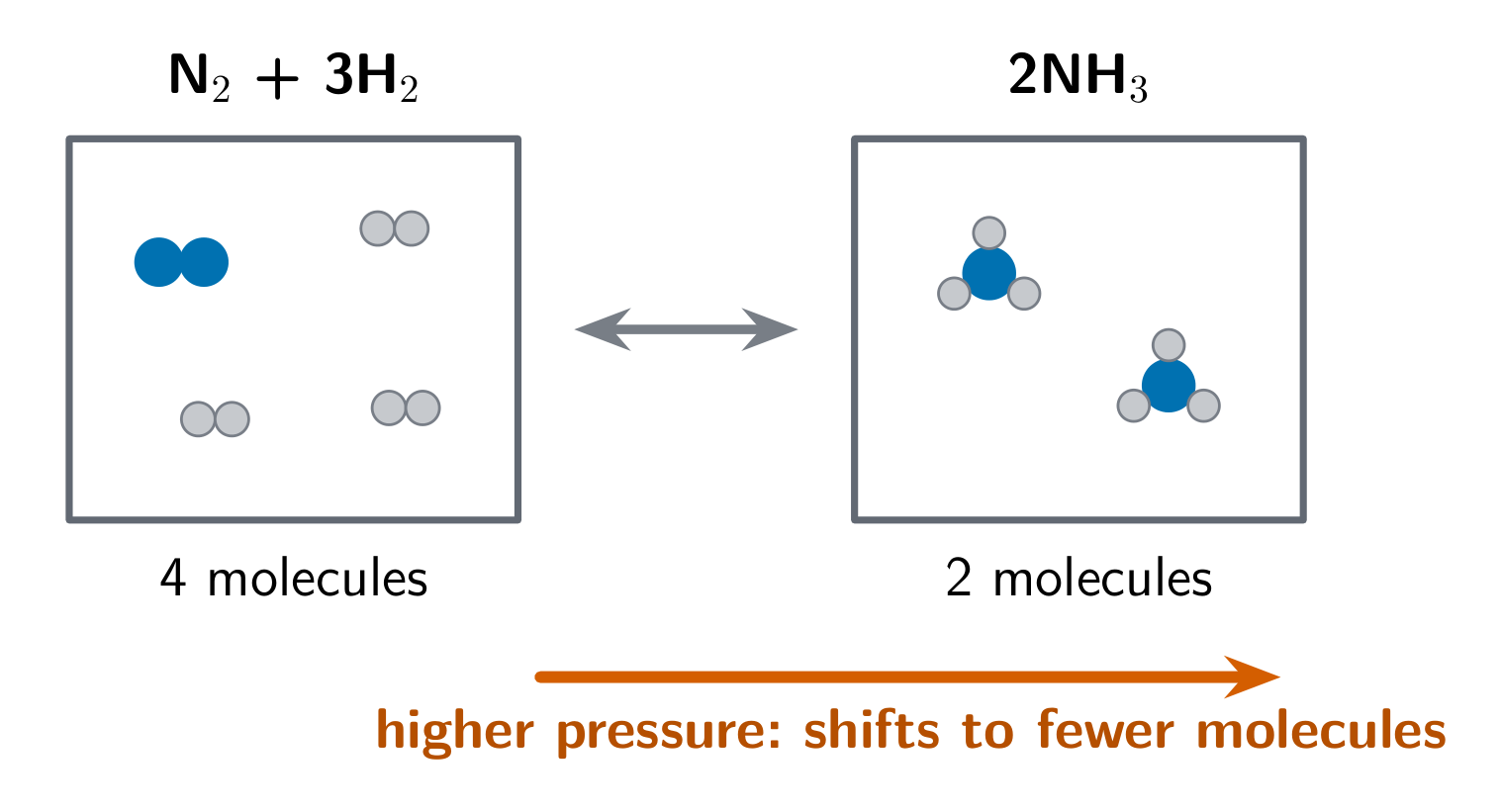
- The Haber process runs at about 200 times normal atmospheric pressure 压强. Building pipes that strong is expensive, so why do it?
- Because $\text{N}_2 + 3\text{H}_2 \rightleftharpoons 2\text{NH}_3$ turns 4 gas molecules into 2. Pressure favours the side with fewer.
- This lesson is Higher Tier.
Why does the Haber process use high pressure?
难度 1/5 · 今日首次完成可获 100 金币及少量额外奖励
4 → 2.
Count the gas molecules
- Add the numbers in front of every gas on each side of the balanced equation.
- Haber: $1 + 3 = 4$ on the left, 2 on the right.
How many gas molecules are on the left of $\text{N}_2 + 3\text{H}_2 \rightleftharpoons 2\text{NH}_3$?
难度 2/5 · 今日首次完成可获 140 金币及少量额外奖励
$1 + 3 = 4$.
Increasing pressure
- Compression 压缩 squeezes the gases into a smaller volume, raising the pressure.
- The equilibrium shifts to the side with fewer gas molecules, which reduces the pressure.
In $\text{N}_2\text{O}_4(\text{g}) \rightleftharpoons 2\text{NO}_2(\text{g})$, what does increasing the pressure do?
难度 1/5 · 今日首次完成可获 100 金币及少量额外奖励
1 on the left vs 2 on the right.
Worked example: the contact process
$2\text{SO}_2(\text{g}) + \text{O}_2(\text{g}) \rightleftharpoons 2\text{SO}_3(\text{g})$. Predict the effect of raising the pressure.
- Left: $2 + 1 = 3$ gas molecules. Right: 2.
- Fewer on the right, so higher pressure shifts the equilibrium right.
- Result: more SO₃.
Pressure favours the side with fewer gas molecules
This reaction has fewer gas molecules on the product side, like 2SO₂ + O₂ ⇌ 2SO₃ (3 → 2). Increase the pressure and the position shifts towards the products.
For the contact process, what does decreasing the pressure do?
难度 1/5 · 今日首次完成可获 100 金币及少量额外奖励
Lower pressure favours more molecules (3).
When pressure has no effect
- If both sides have the same number of gas molecules, pressure does not shift the equilibrium.
- $\text{H}_2(\text{g}) + \text{I}_2(\text{g}) \rightleftharpoons 2\text{HI}(\text{g})$: 2 and 2, so no change.
In which reaction does pressure not affect the position of equilibrium?
难度 1/5 · 今日首次完成可获 100 金币及少量额外奖励
2 and 2.
Count only gases, using the coefficients. In $\text{CaCO}_3(\text{s}) \rightleftharpoons \text{CaO}(\text{s}) + \text{CO}_2(\text{g})$, only CO₂ counts: 0 gas molecules on the left, 1 on the right. Higher pressure shifts it left.
Solids are counted when deciding the effect of pressure.
难度 1/5 · 今日首次完成可获 100 金币及少量额外奖励
Count gases only.
Increasing the pressure shifts an equilibrium towards the side with fewer gas molecules; decreasing it shifts it towards the side with more. Count only gases, using the balancing numbers. Equal numbers on each side means pressure has no effect on the position.
Predict and explain the effect of increasing pressure on $\text{CO}(\text{g}) + 2\text{H}_2(\text{g}) \rightleftharpoons \text{CH}_3\text{OH}(\text{g})$.
Fewer molecules, less pressure.