- Atoms are the building blocks: protons and neutrons in a tiny nucleus, electrons in shells; the outer shell runs the chemistry.
- The periodic table orders elements by atomic number; groups share outer-shell electrons and so share properties.
- Group 0 is unreactive, Group 1 gets more reactive down, Group 7 less; transition metals (chemistry only) behave differently from Group 1.
原子结构与元素周期表
AQA · GCSE · 化学 · 知识点 1
1.1
Atomic structure and the periodic table: the particles and the pattern
词汇
训练
| English | 中文 | 拼音 |
|---|---|---|
| atomic number/əˈtɒmɪk ˈnʌmbə/ | 原子序数 | yuán zi xù shù |
| outer shell electron/ˈaʊtə ʃel ɪˈlektrɒn/ | 最外层电子 | zuì wài céng diàn zi |
1.1
原子、元素、化合物与混合物(4.1.1.1–4.1.1.4)
教学大纲
原子、元素、化合物和混合物(AQA 8462 陈述 4.1.1.1-4.1.1.4)。
- 区分原子、元素、化合物和混合物,并结合符号与化学式进行说明。
- 描述五种物理分离方法,并为给定混合物选择一种合适的方法。
- 回顾原子模型从实心球体到发现中子的发展历程。
- 运用质子、中子和电子的电荷与质量,结合原子序数、质量数、同位素及相对原子质量进行相关计算或说明。
- 写出前二十种元素的电子排布结构。
来源:Cambridge International 教学大纲
All substances are made of atoms 原子 — the smallest part of an element that can exist. Each element has a chemical symbol (O, Na, …); about 100 elements exist, shown in the periodic table.
Compounds 化合物 form when elements elements combine chemically in fixed proportions; they are represented by formulae and can only be separated back into elements by chemical reactions. Chemical reactions always form one or more new substances, often with a detectable energy change. Equations: word equations and symbol equations with balanced formulae; (HT) balanced half-equations and ionic equations.
Mixtures 混合物: two or more elements or compounds not chemically combined; each substance keeps its properties. Separated by physical processes only — no new substances:
- filtration 过滤 — insoluble solid from liquid;
- crystallisation 结晶 — dissolved solid from solution;
- simple distillation 蒸馏 简单蒸馏 — liquid from dissolved solid (and solvents);
- fractional distillation 分馏 — liquids with different boiling points;
- chromatography 色谱法 — soluble substances in a mixture.
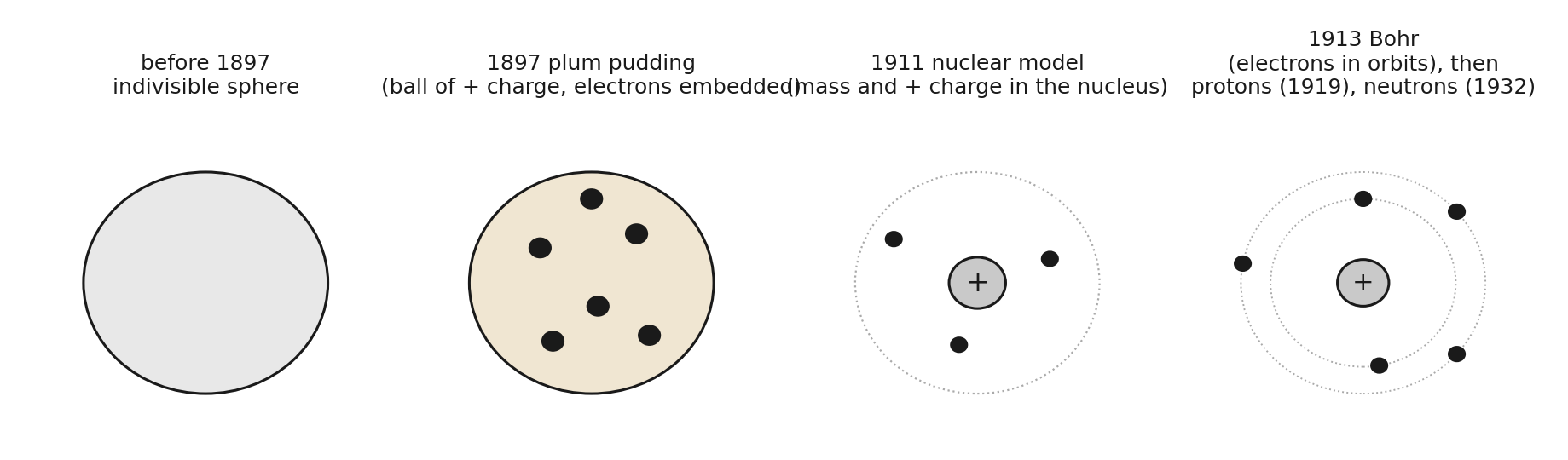
Development of the atom model: atoms were first thought to be indivisible spheres → the electron's discovery gave the plum pudding model 布丁模型 (ball of positive charge with negative electrons embedded) → the alpha-scattering experiment showed mass and positive charge concentrated in a central nucleus (nuclear model) → Bohr: electrons orbit at specific distances → protons identified in the nucleus → Chadwick: the neutron 中子. New evidence changes or replaces models.
| particle | relative mass | relative charge |
|---|---|---|
| proton | 1 | +1 |
| neutron | 1 | 0 |
| electron | very small | −1 |
In an atom protons = electrons, so no overall charge. Atomic number = protons; mass number = protons + neutrons. Atoms of the same element with different neutron numbers are isotopes 同位素. Atom radius ≈ 0.1 nm (1 × 10⁻¹⁰ m); the nucleus is less than 1/10 000 of that. Almost all mass is in the nucleus.
Relative atomic mass (Ar) averages over the isotopes' abundance — calculate it from percentage abundances. Electronic structure: electrons fill the lowest levels first — sodium is 2,8,1; represent the first twenty elements both as numbers and diagrams.
词汇
训练
| English | 中文 | 拼音 |
|---|---|---|
| atom/ˈætəm/ | 原子 | yuán zi |
| compound/ˈkɒmpaʊnd/ | 化合物 | huà hé wù |
| mixture/ˈmɪkstʃə/ | 混合物 | hùn hé wù |
| filtration/fɪlˈtreɪʃn/ | 过滤 | guò lǜ |
| crystallisation/ˌkrɪstəlaɪˈzeɪʃn/ | 结晶 | jié jīng |
| distillation/dɪstɪˈleɪʃn/ | 蒸馏 | zhēng liú |
| chromatography/krəʊməˈtɒɡrəfi/ | 色谱法 | sè pǔ fǎ |
| plum pudding model/plʌm ˈpʊdɪŋ ˈmɒdl/ | 布丁模型 | bù dīng mó xíng |
| neutron/ˈnjuːtrɒn/ | 中子 | zhōng zǐ |
| isotope/ˈaɪsətəʊp/ | 同位素 | tóng wèi sù |
| simple distillation/ˈsɪmpl dɪstɪˈleɪʃn/ | 简单蒸馏 | jiǎn dān zhēng liú |
| fractional distillation/ˈfrækʃənl dɪstɪˈleɪʃn/ | 分馏 | fēn liú |
1.2
元素周期表(4.1.2.1–4.1.2.3)
教学大纲
元素周期表(AQA 8462 陈述 4.1.2)。
- 阐述族、周期与最外层电子数及原子序数之间的关系。
- 描述元素周期表的发展过程,包括门捷列夫留下的空缺及其对同位素的解释。
- 根据在周期表中的位置及性质区分金属与非金属。
- 陈述并解释第0、1和7族元素的趋势,包括置换反应。
来源:Cambridge International 教学大纲
The table orders elements by atomic (proton) number 原子序数, so that elements with similar properties fall in groups (columns). Same group = same number of outer-shell electrons 最外层电子 = similar chemical properties. Explain an element's position from its electronic structure; predict probable reactivity from position.
Development: early tables ordered by atomic weight — incomplete, with some elements misplaced. Mendeleev left gaps for undiscovered elements and sometimes changed the order; his predicted elements were found, supporting his table. Isotopes later explained why atomic-weight order was sometimes wrong.
Metals and non-metals: metals form positive ions; non-metals do not. Metals sit left and lower; non-metals right and upper. Know the characteristic physical and chemical differences, and link atomic structure to position.
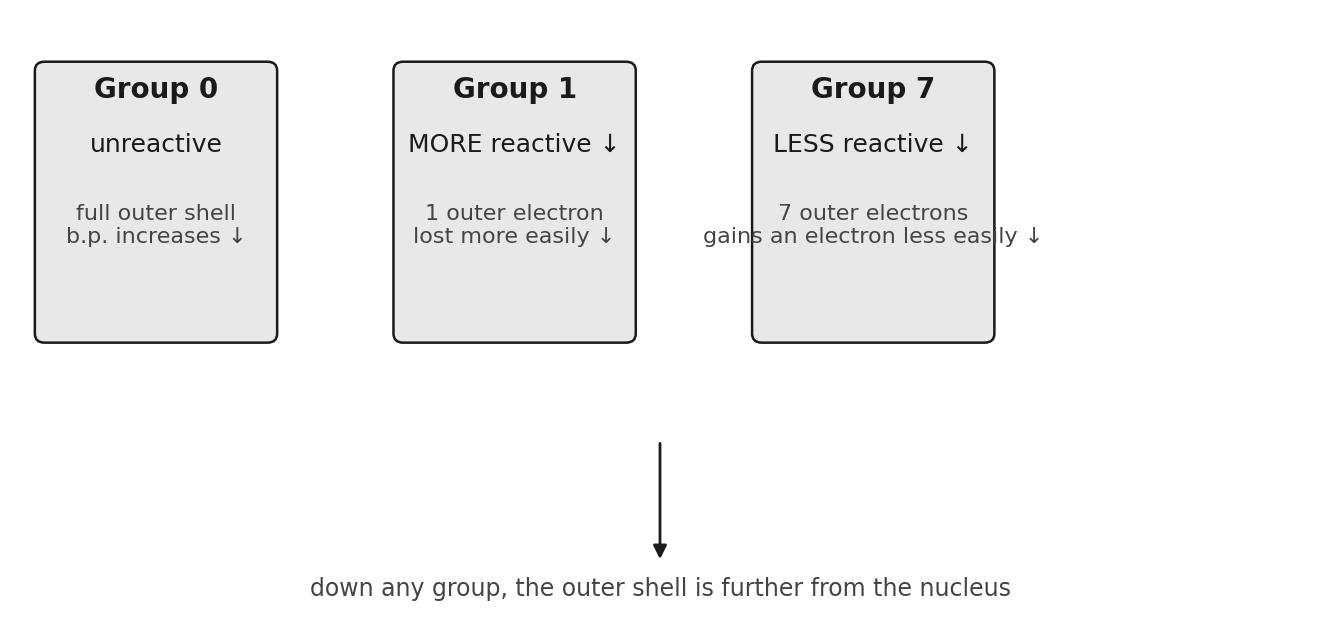
Group 0 — noble gases: unreactive — stable outer-shell arrangements (8 outer electrons; helium 2), so they do not easily form molecules. Boiling points increase down the group (with relative atomic mass).
Group 1 — alkali metals: one outer electron. Reactions of Li, Na, K with oxygen, chlorine and water (e.g. 2 Na + 2 H₂O → 2 NaOH + H₂). Reactivity increases down the group — the outer electron is lost more easily further from the nucleus.
Group 7 — halogens: seven outer electrons; non-metals, diatomic molecules (Cl₂, Br₂, I₂). Reactivity decreases down the group; melting and boiling points increase. A more reactive halogen displaces 置换 a less reactive one from a salt solution (chlorine displaces bromine from potassium bromide).
1.3
过渡金属 — 仅限化学(4.1.3)
教学大纲
过渡金属,仅限化学内容(AQA 8462 陈述 4.1.3)。
- 比较过渡元素与第1族元素在熔点、密度、强度、硬度和反应性方面的差异。
- 描述具有不同电荷的离子、有色化合物及催化作用,并列举具体实例。
来源:Cambridge International 教学大纲
Compared with Group 1, the transition elements (exemplify with Cr, Mn, Fe, Co, Ni, Cu) have higher melting points, densities, strength and hardness, and are less reactive with oxygen, water and halogens.
Typical properties: ions with different charges (Fe²⁺/Fe³⁺), coloured compounds, and use as catalysts 催化剂 (iron in the Haber process).
词汇
训练
| English | 中文 | 拼音 |
|---|---|---|
| catalyst/ˈkætəlɪst/ | 催化剂 | cuī huà jì |
1.3
Checklist before you call this topic done
- p/n/e table, atomic and mass numbers, isotopes, Ar from abundance, 2,8,x structures for the first 20.
- The atom-model timeline: sphere → plum pudding → nuclear → Bohr → proton → neutron.
- Five separation methods each matched to a mixture; Mendeleev's gaps and the isotope explanation.
- Group 0/1/7 trends with electron explanations; halogen displacement equations.
- (Chem) transition metals vs Group 1: four differences plus ions, colours, catalysts.
词汇
训练
| English | 中文 | 拼音 |
|---|---|---|
| displacement/dɪˈspleɪsmənt/ | 置换 | zhì huàn |
该知识点的互动课程
逐步完成,配合即时检查练习。
- 碰撞理论:浓度与反应气体的压强
- 温度与固体颗粒大小:解释两种不同的速率效应
- 催化剂:降低能垒,但总能量变化保持不变
- 可逆反应:生成物可以重新形成反应物
- 逆反应:能量转移方向相反
- 动态平衡:正逆反应速率相等,反应仍在持续进行
- 高阶内容:预测平衡受扰后的响应
- 高阶内容:添加反应物或移除生成物
- 高阶:升温有利于吸热方向
- 高阶:在预测移动方向前,先计算气态物质的化学计量系数之和
- 原油:一种有限的混合物,而非单一化合物
- 烷烃:将化学式与显示的键连接起来
- 分馏:通过蒸发和冷凝进行分离
- 烃的大小:沸点、粘度和可燃性
- 完全燃烧:烃燃烧时原子守恒
- 裂化:化学变化生成有用的小分子
- 纯化学知识:识别前四种烯烃
- 纯化学:氢加成与烯烃燃烧
- 纯化学:氯、溴和碘的加成反应
- 纯化学:水蒸气加成生成醇
- 纯化学:醇的结构、名称及用途
- 化学专用:低级醇类的四个观察现象
- 化学专用:酵母发酵产生水溶液状态的乙醇
- 化学专用:识别酸并解释碳酸盐的观察现象
- 化学专用:酸与醇反应生成酯
- Higher Tier: carboxylic acids are only partially ionised
- 化学专项:烯烃转化为加成聚合物
- 化学专项:绘制重复单元时需保留侧基
- 高阶内容:两端官能团的单体可形成聚酯
- 高级层:氨基酸连接形成多肽链
- 化学专项:DNA由核苷酸单体构成
- 化学专项:将天然聚合物与其单体进行匹配
- 化学纯度:利用熔点和沸点证据进行判断
- 配方:每种测量组分都有其特定用途
- 色谱法:相、斑点位置和 Rf 值
- 必做实验 6:分离并鉴定真实食品色素
- 气体鉴别:氢气会产生爆鸣声
- 气体鉴别:氧气能使带火星的火柴复燃
- 气体鉴别:二氧化碳使澄清石灰水变浑浊
- 气体鉴别:氯气能使湿润的石蕊试纸褪色
- 纯化学知识:通过焰色反应鉴定五种金属离子
- 必做实验 7:在一个实际的未知盐中同时鉴定两种离子
- 纯化学知识:通过颜色和过量碱液鉴定金属氢氧化物
- 纯化学知识:配平不溶性氢氧化物生成的方程式
- 仅化学内容:通过其产生的二氧化碳来鉴定碳酸盐
- 仅化学内容:酸化硝酸银可区分三种卤化物
- 仅化学内容:氯化钡经酸化后可检测硫酸根
- 仅化学内容:仪器的准确性、灵敏度和速度
- Chemistry-only: match emission lines and use calibration data