- Exothermic 放热 reactions give energy out — the surroundings warm; endothermic 吸热 reactions take it in — they cool.
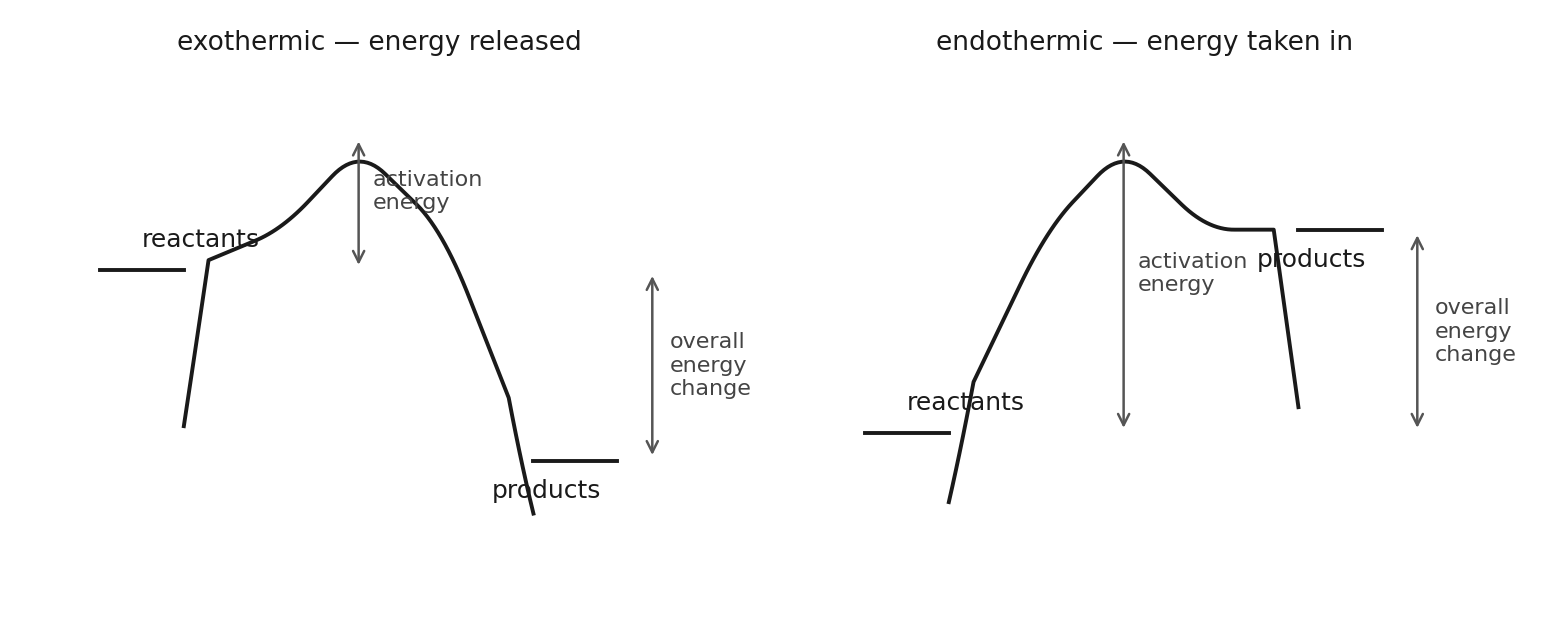
- Reaction profile 反应能量图s show the activation energy 活化能 and the overall change; (HT) bond energies add up the same story.
- Chemical cells and fuel cell 燃料电池s (chemistry only) turn reaction energy into electricity.
能量变化
AQA · GCSE · 化学 · 知识点 5
5.1
Energy changes: reactions that heat and reactions that cool
词汇
训练
| English | 中文 | 拼音 |
|---|---|---|
| exothermic/eɡzəˈðɜːmɪk/ | 放热 | fàng rè |
| endothermic/ˌendəʊˈθɜːmɪk/ | 吸热 | xī rè |
| activation energy/ˌæktɪˈveɪʃn ˈenədʒi/ | 活化能 | huó huà néng |
| reaction profile/rɪˈækʃn ˈprəʊfaɪl/ | 反应能量图 | fǎn yìng néng liàng tú |
| fuel cell/ˈfjuːəl sel/ | 燃料电池 | rán liào diàn chí |
5.1
放热与吸热反应(4.5.1.1–4.5.1.3)
教学大纲
放热反应与吸热反应(AQA 8462 陈述 4.5.1.1-4.5.1.3)。
- 根据温度变化定义放热反应和吸热反应,并举例说明其应用。
- 绘制并解读包含活化能和总能量变化的反应进程图。
- (高中)利用键能计算总能量变化,并解释两类反应之间的差异。
来源:Cambridge International 教学大纲
Energy is conserved: energy transferred to the surroundings comes off the products' store. An exothermic reaction transfers energy out — the surroundings' temperature rises (combustion, many oxidations, neutralisation; uses: hand warmers, self-heating cans). An endothermic reaction takes energy in — the temperature falls (thermal decomposition, citric acid + sodium hydrogencarbonate; uses: sports injury packs). Judge each from the temperature change of the surroundings; ΔH calculations are not required.
Reaction profiles: reactions need colliding particles with at least the activation energy. Draw and read energy-level diagrams — relative energies of reactants and products, the activation energy arrow from the reactants' level, the overall energy change, curved line between. Exothermic: products below reactants; endothermic: products above.
(HT) Bond energies 键能: energy is supplied to break reactant bonds and released when product bonds form:
- exothermic — forming releases more than breaking costs;
- endothermic — breaking costs more than forming releases.
Overall change = Σ(bond energies broken) − Σ(bond energies formed). A catalyst lowers the activation energy — it does not change the overall energy change.
RP4: investigate the variables affecting temperature changes in reacting solutions (e.g. volume/concentration) — plan variables, measure ΔT, plot, conclude.
5.2
化学电池与燃料电池——仅限化学(4.5.2)
教学大纲
化学电池与燃料电池,仅涉及化学原理(AQA 8462 陈述 4.5.2)。
- 解释电池如何产生电能以及电压取决于哪些因素。
- 比较不可充电电池与可充电电池的特点。
- 描述氢燃料电池及其(高级水平)电极半反应方程式,并将其与可充电电池进行比较。
来源:Cambridge International 教学大纲
Cells contain chemicals that react to produce electricity. The voltage depends on the type of electrode and electrolyte; a simple cell is two different metals in an electrolyte — the more reactive metal produces the higher voltage (it releases electrons more readily). Batteries = cells in series for greater voltage.
Non-rechargeable 可充电 (alkaline) cells stop when a reactant runs out; rechargeable cells reverse their reactions when an external current is supplied.
Fuel cells: fuel (e.g. hydrogen) + oxygen supplied continuously; the fuel is oxidised electrochemically to give a potential difference. Overall: hydrogen → water. Evaluate against rechargeable batteries: no pollutants at point of use, continuous refuel; but hydrogen storage, production and cost weigh against. (HT) half-equations for the hydrogen fuel cell:
- negative electrode: 2 H₂ → 4 H⁺ + 4e⁻ (or 2 H₂ + 4 OH⁻ → 4 H₂O + 4e⁻)
- positive electrode: O₂ + 4 H⁺ + 4e⁻ → 2 H₂O (or O₂ + 2 H₂O + 4e⁻ → 4 OH⁻)
词汇
训练
| English | 中文 | 拼音 |
|---|---|---|
| rechargeable/rɪˈtʃɑːdʒəbl/ | 可充电 | kě chōng diàn |
5.2
Checklist before you call this topic done
- Define exo/endo from temperature change, with two examples and two uses each.
- Draw both reaction profiles with activation energy and overall change labelled.
- (HT) Bond-energy sums both ways round; catalyst effect on the profile.
- (Chem) Cell voltage factors; rechargeable vs non-rechargeable; fuel cell equations and evaluation.
词汇
训练
| English | 中文 | 拼音 |
|---|---|---|
| bond energy/bɒnd ˈenədʒi/ | 键能 | jiàn néng |