Graphs of Polar Functions · 极坐标函数的图像
| English | 中文 | Pinyin · 拼音 |
|---|---|---|
| polar function/ˈpəʊlə ˈfʌŋkʃn/ | 极坐标函数 | jí zuò biāo hán shù |
| rose/rəʊz/ | 玫瑰线 | méi guī xiàn |
| cardioid/ˈkɑːdɪəʊɪd/ | 心形线 | xīn xíng xiàn |
| polar coordinates/ˈpəʊlə kəʊˈɔːdɪnəts/ | 极坐标 | jí zuò biāo |
Curves that bloom
- In rectangular graphs, $y$ depends on $x$. In polar graphs, the radius depends on the angle.
- As the angle sweeps around, the radius grows and shrinks, tracing surprising shapes.
- Flowers, hearts, and spirals all appear from simple polar rules.
- These curves are hard to write with $x$ and $y$, but easy with $r$ and $\theta$.
会绽放的曲线
- 在直角坐标图里,$y$ 依赖于 $x$。在极坐标图里,半径依赖于角。
- 当角扫一圈时,半径时大时小,描出令人惊讶的形状。
- 花朵、爱心和螺线,都从简单的极坐标规则中出现。
- 这些曲线用 $x$ 和 $y$ 很难写,用 $r$ 和 $\theta$ 却很容易。
What a polar function is
- A polar function 极坐标函数 has the form $r = f(\theta)$: a radius for each angle.
- To plot it, sweep $\theta$ around and mark the point at distance $r$ in that direction.
- Where $r$ is large the curve reaches far out; where $r = 0$ it touches the origin.
- The whole graph is built one angle at a time.
什么是极坐标函数
- 极坐标函数(polar function)形如 $r = f(\theta)$:为每个角给出一个半径。
- 要画它,让 $\theta$ 扫一圈,在那个方向距离 $r$ 处标一个点。
- $r$ 大的地方曲线伸得远;$r = 0$ 的地方它触到原点。
- 整条图像是一个角一个角地搭起来的。
A polar function $r = f(\theta)$ gives, for each angle, the… · 极坐标函数 $r = f(\theta)$ 为每个角给出……
A polar function outputs a radius for each input angle; plotting $(f(\theta), \theta)$ traces the curve. · 极坐标函数为每个输入角输出一个半径;画出 $(f(\theta), \theta)$ 就描出曲线。
The simple polar equation $r = 3$ (constant) is a circle. · 简单的极坐标方程 $r = 3$(常数)是一个圆。
A constant radius at every angle traces a circle of that radius around the origin. · 在每个角都是恒定半径,就描出以原点为中心、该半径的圆。
Roses and other shapes
- $r = a\sin(k\theta)$ or $a\cos(k\theta)$ traces a rose 玫瑰线 — a flower of petals.
- With $k$ odd there are $k$ petals; with $k$ even there are $2k$.
- $r = a(1 + \sin\theta)$ traces a heart-shaped cardioid 心形线.
- A constant $r = a$ is simply a circle of radius $a$.
玫瑰线和其他形状
- $r = a\sin(k\theta)$ 或 $a\cos(k\theta)$ 描出一条玫瑰线(rose)——一朵有花瓣的花。
- 当 $k$ 为奇数,有 $k$ 瓣;当 $k$ 为偶数,有 $2k$ 瓣。
- $r = a(1 + \sin\theta)$ 描出一条心形的心形线(cardioid)。
- 恒定的 $r = a$ 就是一个半径为 $a$ 的圆。
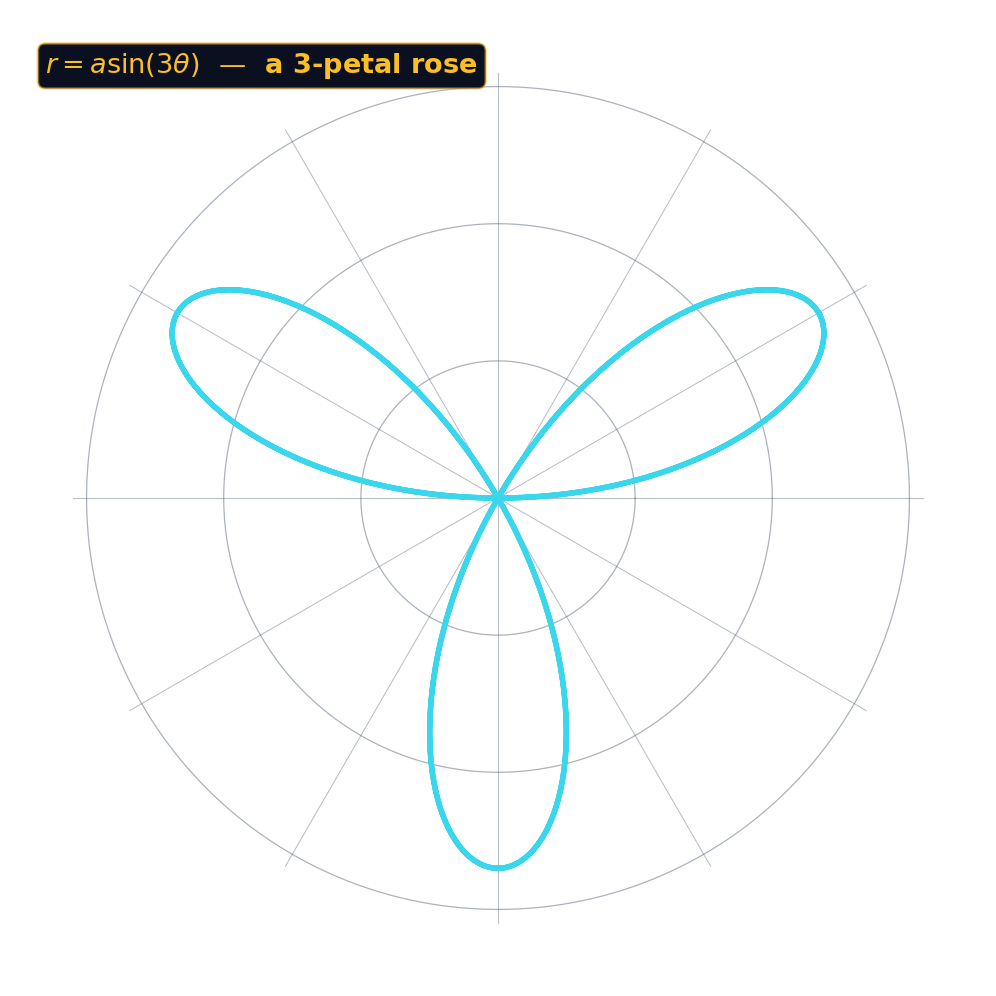
Draw a polar curve petal by petal · 一瓣一瓣地画一条极坐标曲线
A polar function sets r for each angle theta. Sweep theta around and the radius traces a rose, circle, or spiral. · 极坐标函数为每个角 theta 设定 r。让 theta 扫一圈,半径就画出玫瑰线、圆或螺线。
The curve $r = a\sin(3\theta)$ is a rose with how many petals? · 曲线 $r = a\sin(3\theta)$ 是一个有多少瓣的玫瑰线?
For · 支持 $r = a\sin(k\theta)$ with $k$ odd, the rose has exactly $k$ petals — here $3$. · 对 $r = a\sin(k\theta)$,当 $k$ 为奇数,玫瑰线恰好有 $k$ 瓣——这里是 $3$。
The heart-shaped polar curve $r = 1 + \sin\theta$ is called a . · 心形的极坐标曲线 $r = 1 + \sin\theta$ 叫做。
A cardioid ("heart-shaped") is a classic polar curve of the form $r = a(1 + \sin\theta)$. · 心形线("心形的")是一条经典的极坐标曲线,形如 $r = a(1 + \sin\theta)$。
Select all · 所有 true statements about polar graphs. · 选出关于极坐标图像的所有正确说法。
Polar graphs include circles, roses, cardioids, and spirals — rarely straight lines. The other three are correct. · 极坐标图像包括圆、玫瑰线、心形线和螺线——很少是直线。其余三条正确。
Plotting point by point
- Make a table: choose angles, compute $r$ at each, and mark the points.
- Watch for where $r = 0$ (the curve passes through the origin) and where $r$ peaks.
- Join the points smoothly in order of increasing $\theta$.
- The pattern usually repeats after one full turn (or half, for even roses).
一点一点地画
- 列一张表:选一些角,在每个角算出 $r$,标出这些点。
- 留意 $r = 0$ 的地方(曲线经过原点)和 $r$ 达到峰值的地方。
- 按 $\theta$ 递增的顺序,把这些点平滑地连起来。
- 模式通常在转一整圈后重复(偶数瓣的玫瑰线则是半圈)。
Symmetry helps
- Many polar curves are symmetric about an axis, which halves the plotting work.
- A $\sin$ curve is often symmetric about the vertical axis; a $\cos$ curve about the horizontal.
- Spotting the symmetry lets you sketch one part and mirror the rest.
- Converting back to polar coordinates 极坐标 confirms exactly where each feature sits.
对称性有帮助
- 许多极坐标曲线关于某条轴对称,这能把画图工作量减半。
- $\sin$ 曲线常关于竖直轴对称;$\cos$ 曲线常关于水平轴对称。
- 认出对称性,你就能画出一部分再镜像出其余的。
- 转回极坐标(polar coordinates)能精确确认每个特征的位置。
Do not read a polar graph like a rectangular one. A "loop" back to the origin means $r$ passed through $0$, not that the function is undefined. And a single point can be reached at several different angles, so the same curve may be traced more than once.
不要像读直角坐标图那样读极坐标图。一个"回环"回到原点意味着 $r$ 经过了 $0$,而不是函数无定义。而且同一个点可以在好几个不同的角处到达,所以同一条曲线可能被描不止一次。
Sketch $r = 2\cos\theta$ over $0 \le \theta \le \pi$.
- At $\theta = 0$: $r = 2$ (a point $2$ units right).
- At $\theta = \tfrac{\pi}{2}$: $r = 0$ (the origin).
- The points trace a circle of diameter $2$ sitting to the right of the origin.
在 $0 \le \theta \le \pi$ 上画 $r = 2\cos\theta$。
- 在 $\theta = 0$:$r = 2$(一个在右边 $2$ 个单位的点)。
- 在 $\theta = \tfrac{\pi}{2}$:$r = 0$(原点)。
- 这些点描出一个直径为 $2$、位于原点右侧的圆。
A polar function $r = f(\theta)$ gives a radius for each angle. Sweeping $\theta$ traces circles, roses ($r = a\sin k\theta$), cardioids ($r = a(1+\sin\theta)$), and spirals. Plot point by point using polar coordinates, and use symmetry to speed up the sketch.
极坐标函数 $r = f(\theta)$ 为每个角给出一个半径。扫过 $\theta$ 描出圆、玫瑰线($r = a\sin k\theta$)、心形线($r = a(1+\sin\theta)$)和螺线。用极坐标一点一点地画,并利用对称性加快作图。