| English | 释义 | 拼音 |
|---|---|---|
| exponential/ˌekspəˈnenʃl/ | 指数 | zhǐ shù |
| logarithm/ˈlɒɡərɪθəm/ | 对数 | duì shù |
| base/beɪs/ | 底数 | dǐ shù |
| common log/ˈkɒmən lɒɡ/ | 常用对数 | cháng yòng duì shù |
| natural log/ˈnætʃərəl lɒɡ/ | 自然对数 | zì rán duì shù |
| logarithmic scale/ˌlɒɡəˈrɪθmɪk skeɪl/ | 对数刻度 | duì shù kè dù |
Find the time needed for growth
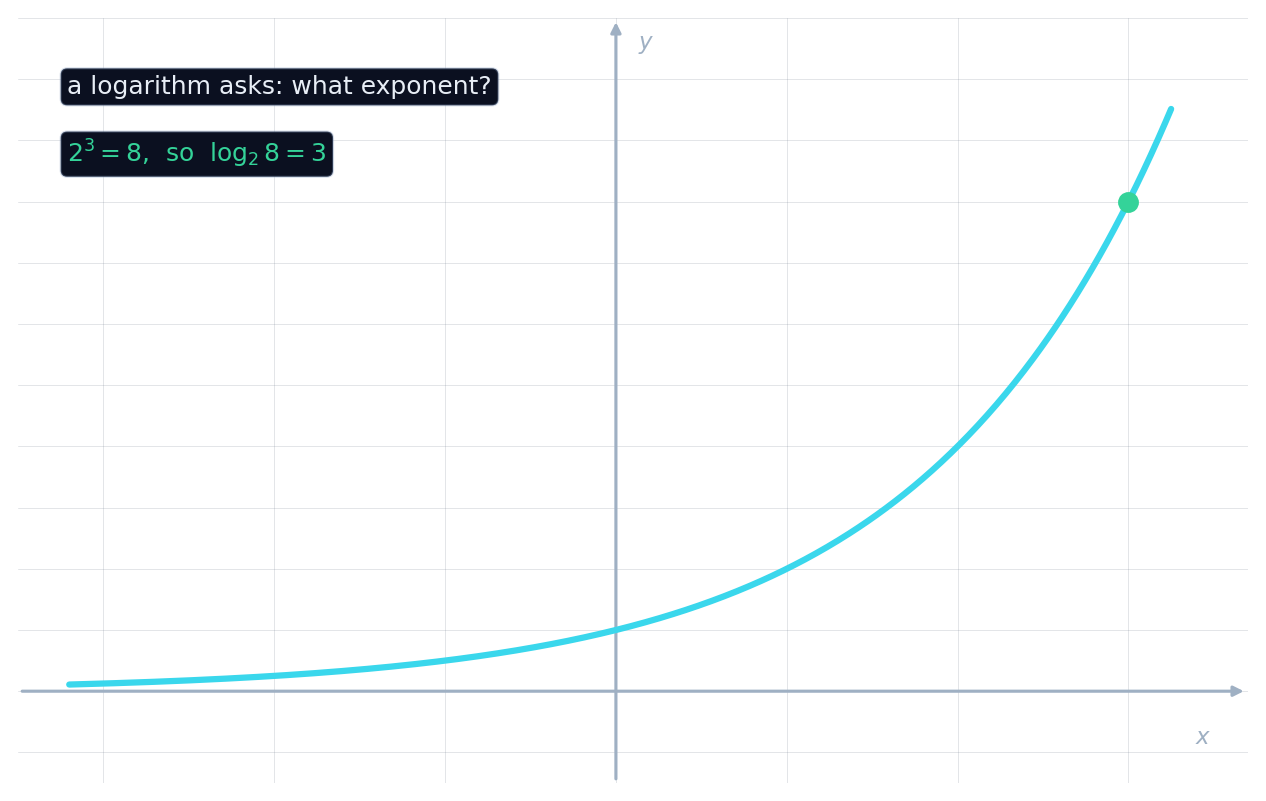
- A culture starts with 100 cells and doubles every hour. In the exponential 指数 model $N(t)=100\cdot2^t$, reaching 800 cells means solving $2^t=8$: the time is 3 hours.
- A logarithm 对数 asks for that exponent: $t=\log_2 8$. If the target is 300 cells instead, $2^t=3$ still has an answer, but it is not a whole number. The model assumes continuous growth at this fixed rate.
Keep the base, argument and exponent in their roles
- In $\log_b y=x$, the base 底数 is $b$, the argument is $y$, and the result is the exponent $x$. It means exactly $b^x=y$.
- Thus $\log_2 8=3$ because $2^3=8$. The logarithm is neither the argument 8 nor the product $2\times8$.
The statement $\log_b y = x$ means the same as…
难度 1/5 · 今日首次完成可获 100 金币及少量额外奖励
A logarithm is the exponent: $\log_b y = x$ asks "$b$ to what power gives $y$?", so $b^x = y$.
Evaluate $\log_2 8$.
难度 2/5 · 今日首次完成可获 140 金币及少量额外奖励
$2^3 = 8$, so the exponent is $3$: $\log_2 8 = 3$.
Convert in either direction
- Rewrite $10^3=1000$ as $\log_{10}1000=3$. In reverse, $\log_5 25=2$ says $5^2=25$. The base stays the same; the other two values exchange roles.
- To solve $2^x=16$, write $x=\log_2 16$. Since $2^4=16$, the required exponent is 4. Check by substituting into the original equation.
Check the base and the argument
- A real logarithm needs $b>0$, $b\ne1$ and $y>0$. Base 1 fails because $1^x=1$ for every $x$: it cannot recover a unique exponent. Zero and negative bases do not define the real exponential function used here for every real exponent.
- Bases between 0 and 1 are valid. For example, $\log_{1/2}8=-3$ because $(1/2)^{-3}=8$. The base need not be greater than 1.
The argument must be strictly positive, but the logarithm's result can be zero or negative. For example, $\log_2 1=0$ and $\log_2(1/8)=-3$ are defined; $\log_2 0$ and $\log_2(-8)$ are not real.
The argument (input) of a logarithm must be ____, because a positive base to any power stays positive.
难度 1/5 · 今日首次完成可获 100 金币及少量额外奖励
Since $b^x > 0$ always, no exponent can produce zero or a negative — so $\log_b y$ needs $y > 0$.
Which conditions define a valid real logarithm $\log_b y$?
难度 1/5 · 今日首次完成可获 100 金币及少量额外奖励
Positive bases below 1 are valid too. Base 1 has no unique inverse; the argument must be strictly positive.
Evaluate $\log_{1/2}8$.
难度 2/5 · 今日首次完成可获 140 金币及少量额外奖励
(1/2)⁻³=8, so the exponent is −3.
Evaluate zero, negative and fractional results
- Since $b^0=1$ and $b^1=b$, every valid base gives $\log_b1=0$ and $\log_b b=1$. Negative exponents handle reciprocals: $2^{-3}=1/8$ gives $\log_2(1/8)=-3$.
- Fractional exponents work too: $9^{1/2}=3$, so $\log_9 3=1/2$. Check the power rather than assuming a logarithm must be a positive integer.
Evaluate $\log_2(1/8)$.
难度 2/5 · 今日首次完成可获 140 金币及少量额外奖励
2⁻³=1/8. A positive argument may give a negative logarithm.
Evaluate $\log_9 3$.
难度 2/5 · 今日首次完成可获 140 金币及少量额外奖励
9^(1/2)=3, so the logarithm is 1/2.
Every defined real logarithm has a positive result.
难度 1/5 · 今日首次完成可获 100 金币及少量额外奖励
For example, log₂1=0 and log₂(1/8)=−3. Positivity is required of the argument, not of the result.
Recognise common and natural notation
- In this course, the common log 常用对数 $\log x$ has base 10, so $\log1000=3$ and $\log0.01=-2$. The natural log 自然对数 $\ln x$ has base $e\approx2.718$, so $\ln e=1$ and $\ln1=0$.
- Calculator LOG and LN buttons use these different bases. For another base, enter $\log_b y=\dfrac{\ln y}{\ln b}$, or use a dedicated base-input key. Put the complete argument inside parentheses.
The natural log $\ln$ uses which base?
难度 1/5 · 今日首次完成可获 100 金币及少量额外奖励
The natural log has base $e$; the common log ($\log$ with no base written) has base $10$.
Select 所有 true statements about logarithms.
难度 2/5 · 今日首次完成可获 140 金币及少量额外奖励
The argument of a log must be positive, so you cannot take the log of a negative. The other three are correct.
Estimate when the power is not familiar
- Since $2^1<3<2^2$, the result satisfies $1<\log_2 3<2$. A calculator gives $\dfrac{\ln3}{\ln2}\approx1.585$; the bounds provide a quick check on the answer.
- Keep extra digits during the calculation and round the final result. Checking $2^{1.585}\approx3$ confirms the estimate. In the growth model, reaching 300 cells takes about 1.585 hours, not 3 hours.
Estimate $\log_2 3$ to three decimal places.
难度 2/5 · 今日首次完成可获 140 金币及少量额外奖励
ln(3)/ln(2)≈1.585. It lies between 1 and 2 because 2<3<4.
Read equal ratios on a logarithmic scale
- On a logarithmic scale 对数刻度, equal distances represent equal multiplicative factors. With base 10, the values 1, 10, 100 and 1000 occupy equally spaced positions 0, 1, 2 and 3, because those positions are their logarithms.
- On a linear scale, equal distances represent equal differences instead. Moving from 10 to 100 and from 100 to 1000 gives the same log-scale distance, although the numerical differences are 90 and 900.
A logarithm locates a value by its exponent
Start with log₂8=3. Compare equal exponent gaps with equal value differences, including bases 10, e and 1/2.
On a base-10 logarithmic scale, what factor multiplies the value when the position increases by one unit?
难度 2/5 · 今日首次完成可获 140 金币及少量额外奖励
One exponent-position unit multiplies the value by the base, 10.
Interpret a fraction of a scale interval
- Halfway from 10 to 100 on a base-10 logarithmic scale is position $1.5$, which represents $10^{1.5}=\sqrt{1000}\approx31.623$. It is not the arithmetic midpoint 55.
- Moving two full base-10 intervals multiplies the original value by $10^2=100$. More generally, an exponent-position change $h$ multiplies the represented value by $b^h$. A scale with base between 0 and 1 has decreasing values as exponent positions increase.
Read $\log_b y$ as the exponent that makes $b^x=y$. Check $b>0$, $b\ne1$ and $y>0$ first. Use familiar powers for exact values, bounds and technology for estimates, and equal ratios to read a logarithmic scale.
What value is halfway from 10 to 100 on a base-10 logarithmic scale?
难度 1/5 · 今日首次完成可获 100 金币及少量额外奖励
The endpoint positions are 1 and 2, so the midpoint position is 1.5. Convert back with 10^1.5; an arithmetic midpoint belongs to a linear scale.
Worked AP-style questions
Multiple choice. On the Richter scale, magnitude is $M=\log_{10}(A/A_0)$, where $A$ is the measured wave amplitude. An earthquake of magnitude 7 has an amplitude how many times that of a magnitude 5 earthquake? (A) 2 (B) 1.4 (C) 20 (D) 100
Answer: D. A change of 2 in the exponent position multiplies the amplitude by $10^2=100$. A is the difference of positions, not the factor; C multiplies the difference by 10.
Free response. A bacteria population is modelled by $P(t)=200\cdot3^t$, with $t$ in days.
(A) Find the time when $P(t)=5400$. $200\cdot3^t=5400$ gives $3^t=27$, so $t=\log_3 27=3$ days.
(B) Find the time when $P(t)=1000$, as a logarithm and as a decimal. $3^t=5$, so $t=\log_3 5=\dfrac{\ln5}{\ln3}\approx1.465$ days. Check: $1<1.465<2$ because $3<5<9$.
- Why it scores: each answer first isolates the power ($3^t=\ldots$), then rewrites it as a logarithm with the same base, and gives units. Dividing 5400 by 3 instead of by 200 is the most common error.
A model is $N(t)=50\cdot2^t$. Find $t$ when $N(t)=1600$.
难度 2/5 · 今日首次完成可获 140 金币及少量额外奖励
$2^t=1600/50=32$, so $t=\log_2 32=5$.
Solve $4\cdot10^x=60$. Give $x$ to 3 decimal places.
难度 2/5 · 今日首次完成可获 140 金币及少量额外奖励
$10^x=15$, so $x=\log 15\approx1.176$. Check: $10^1<15<10^2$, so $x$ is between 1 and 2.
Explain the exponent that works
- Evaluate $\log_3 81$ and justify the result with an exponential statement.
- Compare it with $\log_3(1/81)$, and explain why a negative result is allowed even though a negative argument is not.
Evaluate $\log_3 81$ and $\log_3(1/81)$. Justify each with an exponential statement. Why can the second result be negative?
3 to the fourth power is 81.
What is log base 3 of 81?
难度 1/5 · 今日首次完成可获 100 金币及少量额外奖励
The exponent is 4. Other options — 3 (the lesson value of log base 2 of 8); 81 (the input of the log).