| English | 释义 | 拼音 |
|---|---|---|
| period/ˈpɪərɪəd/ | 周期 | zhōu qī |
| frequency/ˈfriːkwənsi/ | 频率 | pín lǜ |
| angular frequency/ˈæŋɡjʊlə ˈfriːkwənsi/ | 角频率 | jiǎo pín lǜ |
Counting the beats
- A metronome ticks at a steady rate you can count.
- A heavy mass on a soft spring bobs slowly; a stiff spring snaps back quickly.
- Each oscillator has its own natural rhythm.
- Two simple formulas predict exactly how fast each one repeats.
Period, frequency, and omega
- The period 周期 $T$ is the time for one full cycle.
- The frequency 频率 $f = 1/T$ counts cycles per second.
- The angular frequency 角频率 is $\omega = 2\pi f = \dfrac{2\pi}{T}$.
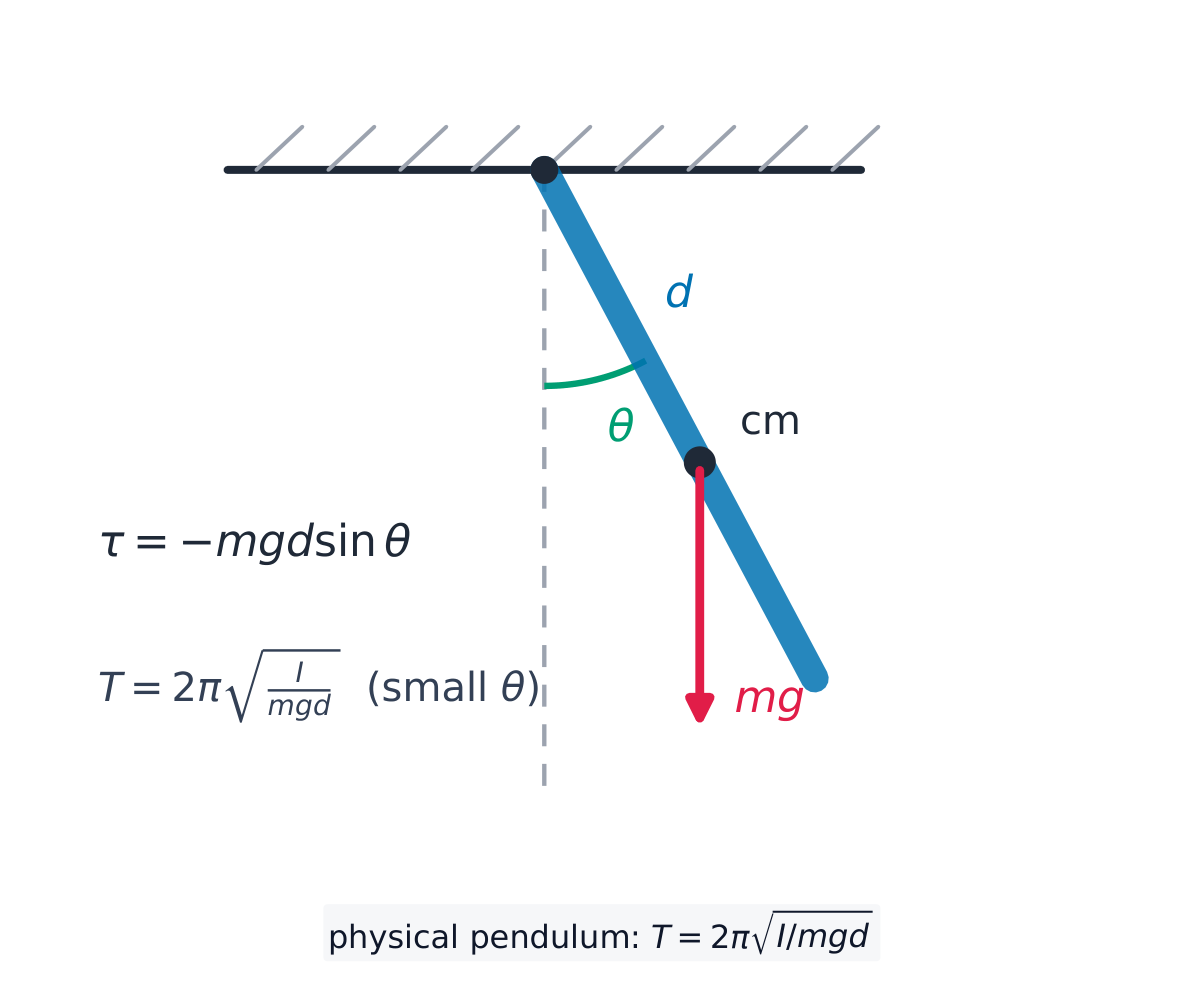
A physical pendulum: T = 2π√(I/mgd) for small angles
An oscillator has a period of $0.25\ \text{s}$. Its frequency (in Hz)?
难度 2/5 · 今日首次完成可获 140 金币及少量额外奖励
$f = 1/T = 1/0.25 = 4\ \text{Hz}$.
A mass on a spring
- A mass $m$ on a spring of stiffness $k$ has period:
- A heavier mass swings slower (longer $T$); a stiffer spring is faster.
- It follows from $\omega = \sqrt{k/m}$.
You replace a mass-spring oscillator's mass with a heavier one. The period...
难度 1/5 · 今日首次完成可获 100 金币及少量额外奖励
$T = 2\pi\sqrt{m/k}$, so a bigger $m$ gives a longer $T$.
If you quadruple the mass on a spring, the period becomes...
难度 1/5 · 今日首次完成可获 100 金币及少量额外奖励
$T \propto \sqrt{m}$, so $\sqrt{4} = 2$ times the period.
A swinging pendulum
- A simple pendulum of length $L$ has the following small-angle period:
- A longer pendulum swings slower; stronger gravity is faster.
- Notice the mass of the bob does not appear.
What changes the period?
Sort each change by whether it changes an oscillator's period.
Making a pendulum's bob heavier (same length) changes its period.
难度 1/5 · 今日首次完成可获 100 金币及少量额外奖励
$T = 2\pi\sqrt{L/g}$ has no mass term -- the bob's mass does not matter.
A simple pendulum swings through small angles with $L = 1.0\ \text{m}$ and $g = 9.8\ \dfrac{\text{m}}{\text{s}^2}$. Find its period (in s, to 1 decimal).
难度 2/5 · 今日首次完成可获 140 金币及少量额外奖励
$T = 2\pi\sqrt{L/g} = 2\pi\sqrt{1/9.8} \approx 2.0\ \text{s}$.
A $0.2\ \text{kg}$ mass on a $k = 50\ \text{N/m}$ spring.
- Period: $T = 2\pi\sqrt{m/k} = 2\pi\sqrt{0.2/50} = 2\pi\sqrt{0.004} \approx 0.40\ \text{s}$.
- Frequency: $f = 1/T \approx 2.5\ \text{Hz}$.
For ideal SHM, a larger amplitude gives a longer period.
难度 1/5 · 今日首次完成可获 100 金币及少量额外奖励
The period is independent of amplitude -- big and small swings take the same time.
A remarkable fact — for ideal SHM the period does not depend on amplitude, so a big swing and a small swing take the same time. The pendulum formula holds only for small angles; the spring period ignores gravity and the pendulum period ignores the bob's mass. And mind the square root: quadrupling the mass only doubles the period.
The period $T$ (one cycle), frequency $f = 1/T$, and angular frequency $\omega = 2\pi/T$ describe the rhythm. A spring gives $T = 2\pi\sqrt{m/k}$; a pendulum gives $T = 2\pi\sqrt{L/g}$. For ideal SHM the period is independent of amplitude; for a pendulum this is a small-angle approximation. Each formula ignores one thing — the spring ignores gravity, the pendulum ignores the bob's mass.
Write from the data: find the frequency
- An oscillator has a period of 0.50 s.
- Find the frequency.
An oscillator has a period of 0.50 s. What is its frequency, in hertz? Does a heavier bob, at the same length, change a simple pendulum's period?
1 divided by 0.50 is 2.
An oscillator has period 0.50 s. What is its frequency?
难度 1/5 · 今日首次完成可获 100 金币及少量额外奖励
Frequency is the reciprocal of the 0.50 s period. Other options — 4 Hz (the lesson frequency); 0.50 Hz (the period used as a frequency).