| English | 释义 | 拼音 |
|---|---|---|
| rotational inertia/rəʊˈteɪʃənl ɪˈnɜːʃə/ | 转动惯量 | zhuǎn dòng guàn liàng |
| angular acceleration/ˈæŋɡjʊlə əkˌseləˈreɪʃn/ | 角加速度 | jiǎo jiā sù dù |
| Newton's second law for rotation/ˈnjuːtnz ˈsekənd lɔː fɔː rəʊˈteɪʃn/ | 转动的牛顿第二定律 | zhuǎn dòng de niú dùn dì èr dìng lǜ |
Spinning up, slowing down
- Push a merry-go-round hard and it speeds up quickly; push a heavy one with the same force and it barely responds. Stop pushing and friction at the axle slowly winds it down.
- Newton's second law for rotation 转动的牛顿第二定律 says exactly how: the angular velocity changes only when there is a net torque, and how fast it changes depends on the rotational inertia 转动惯量.
$\alpha=\tau_\text{net}/I$
- The angular acceleration 角加速度 $\alpha$ is directly proportional to the net torque and in the same direction; it is inversely proportional to $I$. If $\tau_\text{net}=0$, $\omega$ stays constant (it need not be zero).
- In calculus form, $\tau_\text{net}=I\dfrac{d\omega}{dt}$: a torque that changes with time or with $\omega$ gives a differential equation, just like $F=m\,\dfrac{dv}{dt}$.
A $12\ \text{N}\cdot\text{m}$ net torque acts on a wheel with $I=3\ \text{kg}\cdot\text{m}^2$: $\alpha=12/3=4\ \text{rad/s}^2$. Double $I$ and the same torque gives only $2\ \text{rad/s}^2$.
Newton's second law for rotation
For a rigid wheel with fixed inertia about a fixed axis, net torque is proportional to angular acceleration: torque = I times alpha.
A net torque of $8\ \text{N}\cdot\text{m}$ acts on a wheel with $I = 2\ \text{kg}\cdot\text{m}^2$. Its angular acceleration (in rad/s^2)?
难度 2/5 · 今日首次完成可获 140 金币及少量额外奖励
$\alpha = \tau/I = 8/2 = 4\ \tfrac{\text{rad}}{\text{s}^2}$.
For the same net torque, a wheel with a larger rotational inertia gets a smaller angular acceleration.
难度 1/5 · 今日首次完成可获 100 金币及少量额外奖励
$\alpha = \tau/I$, so a larger $I$ means a smaller $\alpha$ -- a gentler response.
The rotational form of Newton's second law is tau = I times ____.
难度 1/5 · 今日首次完成可获 100 金币及少量额外奖励
$\tau_{net} = I\alpha$ -- net torque equals rotational inertia times angular acceleration.
What net torque gives a $5\ \text{kg}\cdot\text{m}^2$ wheel an angular acceleration of $3\ \tfrac{\text{rad}}{\text{s}^2}$ (in N·m)?
难度 2/5 · 今日首次完成可获 140 金币及少量额外奖励
$\tau = I\alpha = 5 \times 3 = 15\ \text{N}\cdot\text{m}$.
A flywheel ($I=8.0\ \text{kg}\cdot\text{m}^2$) spins at 30 rad/s. A constant friction torque of $2.0\ \text{N}\cdot\text{m}$ acts at its axle. How long does it take to stop, in s?
难度 2/5 · 今日首次完成可获 140 金币及少量额外奖励
$\alpha=\tau/I=2.0/8.0=0.25\ \text{rad/s}^2$ (slowing). $t=\omega_0/\alpha=30/0.25=120$ s.
If the net torque on a wheel is zero, the wheel cannot be rotating.
难度 1/5 · 今日首次完成可获 100 金币及少量额外奖励
Zero net torque means zero angular acceleration, so $\omega$ is constant. The wheel can spin steadily.
Translation and rotation, side by side
| Translation | Rotation |
|---|---|
| force $F$ | torque $\tau$ |
| mass $m$ | rotational inertia $I$ |
| acceleration $a$ | angular acceleration $\alpha$ |
| $F_\text{net}=ma$ | $\tau_\text{net}=I\alpha$ |
- A rotating object may need both analyses: $F_\text{net}=ma_\text{cm}$ for its centre of mass and $\tau_\text{net}=I\alpha$ for its spin. They are separate equations, linked only by constraints such as a string that does not slip ($a=\alpha R$).
In $\tau = I\alpha$, rotational inertia $I$ plays the role of which quantity in $F = ma$?
难度 1/5 · 今日首次完成可获 100 金币及少量额外奖励
Torque ~ force, $I$ ~ mass, $\alpha$ ~ acceleration. So $I$ is the rotational mass.
Select 所有 correct analogies between $F = ma$ and $\tau = I\alpha$.
难度 2/5 · 今日首次完成可获 140 金币及少量额外奖励
Force ~ torque and mass ~ $I$; acceleration maps to angular acceleration, not torque.
Method: a block on a string around a pulley
- Draw a free-body diagram for the block and a force diagram for the pulley (the tension acts at the rim, the axle force at the centre, which gives no torque).
- Write $F=ma$ for the block, $\tau=I\alpha$ for the pulley, add the no-slip link $a=\alpha R$, and solve the three equations together.
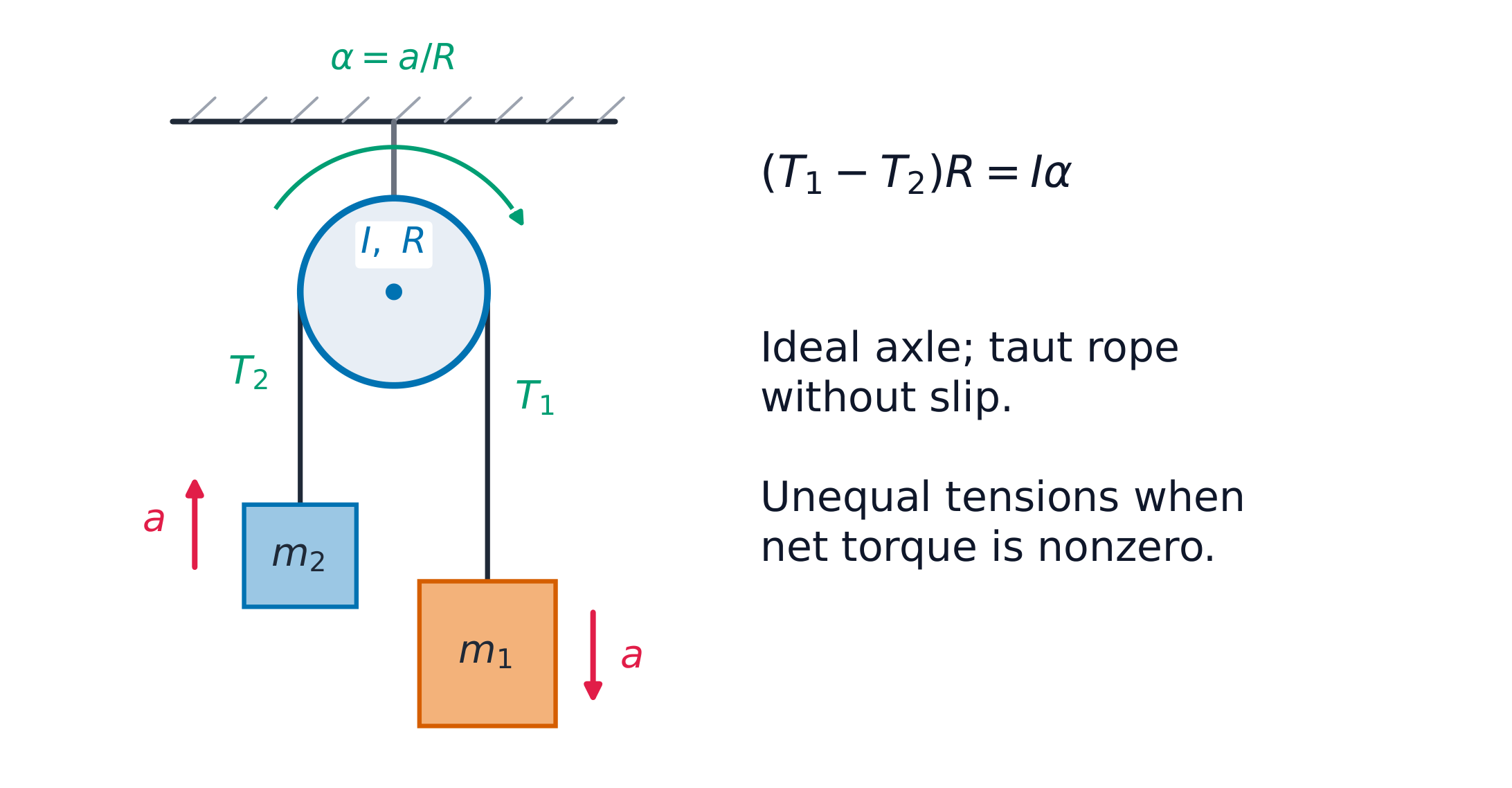
Worked FRQ: the falling block
A block of mass $m$ hangs from a light string wrapped around a solid disk pulley (mass $M$, radius $R$, $I=\tfrac12MR^2$) on a frictionless axle. The block is released from rest.
(A) Derive an expression for the block's acceleration in terms of $m$, $M$ and $g$. Line 1: the block. Lines 2–3: the pulley, with $\alpha=a/R$. Line 4: add them.
(B) Calculate $a$, $T$ and $\alpha$ for $m=2.0$ kg, $M=4.0$ kg, $R=0.10$ m. $a=\dfrac{2.0(9.8)}{2.0+2.0}=4.9\ \text{m/s}^2$; $T=\tfrac12(4.0)(4.9)=9.8$ N; $\alpha=a/R=49\ \text{rad/s}^2$.
(C) Check the answer in a limiting case. If $M\to0$, $a\to g$: a massless pulley lets the block fall freely, as expected. A heavier pulley gives a smaller $a$.
- Why it scores: separate equations for each object with consistent positive directions; the no-slip link stated; a limiting-case check of the derived expression.
A 3.0 kg block hangs from a string wrapped around a solid disk pulley ($M=2.0$ kg, $I=\tfrac12MR^2$) on a frictionless axle. Find the block's acceleration, in m/s². Use $g=9.8\ \text{m/s}^2$.
难度 2/5 · 今日首次完成可获 140 金币及少量额外奖励
$a=\dfrac{mg}{m+\tfrac12M}=\dfrac{3.0(9.8)}{3.0+1.0}=7.35\ \text{m/s}^2$.
In the falling-block system with a pulley of mass $M$, how does the string tension $T$ compare with the block's weight $mg$ while the block speeds up?
难度 1/5 · 今日首次完成可获 100 金币及少量额外奖励
For the block, $mg-T=ma$ with $a>0$, so $T<mg$. Here $T=\tfrac12Ma$.
- A pulley with mass needs different tensions on each side (or a tension less than $mg$) whenever it has angular acceleration. Equal tensions only hold for a massless pulley or $\alpha=0$.
- The axle force gives no torque about the axle, but it does appear in $F=ma$ for the pulley.
- Zero net torque means constant $\omega$, not $\omega=0$.
Angular velocity changes only when the net torque is not zero: $\alpha=\tau_\text{net}/I$, in the direction of the net torque, or $\tau_\text{net}=I\,d\omega/dt$. A rotating system may need separate linear ($F=ma$) and rotational ($\tau=I\alpha$) analyses, linked by constraints such as $a=\alpha R$.