| English | 释义 | 拼音 |
|---|---|---|
| elastic collision/ɪˈlæstɪk kəˈlɪʒn/ | 弹性碰撞 | tán xìng pèng zhuàng |
| inelastic collision/ɪnɪˈlæstɪk kəˈlɪʒn/ | 非弹性碰撞 | fēi tán xìng pèng zhuàng |
| perfectly inelastic collision/ˈpɜːfektlɪ ɪnɪˈlæstɪk kəˈlɪʒn/ | 完全非弹性碰撞 | wán quán fēi tán xìng pèng zhuàng |
| energy lost/ˈenədʒi lɒst/ | 损失的能量 | sǔn shī de néng liàng |
Pool balls versus clay
- Two pool balls click off each other and both keep rolling briskly.
- Two identical lumps of clay approach at equal speeds, smack together and stop, stuck as one.
- Both obey the same momentum law — yet feel completely different.
- The difference is what happens to the energy.
Momentum yes, energy maybe
- For the colliding objects, momentum is conserved when the net external impulse during the collision is zero or negligible.
- Kinetic energy is not always conserved — some can turn to heat, sound, or dents.
- That single difference sorts collisions into two families.
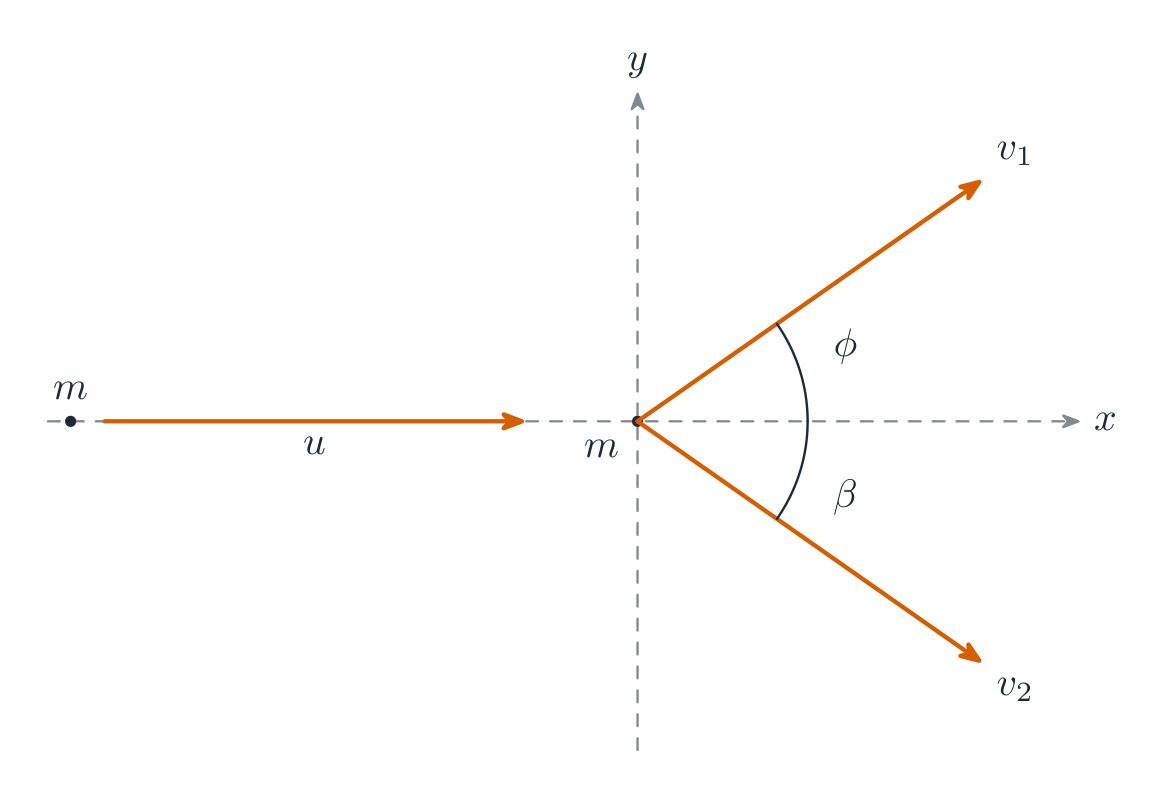
A glancing collision, resolved along two perpendicular axes
With negligible net external impulse, total momentum is conserved in a collision whether it is elastic or inelastic.
难度 1/5 · 今日首次完成可获 100 金币及少量额外奖励
Yes -- momentum is always conserved (no net external force). Only kinetic energy may or may not be.
Elastic versus inelastic
- An elastic collision 弹性碰撞 conserves kinetic energy too (ideal, like hard spheres).
- An inelastic collision 非弹性碰撞 loses some kinetic energy to other forms.
- Most real collisions are at least a little inelastic.
In which collision is kinetic energy conserved?
难度 1/5 · 今日首次完成可获 100 金币及少量额外奖励
Only an elastic collision conserves kinetic energy. Momentum, though, is conserved in all of them.
For collisions with negligible net external impulse, select all true statements.
难度 2/5 · 今日首次完成可获 140 金币及少量额外奖励
Momentum always holds; kinetic energy holds only when the collision is elastic.
Perfectly inelastic
- A perfectly inelastic collision 完全非弹性碰撞 is the extreme case: the objects stick together and move off with one common velocity.
- Momentum conservation alone gives that final velocity.
- The clay lumps are the classic example.
Elastic or inelastic?
With negligible external impulse, momentum is conserved. Sort each collision by whether kinetic energy is conserved or the objects stick together.
A $3\ \text{kg}$ cart at $4\ \tfrac{\text{m}}{\text{s}}$ sticks to a stationary $1\ \text{kg}$ cart. Their common speed afterward (in m/s)?
难度 2/5 · 今日首次完成可获 140 金币及少量额外奖励
$3(4) = (3 + 1)v_f$, so $v_f = 12/4 = 3\ \tfrac{\text{m}}{\text{s}}$.
A collision where the objects stick together is called perfectly ____.
难度 1/5 · 今日首次完成可获 100 金币及少量额外奖励
In a perfectly inelastic collision the objects move off with one common velocity.
Finding the energy lost
- Compare total kinetic energy before and after the collision.
- Any drop is the energy lost 损失的能量 — gone to heat, sound, or deformation.
- For fixed initial masses and velocities in an isolated two-object collision, this loss is largest when both end with the same velocity.
Before a collision the total KE is $20\ \text{J}$; after it is $14\ \text{J}$. How much energy was lost (in J)?
难度 2/5 · 今日首次完成可获 140 金币及少量额外奖励
Energy lost $= 20 - 14 = 6\ \text{J}$, gone to heat, sound, or deformation.
A $2\ \text{kg}$ cart at $3\ \tfrac{\text{m}}{\text{s}}$ hits and sticks to a stationary $4\ \text{kg}$ cart.
- Momentum: $2(3) = (2 + 4)v_f$, so $v_f = 1\ \tfrac{\text{m}}{\text{s}}$.
- KE before $= \tfrac{1}{2}(2)(9) = 9\ \text{J}$; after $= \tfrac{1}{2}(6)(1) = 3\ \text{J}$ — so $6\ \text{J}$ was lost to heat.
Never assume kinetic energy is conserved unless a collision is stated to be elastic. Using energy conservation on an inelastic collision gives a wrong answer — momentum is conserved for the chosen system when its net external impulse is negligible.
With negligible net external impulse, momentum is conserved in every collision; kinetic energy only in an elastic collision. An inelastic collision loses some energy; a perfectly inelastic collision (objects stick together) loses the most. Compare KE before and after to find the energy lost to heat and sound.
Write from the data given
- A 2 kg cart at 4 m/s sticks to a 2 kg cart at rest.
- Find the common speed and the kinetic energy lost.
On a frictionless horizontal track, a 2 kg cart at 4 m/s sticks to a 2 kg cart at rest. What is their common speed, and how much kinetic energy is lost?
8 divided by 4 is 2. Half of 4 times 4 is 8 J after the collision, against 16 J before.
On a frictionless horizontal track, a 2 kg cart at 4 m/s sticks to a 2 kg cart initially at rest. How much kinetic energy is lost?
难度 1/5 · 今日首次完成可获 100 金币及少量额外奖励
16 J becomes 8 J, so 8 J is lost to the sticking. Other options — 6 J (the lesson loss); 0 (because momentum is conserved).