| English | 释义 | 拼音 |
|---|---|---|
| power/ˈpaʊə/ | 功率 | gōng lǜ |
| watts/wɒts/ | 瓦特 | wǎ tè |
| average power/ˈævrɪdʒ ˈpaʊə/ | 平均功率 | píng jūn gōng lǜ |
| instantaneous power/ˌɪnstənˈteɪnɪəs ˈpaʊə/ | 瞬时功率 | shùn shí gōng lǜ |
Same job, but how fast?
- Two cranes lift the same load to the same roof — one in ten seconds, one in one.
- They do the same work, but the fast one is far more powerful.
- Power is not about how much energy, but how quickly you deliver it.
- It is the difference between a moped and a sports car.
Power
- Power 功率 is the rate of doing work:
- Measured in watts 瓦特 — one watt is one joule per second.
- Same work in less time means more power.
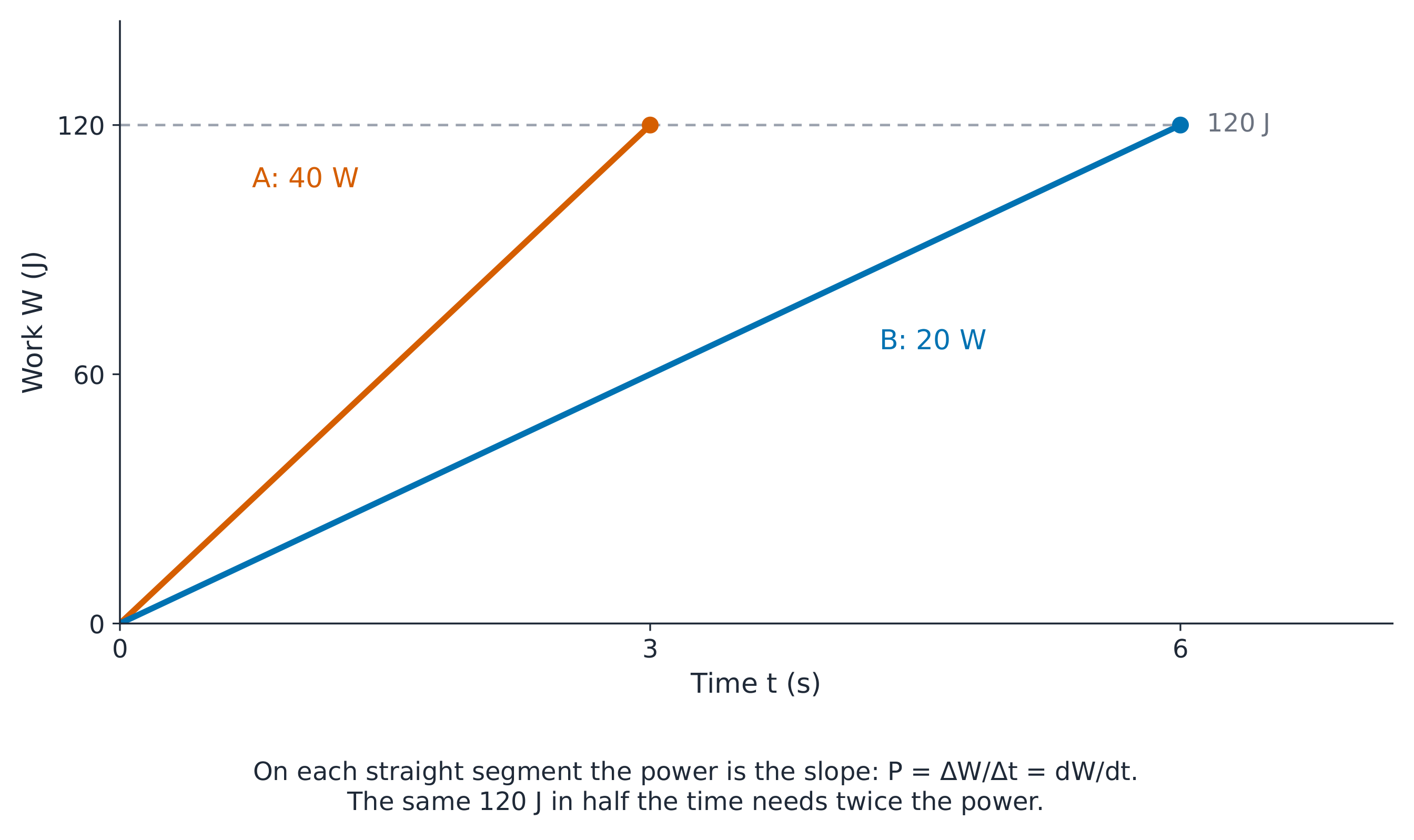
Straight work–time segments have constant power equal to slope
A machine does $600\ \text{J}$ of work in $3\ \text{s}$. What is its average power (in W)?
难度 2/5 · 今日首次完成可获 140 金币及少量额外奖励
$P = W/t = 600/3 = 200\ \text{W}$.
The SI unit of power is the ____, equal to one joule per second.
难度 1/5 · 今日首次完成可获 100 金币及少量额外奖励
One watt = one joule per second.
A stronger motor does the same $4900\ \text{J}$ of work in only $2\ \text{s}$. Its average power (in W)?
难度 2/5 · 今日首次完成可获 140 金币及少量额外奖励
$P = 4900/2 = 2450\ \text{W}$ -- same work, less time, so more power.
Average versus instantaneous
- Average power 平均功率 is the total work divided by the total time.
- Instantaneous power 瞬时功率 is the rate at one exact moment.
- When force or speed changes, the two can differ a lot.
A car engine pushes with $500\ \text{N}$ while the car moves at $20\ \tfrac{\text{m}}{\text{s}}$. Instantaneous power (in W)?
难度 2/5 · 今日首次完成可获 140 金币及少量额外奖励
$P = Fv = 500 \times 20 = 10{,}000\ \text{W}$ (10 kW).
A force acts along the velocity. With all other quantities fixed for each change, select all ways to increase its positive power.
难度 2/5 · 今日首次完成可获 140 金币及少量额外奖励
$P = Fv$, so more force or more speed raises power. Spreading work over more time lowers power.
Power from force and velocity
- At any instant, power is force times velocity:
- Push harder or move faster and you deliver more power.
- This is why cars need more engine power at high speed to overcome drag.
Power delivered
For a fixed force parallel to velocity, positive power is proportional to speed.
A more powerful motor always does more total work than a weaker one.
难度 1/5 · 今日首次完成可获 100 金币及少量额外奖励
Power is a 率. Two motors can do identical total work; the more powerful one just finishes faster.
Units and everyday sense
- One watt = one joule per second; a kilowatt is 1000 of them.
- A light bulb is tens of watts; a car engine is tens of thousands.
- Your electricity bill charges for energy (kilowatt-hours), which is power times time.
A motor lifts a $50\ \text{kg}$ load $10\ \text{m}$ in $5\ \text{s}$ ($g = 9.8$).
- Work: $W = mgh = 50 \times 9.8 \times 10 = 4900\ \text{J}$.
- Average power: $P = \dfrac{W}{t} = \dfrac{4900}{5} = 980\ \text{W}$.
More power does not mean more work or more energy — it means the same work delivered faster. A powerful and a weak motor can do identical total work; the powerful one just finishes sooner.
Power $P = dW/dt$ is how fast work is done, in watts (J/s). Average power divides total work by total time; instantaneous power is $\vec{F}\cdot\vec{v}$ at one moment. Same work in less time = more power — power is a rate, not an amount.
Write from the data: find the average power
- A motor does 120 J of work in 4 s.
- Find the average power.
A motor does 120 J of work in 4 s. What is its average power, in watts?
120 divided by 4 is 30.
A motor does 120 J of work in 4 s. What is its average power?
难度 1/5 · 今日首次完成可获 100 金币及少量额外奖励
120 joules in 4 seconds is 30 watts. Other options — 200 W (the lesson average); 120 W (the work used as a power).