| English | 释义 | 拼音 |
|---|---|---|
| mass/mæs/ | 质量 | zhì liàng |
| Newton's law of universal gravitation/ˈnjuːtnz lɔː ɒv ˌjuːnɪˈvɜːsl ˌɡrævɪˈteɪʃn/ | 万有引力定律 | wàn yǒu yǐn lì dìng lǜ |
| weight/weɪt/ | 重量 | zhòng liàng |
| gravitational field/ˌɡrævɪˈteɪʃənl fiːld/ | 引力场 | yǐn lì chǎng |
The apple and the Moon
- The same force that drops an apple also holds the Moon in its orbit.
- Newton's leap: every mass pulls on every other mass.
- The pull is usually far too weak to feel — until one of the masses is planet-sized.
- One equation covers falling apples, orbiting moons, and whole galaxies.
Universal gravitation
- Newton's law of universal gravitation 万有引力定律 gives the attraction between two point masses (or non-overlapping spherically symmetric bodies):
- It grows with the masses and falls off with the square of the distance $r$ between them.
- $G$ is the tiny universal gravitational constant.
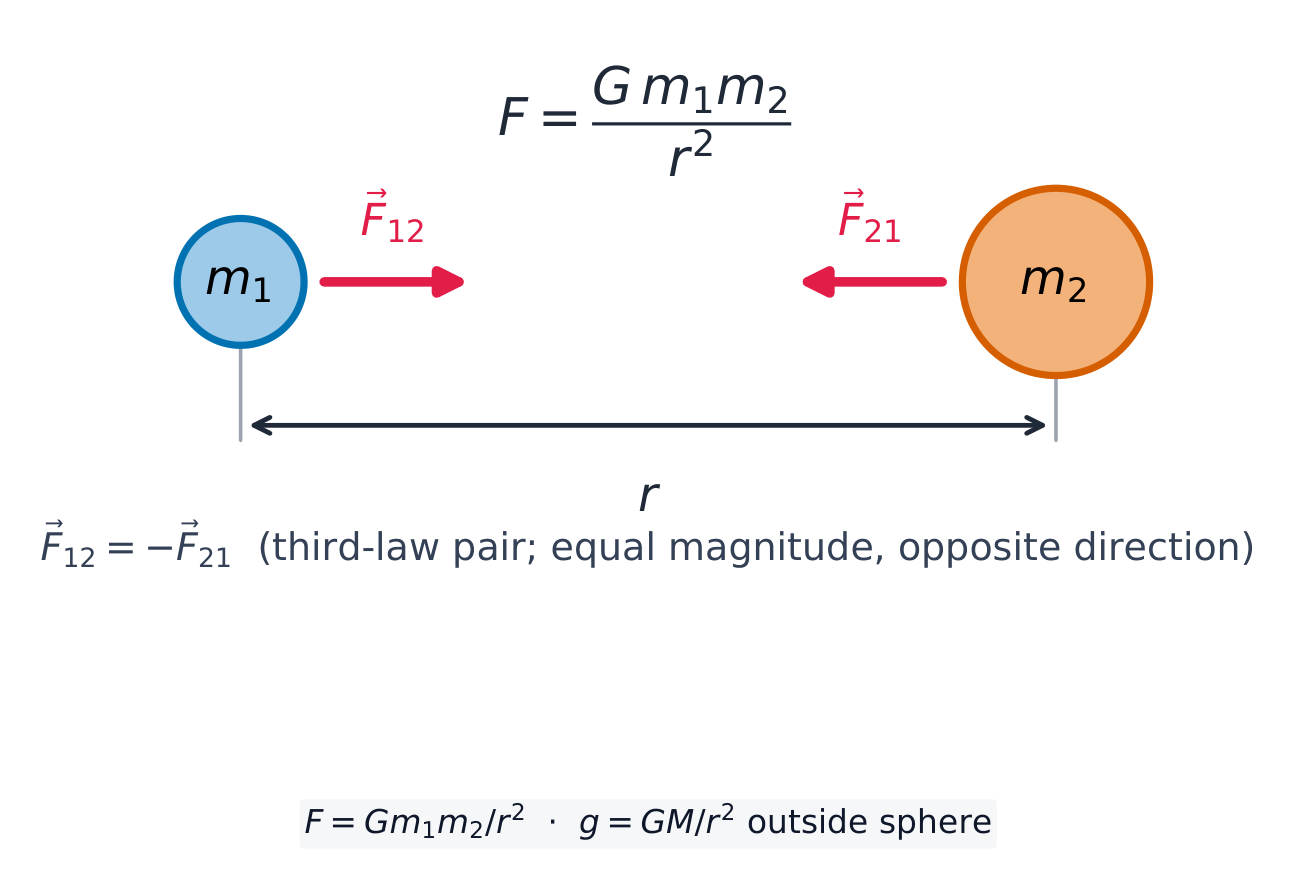
Newton's law of gravitation: equal and opposite forces that fall off as 1/r²
Select 所有 ways to increase the gravitational force between two objects.
难度 2/5 · 今日首次完成可获 140 金币及少量额外奖励
More mass or less distance both raise $F_g = Gm_1m_2/r^2$; more distance lowers it.
Mass versus weight
- Mass 质量 is how much matter an object has — the same everywhere in the universe.
- Weight 重量 is the gravitational force on that mass, $F_g = mg$ — it changes with location.
- On the Moon your mass is unchanged, but your weight is about one-sixth.
An astronaut has a mass of $70\ \text{kg}$. What is her weight on Earth (in N, use $g = 9.8$)?
难度 2/5 · 今日首次完成可获 140 金币及少量额外奖励
$F_g = mg = 70 \times 9.8 = 686\ \text{N}$.
An astronaut's mass is smaller on the Moon than on Earth.
难度 1/5 · 今日首次完成可获 100 金币及少量额外奖励
Mass is intrinsic and unchanged everywhere. It is the 重量 (about one-sixth on the Moon) that differs.
A rock weighs $60\ \text{N}$ on Earth ($g = 9.8$). What is its mass (in kg)?
难度 2/5 · 今日首次完成可获 140 金币及少量额外奖励
$m = F_g/g = 60/9.8 \approx 6.12\ \text{kg}$ -- and that mass stays the same on the Moon.
The gravitational field
- Near a planet, the gravitational field 引力场 strength is $g = \dfrac{GM}{r^2}$.
- This $g$ is exactly the one in $F_g = mg$.
- Outside a planet with a spherically symmetric mass distribution, it pulls as if all its mass sat at its center; inside, the formula needs the enclosed mass.
The gravitational field strength near a planet is $g = GM/r^{____}$.
难度 1/5 · 今日首次完成可获 100 金币及少量额外奖励
$g = GM/r^2$ -- the inverse-square law again.
It weakens with distance
- Because of the $1/r^2$, gravity drops fast as you move away.
- Double your distance from a planet's center and $g$ falls to a quarter.
- Satellites orbit far out, where the pull is gentler than at the surface.
Gravity falls off with distance
The gravitational force between two masses gets weaker as they move apart (an inverse-square law).
You move to twice your original distance from a planet's center. The gravitational force on you becomes...
难度 1/5 · 今日首次完成可获 100 金币及少量额外奖励
Gravity goes as $1/r^2$, so doubling $r$ divides the force by $2^2 = 4$.
A $10\ \text{kg}$ rock has the same mass on Earth and the Moon.
- On Earth ($g = 9.8$): weight $= mg = 98\ \text{N}$.
- On the Moon ($g = 1.6$): weight $= 16\ \text{N}$.
- Mass is fixed; only the weight changes with the local field.
Do not confuse mass and weight. A scale in kilograms reads your mass; the downward pull in newtons is your weight. An astronaut floating in orbit is weightless in feel, yet their mass — and inertia — is completely unchanged.
Universal gravitation: $F_g = \dfrac{G m_1 m_2}{r^2}$ — every mass attracts every other, falling off as $1/r^2$. Mass is intrinsic; weight $= mg$ depends on the local gravitational field $g = GM/r^2$. Move twice as far out and $g$ drops to a quarter.
Write from the data: find the weight
- A 40 kg crate is on Earth. Use g = 10.
- Also say what happens to the gravitational force if the distance from a planet's centre doubles.
A crate has mass 40 kg. Use g = 10 N/kg. What is its weight on Earth? If it is then moved to twice the distance from a planet's centre, by what factor does the gravitational force change?
40 times 10 is 400. Two squared is 4.
A crate has mass 40 kg on Earth, where g = 10 N/kg. What is its weight?
难度 1/5 · 今日首次完成可获 100 金币及少量额外奖励
Mass 40 kg times g of 10 is a weight of 400 N. Other options — 686 N (the lesson astronaut); 40 N (the mass left in newtons).