| English | 释义 | 拼音 |
|---|---|---|
| Ampère's law/ˈæmpeəz lɔː/ | 安培定律 | ān péi dìng lǜ |
| Amperian loop/æmˈpɪərɪən luːp/ | 安培环路 | ān péi huán lù |
Gauss's law has a magnetic cousin — a shortcut for B
- Adding up Biot–Savart pieces for a whole coil is hard work.
- When the field is symmetric, there is a one-line shortcut.
- Ampère's law 安培定律 links the field around a loop to the current through it.
- It plays the same role for $B$ that Gauss's law plays for $E$.
Ampère's law plays the same role for the magnetic field that ____ plays for the electric field.
难度 1/5 · 今日首次完成可获 100 金币及少量额外奖励
Both are symmetry shortcuts: Gauss for E, Ampère for B.
The law itself
- For steady currents in vacuum, around any closed loop: $\oint \vec B \cdot d\vec\ell = \mu_0 I_{\text{enc}}$.
- The left side sums the field along the loop; the right is the enclosed current.
- Count the signed net current threading a surface bounded by the loop; use the right-hand rule to link the positive current direction to traversal.
- Choose the loop cleverly and $B$ pops right out.
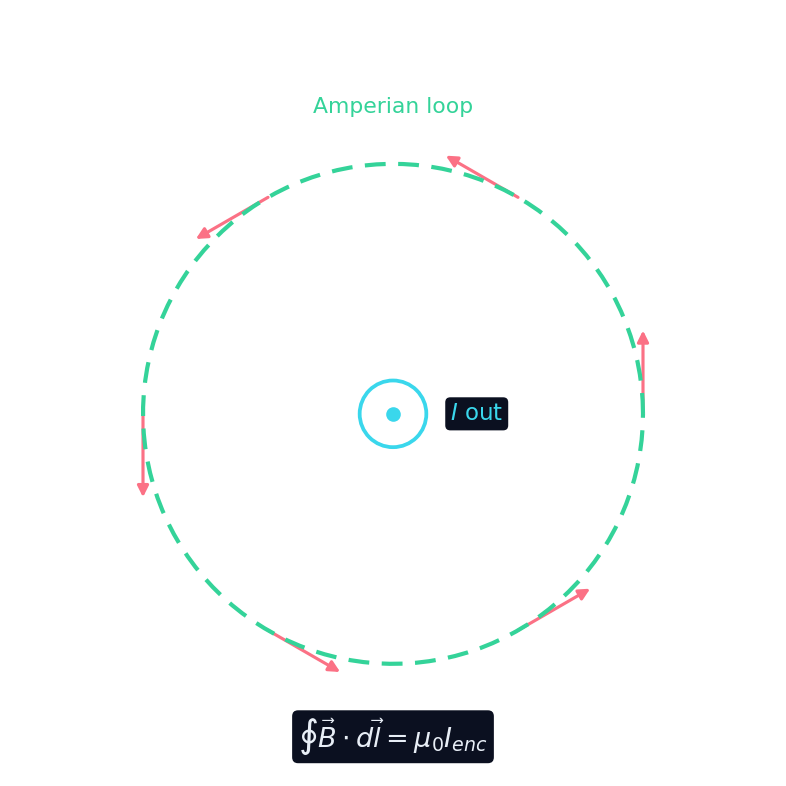
In Ampère's law, the field summed around a loop equals:
难度 1/5 · 今日首次完成可获 100 金币及少量额外奖励
$\oint \vec B \cdot d\vec\ell = \mu_0 I_{\text{enc}}$.
Only enclosed current matters
- A current outside the loop adds nothing to the line integral.
- Its field goes around one side of the loop and back on the other — it cancels.
- So the right side counts only $I_{\text{enc}}$, the current passing through.
- Same idea as Gauss's law, with current in place of charge.
A current outside an Amperian loop contributes nothing to the line integral of B.
难度 1/5 · 今日首次完成可获 100 金币及少量额外奖励
Only the enclosed current counts; outside current cancels around the loop.
Pick an Amperian loop with the symmetry
- Straight wire → a circular Amperian loop 安培环路 around it.
- Solenoid → a rectangular loop through its side.
- Choose it so $B$ is constant and along (or across) each part of the loop.
- Then $\oint \vec B \cdot d\vec\ell$ becomes a simple $B \times (\text{length})$.
Which current is enclosed?
Ampère's law uses only the current threading the loop. Sort each wire.
The closed path you integrate B around is called an ____ loop.
难度 1/5 · 今日首次完成可获 100 金币及少量额外奖励
It is an Amperian loop, chosen to match the symmetry.
Select 所有 true statements about Ampère's law.
难度 2/5 · 今日首次完成可获 140 金币及少量额外奖励
For steady currents in vacuum, the line integral equals mu0 times the signed enclosed current. Symmetry helps determine B. Changing electric flux requires a displacement-current term.
Fast, clean results
- Around a straight wire: $B = \dfrac{\mu_0 I}{2\pi r}$ — recovered in one line.
- Inside a long air-core solenoid, far from its ends: $B = \mu_0 n I$, where $n$ is turns per metre.
- For an ideal tightly wound toroid, the field is confined to the ring; real toroids have leakage fields.
- Each drops out of Ampère's law with almost no algebra.
Ampère's law gives the field inside a long solenoid as:
难度 1/5 · 今日首次完成可获 100 金币及少量额外奖励
Inside a solenoid $B = \mu_0 n I$ ($n$ = turns per metre).
Use a circular Amperian loop of radius $r$ around a straight wire carrying $I$.
- Symmetry: $\oint B\,d\ell = B(2\pi r)$.
- Set equal to $\mu_0 I$: $B = \dfrac{\mu_0 I}{2\pi r}$ — the straight-wire result.
Worked example: inside a thick wire
- Inside a conductor, a circular loop of radius $r$ encloses only part of the current. Find $I_{\text{enc}}$ first, then $B(2\pi r)=\mu_0I_{\text{enc}}$.
- For uniform current $I$ in a wire of radius $R$, $I_{\text{enc}}=I\dfrac{r^2}{R^2}$, so $B=\dfrac{\mu_0Ir}{2\pi R^2}$. It rises linearly to $\dfrac{\mu_0I}{2\pi R}$ at the surface, then falls as $1/r$ outside.
Non-uniform current (FRQ style). The current density is $J=\alpha r$ in a wire of radius $R$. Find $B$ inside.
- Add up thin rings of area $2\pi r'\,dr'$, so $I_{\text{enc}}=\displaystyle\int_0^r\alpha r'(2\pi r')\,dr'=\frac{2\pi\alpha r^3}{3}$.
- Ampère: $B(2\pi r)=\mu_0\dfrac{2\pi\alpha r^3}{3}$, so $B=\dfrac{\mu_0\alpha r^2}{3}$ for $r\le R$.
- Check at $r=R$, where the total $I=\tfrac23\pi\alpha R^3$ gives $B=\dfrac{\mu_0I}{2\pi R}$, matching the outside formula ✓
A long wire of radius 2.0 mm carries a uniform 10 A current. Find B at 1.0 mm from its axis, in mT. Use μ₀ = 4π × 10⁻⁷ T·m/A.
难度 2/5 · 今日首次完成可获 140 金币及少量额外奖励
B = μ₀Ir/(2πR²) = (4π × 10⁻⁷ × 10 × 0.001)/(2π × 4 × 10⁻⁶) = 5.0 × 10⁻⁴ T = 0.50 mT.
For a wire with uniform current, where is the magnetic field strongest?
难度 1/5 · 今日首次完成可获 100 金币及少量额外奖励
B grows as r inside and falls as 1/r outside, so it peaks at r = R.
Like Gauss's law, this form of Ampère's law holds for steady currents. For changing electric flux, the displacement-current term is also needed. Symmetry makes it useful for finding $B$. And only the enclosed current counts — a nearby wire outside the loop changes $B$ but adds nothing to $\oint \vec B \cdot d\vec\ell$.
Ampère's law says $\oint \vec B \cdot d\vec\ell = \mu_0 I_{\text{enc}}$ — the line integral of the field around a loop is set by the signed enclosed current for steady currents; outside currents can still change the local field. Pick an Amperian loop matching the symmetry to read $B$ off in one step (straight wire $\mu_0 I/2\pi r$, solenoid $\mu_0 n I$).
Write from the data given
- A long air-core solenoid has 500 turns per metre and carries 2 amperes. Use $\mu_0=4\pi\times10^{-7}\ \dfrac{\text{T}\cdot\text{m}}{\text{A}}$.
- Find the field inside. Say the ideal field outside.
A long air-core solenoid has 500 turns per metre and carries 2 amperes. Use mu0 = 4 pi times 10 to the minus 7 tesla metres per ampere. Find the field inside far from the ends, and the ideal outside field.
B = mu0 n I = (4 pi times 10 to the minus 7)(500)(2) = 4 pi times 10 to the minus 4 T. nI = 1000 amperes per metre is current per axial length, not volume current density.
A long air-core solenoid has 500 turns per metre and carries 2 amperes. With mu0 = 4 pi times 10 to the minus 7 tesla metres per ampere, what is its ideal field inside and outside?
难度 1/5 · 今日首次完成可获 100 金币及少量额外奖励
mu0 times 500 times 2 is 4 pi times 10 to the minus 4 tesla inside an ideal solenoid.