| English | 释义 | 拼音 |
|---|---|---|
| Arc length/ɑːk leŋθ/ | 弧长 | hú cháng |
Measuring the length of a curve
- Area and volume were integrals; so is the length of a curve itself.
- Arc length 弧长 adds up the lengths of tiny straight pieces along the curve.
- On each little piece, the curve is nearly a straight line — a hypotenuse of a small right triangle.
- Sum those hypotenuses (integrate) to get the total length.
From a small triangle to the formula
- A tiny piece has horizontal run $dx$ and vertical rise $dy=f'(x)\,dx$.
- Its length is $\sqrt{dx^2+dy^2}=\sqrt{1+\big(f'(x)\big)^2}\,dx$ (Pythagoras).
- For $a<b$ and continuous $f'$ on $[a,b]$, add them from $a$ to $b$:
-
$$L=\int_a^b \sqrt{1+\big(f'(x)\big)^2}\,dx$$
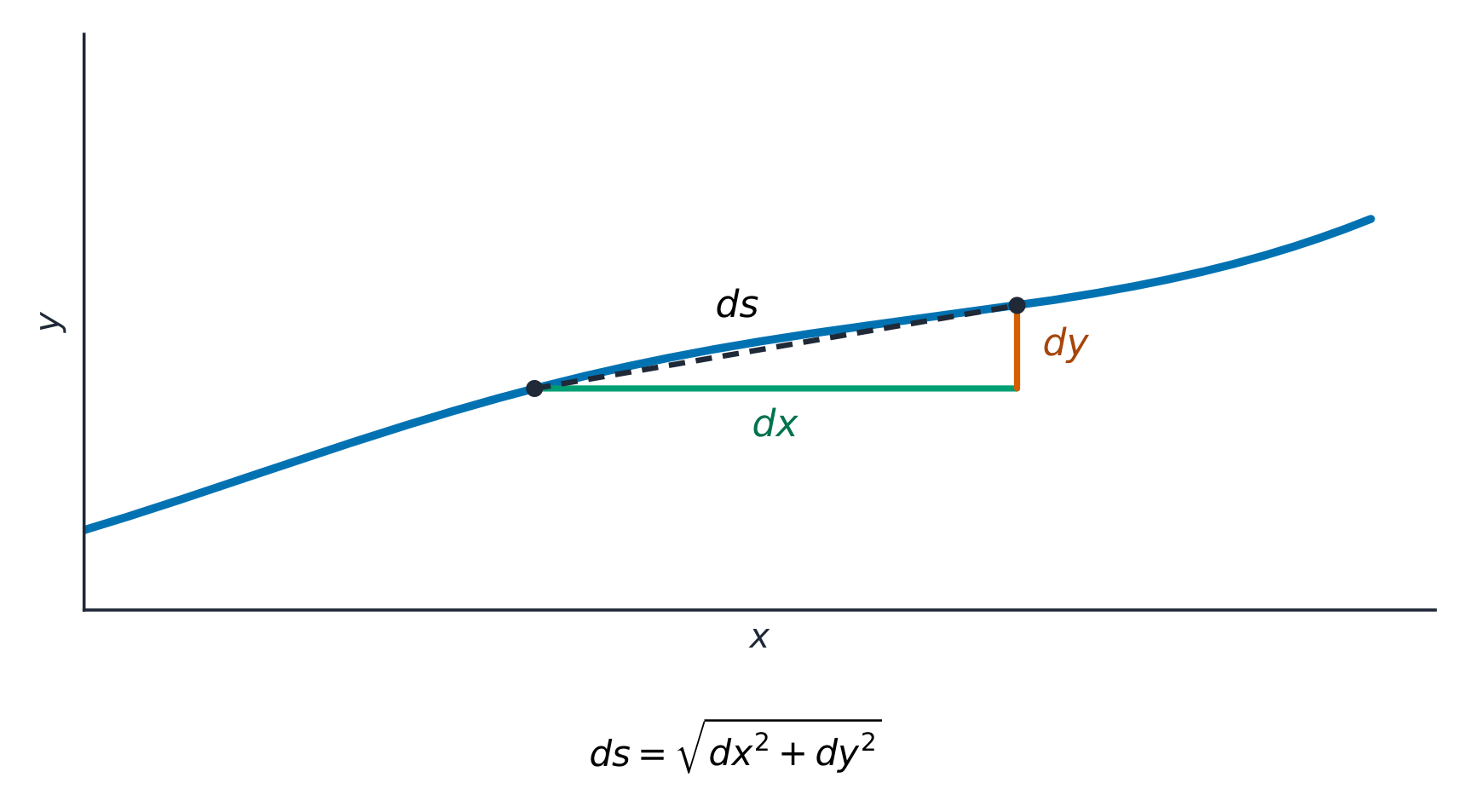
Each small piece of a curve is the hypotenuse of a dx-by-dy triangle
The straight-line case of arc length
y = a·x
The activity shows $y=ax$, a straight line. Its derivative is $a$, so its length on $[0,1]$ is(是) $\sqrt{1+a^2}$; at the default $a=1$, this is $\sqrt2$. The curved worked example below uses a different function.
The arc length of $y=f(x)$ on $[a,b]$ is...
难度 1/5 · 今日首次完成可获 100 金币及少量额外奖励
Square the derivative, add 1, take the root.
Using the formula
- Compute $f'(x)$, square it, add $1$, take the square root, and integrate over $[a,b]$.
- The integrand is always $\ge1$, so arc length is at least the horizontal distance $b-a$ (a curve is longer than the straight line).
- Many arc-length integrals are hard by hand; on the BC exam you often set them up and evaluate numerically.
- The key skill is building the integrand correctly from $f'$.
支持 $y=\tfrac23 x^{3/2}$, $f'(x)=x^{1/2}$. The arc-length integrand is...
难度 1/5 · 今日首次完成可获 100 金币及少量额外奖励
$(f')^2=x$, so $\sqrt{1+x}$.
Evaluate $\int_0^3 \sqrt{1+x}\,dx$ (a decimal).
难度 2/5 · 今日首次完成可获 140 金币及少量额外奖励
Put $u=1+x$, so $du=dx$ and the limits become $1,4$. Then $L=\int_1^4 u^{1/2}\,du=[(2/3)u^{3/2}]_1^4=(2/3)(8-1)=14/3\approx4.667$.
Because the integrand is $\ge 1$, the arc length is always at least...
难度 1/5 · 今日首次完成可获 100 金币及少量额外奖励
A curve is at least as long as the straight run.
Arc length as distance traveled
- If a particle follows $y=f(x)$ from $a$ to $b$ without retracing, the arc length is the distance it travels along that path.
- (For motion given by $x(t),y(t)$, the parametric version comes in lesson 9.3.)
- So this same integral measures both a curve's geometric length and a path's traveled distance.
- Setup is identical; only the interpretation changes.
The arc-length integrand uses the derivative $f'(x)$, not $f(x)$.
难度 1/5 · 今日首次完成可获 100 金币及少量额外奖励
它是 $\sqrt{1+(f'(x))^2}$.
Along a path $y=f(x)$, the arc length also measures the ____ traveled.
难度 1/5 · 今日首次完成可获 100 金币及少量额外奖励
Arc length = distance traveled along the path.
The integrand is $\sqrt{1+(f'(x))^2}$ — the derivative is squared, and there's a $\boldsymbol{+1}$ inside the root, not outside. Don't write $\sqrt{1+f(x)^2}$ (using $f$ instead of $f'$) or forget the $+1$. And the whole thing is under one square root before integrating.
Set up the arc length of $y=\tfrac23 x^{3/2}$ from $x=0$ to $x=3$.
- $f'(x)=x^{1/2}$, so $\big(f'(x)\big)^2=x$.
- $L=\displaystyle\int_0^3 \sqrt{1+x}\,dx=\Big[\tfrac23(1+x)^{3/2}\Big]_0^3=\tfrac23(8-1)=\tfrac{14}{3}$.
With a calculator. Find the length of $y=x^2$ from $x=0$ to $x=2$.
- $f'(x)=2x$, so $L=\displaystyle\int_0^2\sqrt{1+4x^2}\,dx$. This has no easy antiderivative.
- On the calculator section, write the integral, then evaluate: $L\approx4.647$.
- Sanity check: the straight line from $(0,0)$ to $(2,4)$ has length $\sqrt{20}\approx4.472$. The curve is a little longer ✓
Use a calculator to find the length of y = x² from x = 0 to x = 1, to 3 decimal places.
难度 2/5 · 今日首次完成可获 140 金币及少量额外奖励
L = ∫₀¹ √(1 + 4x²) dx ≈ 1.479.
Find the arc length of y = 2x + 1 on [0, 3] to 3 decimal places. (Check: it should equal the distance formula.)
难度 2/5 · 今日首次完成可获 140 金币及少量额外奖励
L = ∫₀³ √(1 + 4) dx = 3√5 ≈ 6.708, the same as the distance from (0, 1) to (3, 7).
A perfect square under the root. Find the length of $y=\dfrac{x^3}{6}+\dfrac{1}{2x}$ on $[1,2]$.
- $f'(x)=\dfrac{x^2}{2}-\dfrac{1}{2x^2}$, so $1+(f')^2=\dfrac{x^4}{4}+\dfrac12+\dfrac{1}{4x^4}=\Big(\dfrac{x^2}{2}+\dfrac{1}{2x^2}\Big)^2$.
- $L=\displaystyle\int_1^2\Big(\frac{x^2}{2}+\frac{1}{2x^2}\Big)dx=\Big[\frac{x^3}{6}-\frac{1}{2x}\Big]_1^2=\frac{13}{12}+\frac{4}{12}=\frac{17}{12}$.
Which integral gives the length of y = sin x from 0 to π?
难度 1/5 · 今日首次完成可获 100 金币及少量额外奖励
f′(x) = cos x, squared inside the root with +1. (Its value is about 3.820.)
The arc length of $y=f(x)$ on $[a,b]$ is $L=\int_a^b\sqrt{1+\big(f'(x)\big)^2}\,dx$ — summing tiny hypotenuses $\sqrt{1+(f')^2}\,dx$. Square the derivative, add $1$ inside the root, integrate. It also gives the distance traveled along the path.