| English | 释义 | 拼音 |
|---|---|---|
| definite integral/ˈdefɪnət ˈɪntɪɡrəl/ | 定积分 | dìng jī fēn |
Start here, add the change, land there
- Many applied problems give a rate and a starting amount, and ask for a later total.
- The key relationship: final value = initial value + accumulated change.
- The accumulated change is the definite integral of the rate over the interval.
- This one idea powers tanks, populations, accounts, and more.
The accumulation formula
- If $R(t)$ is the rate and $Q$ the quantity, then:
-
$$Q(b)=Q(a)+\int_a^b R(t)\,dt$$
- Start with $Q(a)$, add the net accumulated change $\displaystyle\int_a^b R(t)\,dt$, arrive at $Q(b)$.
- It's the FTC in applied clothing: the integral of a rate is the net change of its quantity.
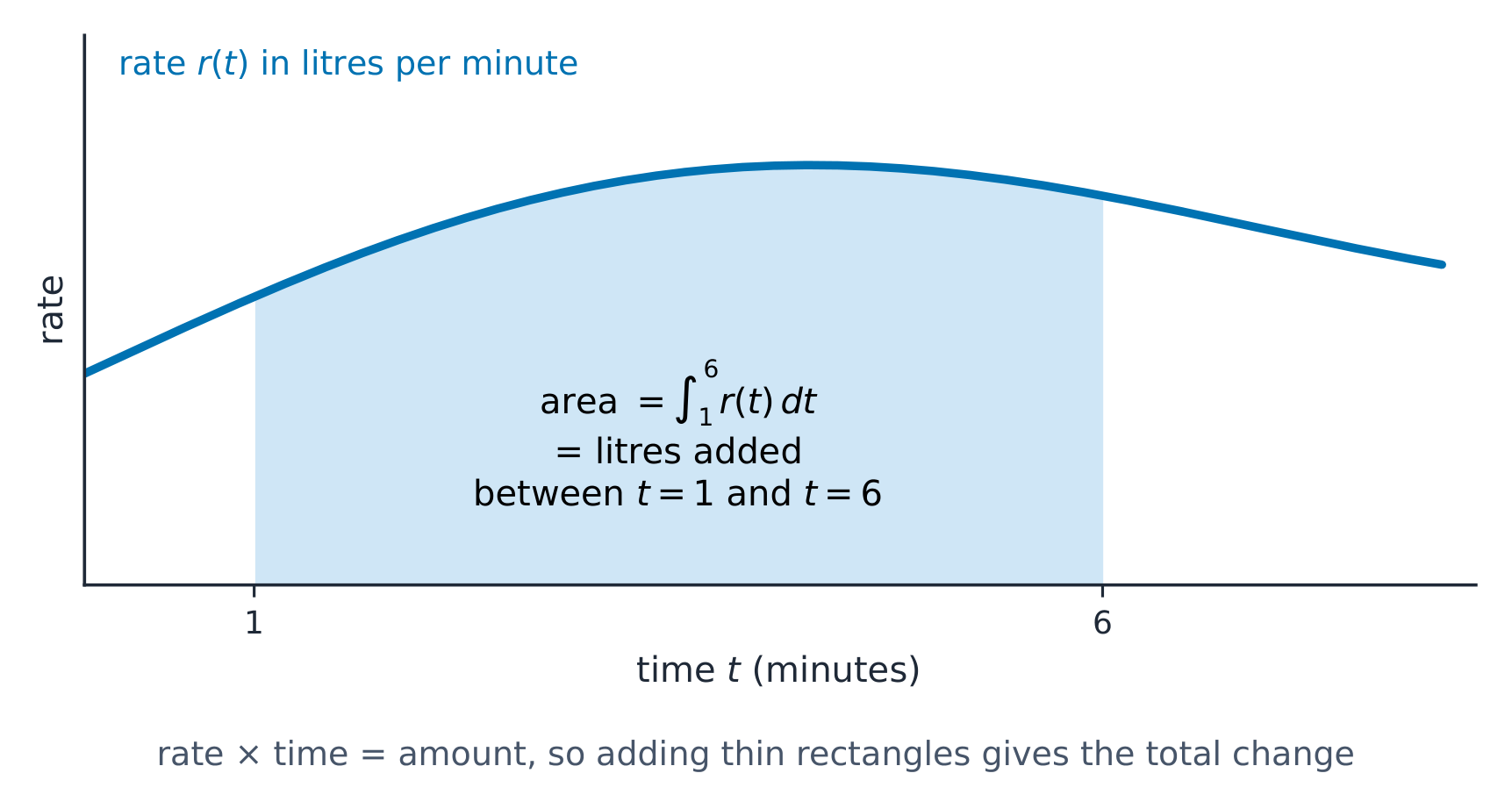
The area under a rate graph is the total amount accumulated
Accumulated inflow is the area
y = 4t (inflow rate)
The area under the inflow rate $R(t)$ is the water added; the total is the initial amount plus that area.
The applied accumulation relationship is: final value =...
难度 1/5 · 今日首次完成可获 100 金币及少量额外奖励
Final = initial + accumulated change.
To find the final amount, add the accumulated change to the ____ value.
难度 1/5 · 今日首次完成可获 100 金币及少量额外奖励
Final = initial + integral of the rate.
Reading the context and units
- A definite integral 定积分 of a rate has units of (rate units)$\times$(time) = the quantity's units.
- $\int$ of litres/min over minutes gives litres; $\int$ of people/year over years gives people.
- The sign matters: a negative rate (draining, cooling) subtracts from the total.
- Always interpret the integral in the problem's own words and units.
A tank has $50$ L; water flows in at $R(t)=4t$ for $0\le t\le 3$ ($\int_0^3 4t\,dt=18$). Find the total at $t=3$.
难度 2/5 · 今日首次完成可获 140 金币及少量额外奖励
$50+18=68$ L.
If $R$ is in litres/min and $t$ in minutes, $\int R\,dt$ has units of...
难度 1/5 · 今日首次完成可获 100 金币及少量额外奖励
(litres/min)×(min) = litres.
Net vs. gross change
- The integral $\int_a^b R\,dt$ is the net change — inflow minus outflow.
- If a tank is filled and drained, the net integral accounts for both automatically.
- To find total added or total removed separately, integrate only the positive or negative parts.
- But "final = initial + net accumulated change" always uses the plain signed integral.
The definite integral of the rate gives the change, not the final total by itself.
难度 1/5 · 今日首次完成可获 100 金币及少量额外奖励
You must add the initial value.
For an outflow (draining) rate, the integral over the interval is...
难度 1/5 · 今日首次完成可获 100 金币及少量额外奖励
An outflow rate is negative → subtracts.
Don't report the integral alone as the final amount — it's only the change. You must add the initial value: final $=$ initial $+\int_a^b R\,dt$. And keep the sign of the rate: an outflow rate is negative, so its integral correctly subtracts from the starting total.
A tank holds $50$ L at $t=0$. Water flows in at $R(t)=4t$ L/min for $0\le t\le 3$. How much at $t=3$?
- Accumulated change: $\displaystyle\int_0^3 4t\,dt=\Big[2t^2\Big]_0^3=18$ L.
- Final $=$ initial $+$ change $=50+18=68$ L.
- (The integral $18$ is the added water; $68$ is the total.)
Rate in minus rate out
- Many AP questions have water flowing in at $E(t)$ and out at $L(t)$. The amount is $W(t)=W(0)+\displaystyle\int_0^t\big(E(s)-L(s)\big)\,ds$.
- $W'(t)=E(t)-L(t)$. The amount increases while in > out. For the maximum amount, test where $E=L$ and the endpoints (candidates test).
The amount of water in a tank is increasing whenever the rate in is greater than the rate out.
难度 1/5 · 今日首次完成可获 100 金币及少量额外奖励
True. W′(t) = E(t) − L(t) > 0 then.
When is the tank fullest? A tank holds 20 L at $t=0$. Water flows in at $E(t)=12$ L/min and out at $L(t)=3t$ L/min, for $0\le t\le8$.
- $W(t)=20+\displaystyle\int_0^t(12-3s)\,ds=20+12t-1.5t^2$.
- $W'(t)=12-3t=0$ at $t=4$. Candidates: $W(0)=20$, $W(4)=44$, $W(8)=20$.
- The maximum is 44 L at $t=4$. At $t=5$, $W'(5)=-3<0$: the amount is decreasing, because water leaves faster than it enters.
A tank holds 100 L at t = 0. Water flows in at 6 L/min and out at 2t L/min. How many litres are in the tank at t = 5?
难度 2/5 · 今日首次完成可获 140 金币及少量额外奖励
100 + ∫₀⁵ (6 − 2t) dt = 100 + (30 − 25) = 105 L.
For the same tank on 0 ≤ t ≤ 10, at what time t (minutes) is the amount of water greatest?
难度 2/5 · 今日首次完成可获 140 金币及少量额外奖励
W′ = 6 − 2t = 0 at t = 3. W(0) = 100, W(3) = 109, W(10) = 60, so the maximum is at t = 3.
In applied contexts, final value = initial value + accumulated change, where the change is the definite integral of the rate: $Q(b)=Q(a)+\int_a^b R(t)\,dt$. The integral carries the quantity's units and its sign (inflow adds, outflow subtracts). Never forget to add the initial value.