The photoelectric effect · 光电效应
| English | 中文 | Pinyin · 拼音 |
|---|---|---|
| photoelectric effect/ˌfəʊtəʊɪˈlektrɪk ɪˈfekt/ | 光电效应 | guāng diàn xiào yìng |
| photoelectrons/ˌfəʊtəʊɪˈlektrɒnz/ | 光电子 | guāng diàn zi |
| threshold frequency/ˈθreʃəʊld ˈfriːkwənsi/ | 极限频率 | jí xiàn pín lǜ |
| work function/wɜːk ˈfʌŋkʃn/ | 逸出功 | yì chū gōng |
| threshold wavelength/ˈθreʃəʊld ˈweɪvleŋθ/ | 极限波长 | jí xiàn bō cháng |
| stopping potential/ˈstɒpɪŋ pəˈtenʃl/ | 遏止电势 | è zhǐ diàn shì |
The brightest red lamp will not do it
- Shine a blazing red lamp on a clean zinc plate and nothing comes off, however long you wait.
- Swap it for a feeble ultraviolet lamp and electrons are emitted at once, from the very first instant.
- A wave carries more energy when it is brighter, so a wave model says the red lamp should eventually win. It never does.
- That single stubborn fact is why photons exist. This lesson is the photoelectric effect 光电效应 and the equation that explains it.
再亮的红灯也做不到
- 拿一盏炽亮的红灯照干净的锌板,不管等多久,什么也出不来。
- 换成一盏微弱的紫外灯,电子立刻就被发射出来,从头一瞬间就有。
- 波越亮携带的能量越多,所以波的模型说红灯最终应该会赢。它从来没赢过。
- 就是这一个顽固的事实使光子成为必需。这一课讲光电效应(photoelectric effect)以及解释它的那个方程。
What the effect is
- The photoelectric effect is the emission of electrons from the surface of a metal when electromagnetic radiation of high enough frequency is incident on it.
- Two marks: emission of electrons, and from a metal surface illuminated by electromagnetic radiation. The emitted electrons are photoelectrons 光电子.
- The classic demonstration is a negatively charged zinc plate on a gold-leaf electroscope: shine ultraviolet on it and the leaf falls as the charge leaks away.
The leaf drops only under ultraviolet
这个效应是什么
- 当频率足够高的电磁辐射入射到金属表面时,电子从金属表面被发射出来,这就是光电效应。
- 两分:电子的发射,以及从被电磁辐射照射的金属表面。发射出来的电子叫光电子(photoelectrons)。
- 经典演示是带负电的锌板放在金箔验电器上:用紫外线照它,金箔随着电荷漏掉而落下。

只有在紫外线下金箔才落
Threshold frequency and work function
- Every metal has a threshold frequency 极限频率 $f_0$: the minimum frequency of radiation for which photoelectrons are emitted. Below it, nothing, however bright.
- The work function 逸出功 $\Phi$ is the minimum energy needed to remove an electron from the surface of the metal, and
- Both "minimum" and "from the surface" carry marks. An electron deeper inside needs more, which is exactly why the equation gives a maximum kinetic energy.
- The threshold wavelength 极限波长 $\lambda_0 = hc/\Phi$ is a maximum: longer wavelengths do nothing at all. Typical work functions are $2$ to $5\ \text{eV}$.
极限频率与逸出功
- 每种金属都有一个极限频率(threshold frequency)$f_0$:能发射光电子的辐射的最低频率。低于它,不管多亮都没有。
- 逸出功(work function)$\Phi$ 是把一个电子从金属表面移走所需的最小能量,而
- "最小"和"从表面"两者都带分。金属内部更深处的电子需要更多能量,这正是方程给出的是最大动能的原因。
- 极限波长(threshold wavelength)$\lambda_0 = hc/\Phi$ 是一个最大值:更长的波长什么也做不了。典型的逸出功是 $2$ 到 $5\ \text{eV}$。
Below the threshold frequency, shining a brighter light on the metal: · 在阈值频率以下,用更亮的光照射金属:
Each photon is below $\Phi$, so no single photon can free an electron — brightness cannot help. · 每个光子都低于 $\Phi$,所以没有单个光子能释放一个电子——亮度无济于事。
The minimum energy needed to free an electron from the surface is the ____ function. · 把电子从表面释放所需的最少能量是 ____ 功。
The work function $\Phi = hf_0$ — the least energy to release a surface electron. · 逸出功 $\Phi = hf_0$——释放一个表面电子所需的最少能量。
Match each term to the definition the examiner marks. · 把每个术语与评分认可的定义配对。
Frequency has a minimum, wavelength a maximum: they run opposite ways. "Minimum" and "from the surface" both carry marks in the work function. · 频率是最小值、波长是最大值:两者方向相反。逸出功里"最小"和"从表面"都带分。
Worked example: which metals emit
- Light of $400\ \text{nm}$ falls on caesium ($2.1\ \text{eV}$), sodium ($2.3\ \text{eV}$), zinc ($4.3\ \text{eV}$) and platinum ($5.6\ \text{eV}$). Which emit, and with what maximum kinetic energy?
- Photon energy: $hc/\lambda = 1240/400 = 3.1\ \text{eV}$.
- Emission needs $hf \geq \Phi$. So caesium emits, with $3.1 - 2.1 = 1.0\ \text{eV}$, and sodium with $0.8\ \text{eV}$.
- Zinc and platinum emit nothing, however intense the light. To make zinc emit you need $\lambda < 1240/4.3 = 290\ \text{nm}$, in the ultraviolet, which is why the electroscope demonstration uses a UV lamp on zinc.
例题:哪些金属会发射
- $400\ \text{nm}$ 的光照射铯($2.1\ \text{eV}$)、钠($2.3\ \text{eV}$)、锌($4.3\ \text{eV}$)和铂($5.6\ \text{eV}$)。哪些会发射,最大动能是多少?
- 光子能量:$hc/\lambda = 1240/400 = 3.1\ \text{eV}$。
- 发射需要 $hf \geq \Phi$。所以铯发射,动能 $3.1 - 2.1 = 1.0\ \text{eV}$;钠发射,$0.8\ \text{eV}$。
- 锌和铂什么也不发射,不管光多强。要让锌发射需要 $\lambda < 1240/4.3 = 290\ \text{nm}$,在紫外区,这正是验电器演示要用紫外灯照锌的原因。
Light of 400 nm (photon energy 3.1 eV) falls on these metals. Which emit photoelectrons? Select all · 所有 that apply. · 400 nm 的光(光子能量 3.1 eV)照射这些金属。哪些会发射光电子?选出所有适用的。
Emission needs hf >= work function. Zinc and platinum emit nothing at this wavelength however intense the light; zinc needs below 290 nm, in the ultraviolet. · 发射需要 hf >= 逸出功。在这个波长下,锌和铂不管光多强都不发射;锌需要低于 290 nm,在紫外区。
Einstein's photoelectric equation
- One photon gives all its energy to one electron. There is no sharing and no saving up.
- If $hf$ exceeds the work function, the electron escapes with kinetic energy up to a maximum:
- So the maximum kinetic energy depends linearly on frequency, and not at all on brightness.
The work function first, the rest as speed
爱因斯坦光电方程
- **一个光子把它的全部能量交给一个电子。**不分摊,也不积攒。
- 若 $hf$ 超过逸出功,电子逃逸出来,动能最多为:
- 所以最大动能线性地依赖频率,而完全不依赖亮度。

先付逸出功,余下的化作速度
A $5.0\ \text{eV}$ photon hits a metal with work function $2.0\ \text{eV}$. What is the maximum KE of the photoelectron? · 一个 $5.0\ \text{eV}$ 的光子打到逸出功为 $2.0\ \text{eV}$ 的金属上。光电子的最大动能是多少?
Max KE $= hf - \Phi = 5.0 - 2.0 = 3.0\ \text{eV}$. · 最大动能 $= hf - \Phi = 5.0 - 2.0 = 3.0\ \text{eV}$。
The maximum KE of photoelectrons depends on the frequency, not the brightness. · 光电子的最大动能取决于频率,而不是亮度。
Max KE $= h(f - f_0)$ — set by frequency alone. Brightness changes the number of electrons. · 最大动能 $= h(f - f_0)$——只由频率决定。亮度改变电子的数目。
Worked example: work function and maximum speed
- Magnesium emits only above $8.8\times10^{14}\ \text{Hz}$. It is illuminated at $1.2\times10^{15}\ \text{Hz}$. Find the work function and the maximum speed of the photoelectrons.
- $\Phi = hf_0 = (6.63\times10^{-34})(8.8\times10^{14}) = 5.8\times10^{-19}\ \text{J} = 3.6\ \text{eV}$.
- $\tfrac{1}{2}mv_{\text{max}}^2 = h(f - f_0) = (6.63\times10^{-34})(1.2\times10^{15} - 8.8\times10^{14}) = 2.1\times10^{-19}\ \text{J}$.
- $v_{\text{max}} = \sqrt{\dfrac{2\times 2.1\times10^{-19}}{9.11\times10^{-31}}} = 6.8\times10^{5}\ \text{m/s}$.
- Subtract the frequencies before multiplying by $h$. Rounding $hf$ and $\Phi$ separately and then subtracting loses a significant figure in the small difference.
例题:逸出功与最大速率
- 镁只在高于 $8.8\times10^{14}\ \text{Hz}$ 时才发射。现用 $1.2\times10^{15}\ \text{Hz}$ 照射它。求逸出功和光电子的最大速率。
- $\Phi = hf_0 = (6.63\times10^{-34})(8.8\times10^{14}) = 5.8\times10^{-19}\ \text{J} = 3.6\ \text{eV}$。
- $\tfrac{1}{2}mv_{\text{max}}^2 = h(f - f_0) = (6.63\times10^{-34})(1.2\times10^{15} - 8.8\times10^{14}) = 2.1\times10^{-19}\ \text{J}$。
- $v_{\text{max}} = \sqrt{\dfrac{2\times 2.1\times10^{-19}}{9.11\times10^{-31}}} = 6.8\times10^{5}\ \text{m/s}$。
- **先把频率相减,再乘 $h$。**把 $hf$ 和 $\Phi$ 分别取近似再相减,会在这个小差值上丢掉一位有效数字。
A metal has threshold frequency 8.8e14 Hz and is lit at 1.2e15 Hz. What is the maximum kinetic energy of the photoelectrons, in units of 1e-19 J? · 某金属极限频率为 8.8e14 Hz,用 1.2e15 Hz 的光照射。光电子的最大动能是多少(以 1e-19 J 为单位)?
h(f - f0) = 6.63e-34 x 3.2e14 = 2.1e-19 J. Subtract the frequencies FIRST; rounding hf and the work function separately loses a figure in the small difference. · h(f - f0) = 6.63e-34 x 3.2e14 = 2.1e-19 J。先把频率相减;把 hf 和逸出功分别取近似会在这个小差值上丢掉一位。
The straight-line graph
- Write the equation as $E_{\text{K,max}} = hf - \Phi$. That is a straight line with gradient $h$, intercept $-\Phi$ on the energy axis, and $f_0 = \Phi/h$ on the frequency axis.
- The gradient is the same for every metal, since $h$ is a constant. So two metals give two parallel lines, the larger work function cutting the frequency axis further to the right.
- The intensity of the light moves neither line. "Sketch the line for metal Y" is marked on exactly those two features: parallel, and shifted.
- This is how the Planck constant is measured.
Same slope, different intercepts
那条直线图
- 把方程写成 $E_{\text{K,max}} = hf - \Phi$。这是一条直线,斜率为 $h$,在能量轴上的截距是 $-\Phi$,在频率轴上是 $f_0 = \Phi/h$。
- 斜率对每种金属都相同,因为 $h$ 是常量。所以两种金属给出两条平行线,逸出功大的那条与频率轴的交点更靠右。
- 光的强度不会移动任何一条线。"画出金属 Y 的线"正是按这两个特征评分:平行,且平移。
- 普朗克常量就是这样测出来的。
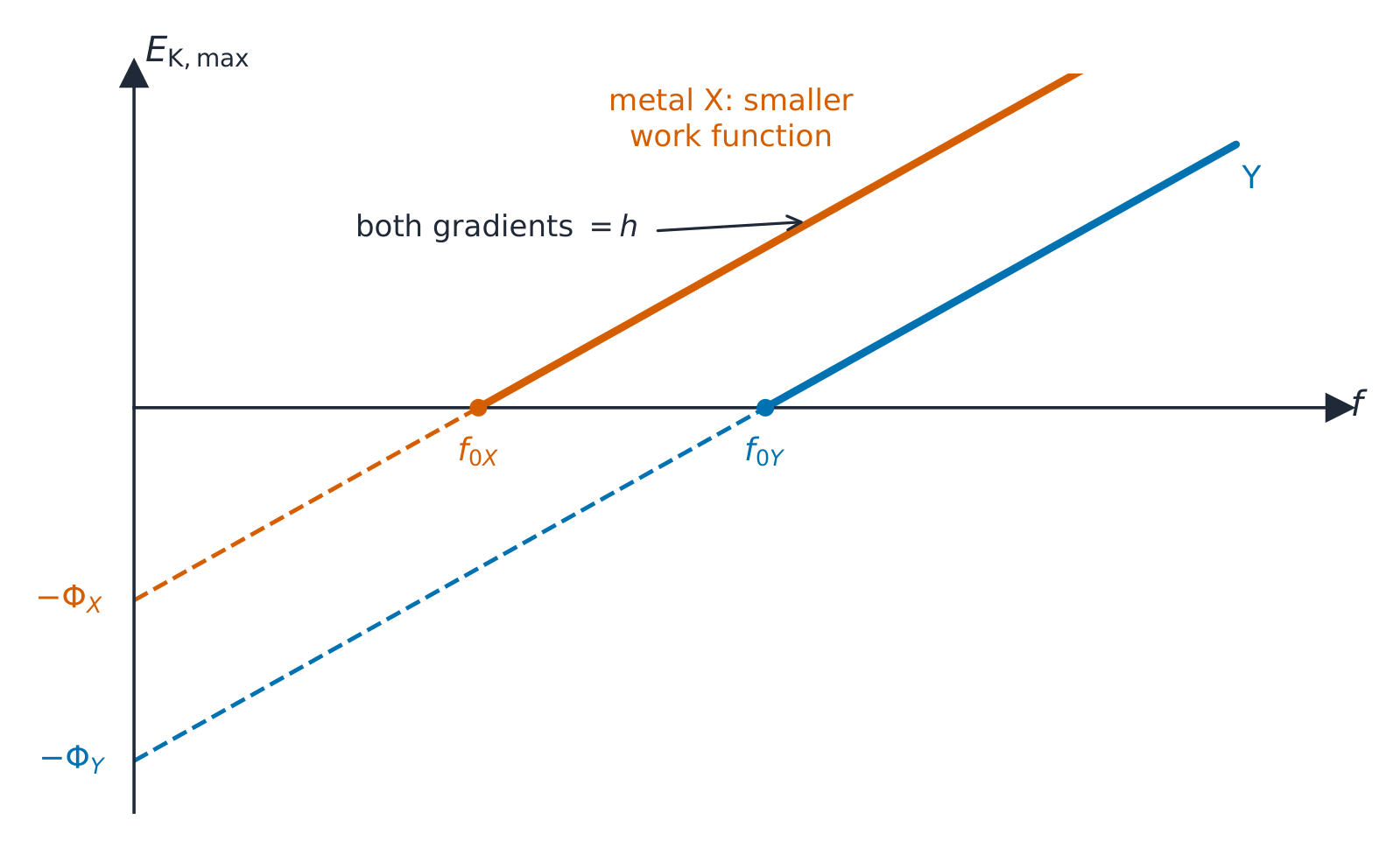
同样的斜率,不同的截距
The photoelectric effect · 光电效应
KEmax = h·f − φ
Max KE is a straight line in frequency, with intercept −φ (the work function). · 最大动能是频率的一条直线,截距为 −φ(逸出功)。
On a graph of maximum kinetic energy against frequency, the gradient equals the ____ constant, so the lines for two different metals are parallel. · 在最大动能对频率的图上,斜率等于____常量,所以两种不同金属的线是平行的。
E = hf - Phi, so gradient h and intercept -Phi. The metal changes only the intercepts, never the slope, and the intensity changes neither. · E = hf - Phi,所以斜率是 h、截距是 -Phi。换金属只改变截距、从不改变斜率,而强度两者都不改变。
Measuring it: the photocell
- Photoelectrons cross a vacuum to a collector, and the current counts electrons per second.
- Make the collector negative so the electrons must climb a potential hill. Raise the reverse p.d. until the current just reaches zero: that is the stopping potential 遏止电势 $V_{\text{s}}$, and
Turn the voltage up until the count reaches zero
怎么测:光电管
- 光电子穿过真空到达收集极,而电流就是每秒电子个数的计数。
- 把收集极做成负的,电子就得爬一个电势坡。加大反向电压直到电流刚好降到零:那就是遏止电势(stopping potential)$V_{\text{s}}$,而
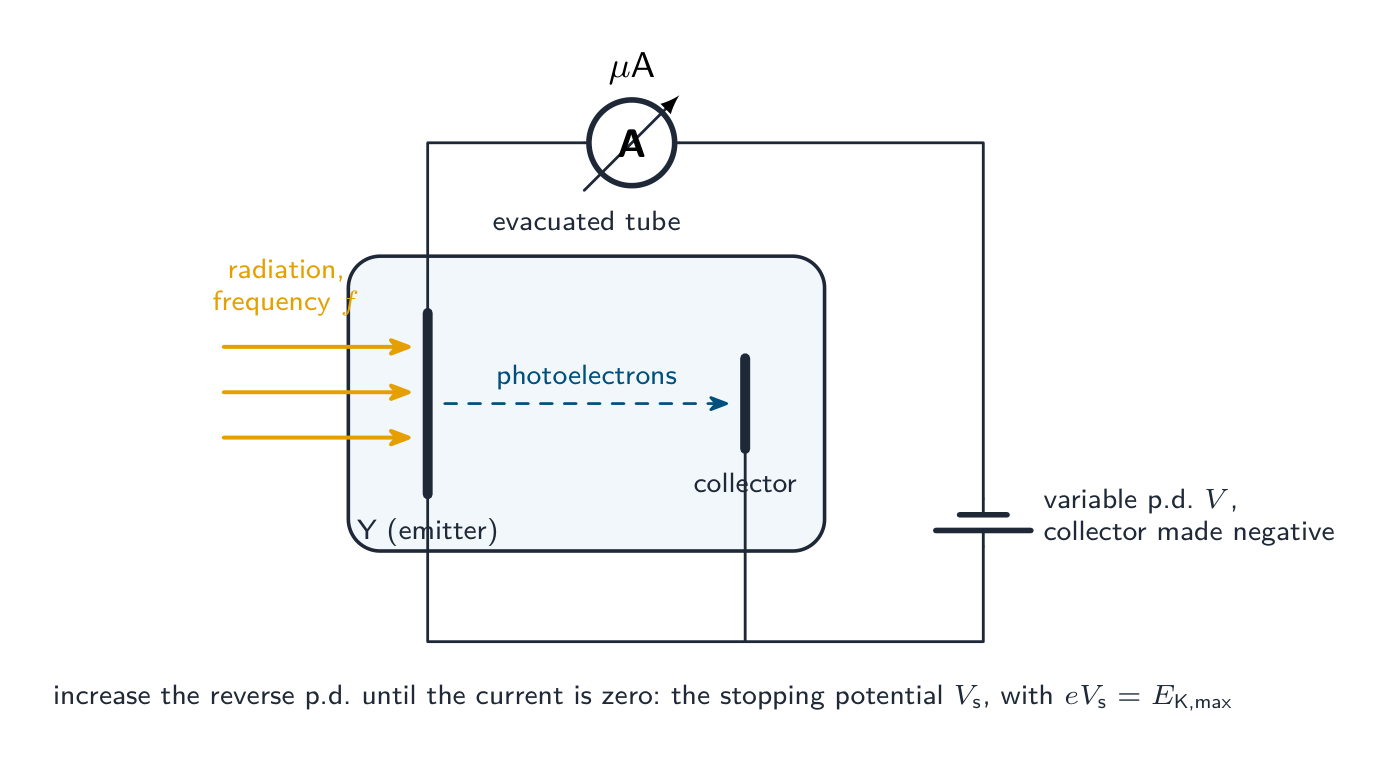
把电压加大到计数归零为止
Put the stopping-potential measurement in order. · 把遏止电势的测量步骤按顺序排列。
The current counts electrons per second; the stopping potential measures the energy of the fastest one. Intensity moves the first, frequency the second. · 电流数的是每秒的电子个数;遏止电势量的是最快那个的能量。强度改变前者,频率改变后者。
Intensity versus frequency
- At fixed frequency, doubling the intensity doubles the current but leaves the stopping potential unchanged.
- Raising the frequency raises the stopping potential but, at fixed intensity, does not raise the current.
- The reason is the one-photon-one-electron rule: intensity sets how many photons arrive per second, so it sets how many electrons leave. Frequency sets how much energy each one carries, so it sets how fast they leave.
- Keep those two sentences apart in an answer. Most lost marks here come from writing one when the question asked for the other.
强度与频率之别
- 频率固定时,强度加倍会使电流加倍,而遏止电势不变。
- 提高频率会提高遏止电势,但在强度固定时不会提高电流。
- 原因就是一个光子对一个电子这条规则:强度决定每秒到达多少个光子,于是决定离开多少个电子。频率决定每个携带多少能量,于是决定它们离开时有多快。
- 答题时要把这两句话分清楚。这里丢分最多的情形,就是问的是这一个而写成了另一个。
Doubling the brightness at the same frequency: · 在相同频率下把亮度加倍:
More photons per second → more electrons (more current), but each photon still carries the same $hf$. · 每秒更多的光子 → 更多电子(更大电流),但每个光子仍携带相同的 $hf$。
Why a wave model cannot do it
- A wave model predicts brightness should set the electrons' energy, and that any frequency should work given enough time to accumulate energy. Three observations kill it.
- No emission below $f_0$, however bright and however long you wait.
- Immediate emission at or above $f_0$, even from a very dim source.
- Maximum kinetic energy depends on frequency, not on brightness.
- All three follow at once from one photon delivering $hf$ to one electron, whole.
波的模型为什么做不到
- 波的模型预言亮度应当决定电子的能量,而且只要有足够时间积累能量,任何频率都该行得通。三个观测结果否定了它。
- 低于 $f_0$ 没有发射,不管多亮、等多久。
- 达到或高于 $f_0$ 时立即发射,哪怕光源非常暗。
- 最大动能取决于频率,而不是亮度。
- 这三条同时从"一个光子把 $hf$ 整个交给一个电子"这一点推出。
The wave model wrongly predicts that any frequency would emit electrons if you wait long enough. · 波模型错误地预测,只要等待足够长的时间,任何频率都会发射电子。
Waves would let energy build up gradually — but experiment shows a sharp threshold frequency, which the photon model explains. · 波会让能量逐渐积累——但实验显示有一个明确的阈值频率,这正是光子模型所解释的。
You've got it
- the photoelectric effect is the emission of electrons from a metal surface illuminated by radiation of high enough frequency
- the work function is the minimum energy to remove an electron from the surface, and $\Phi = hf_0$
- $hf = \Phi + \tfrac{1}{2}mv_{\text{max}}^2$, so $E_{\text{K,max}}$ against $f$ is a straight line of gradient $h$ and intercept $-\Phi$, parallel for every metal
- intensity sets the current, frequency sets the maximum kinetic energy, and the stopping potential gives $eV_{\text{s}} = E_{\text{K,max}}$
你掌握了
- 光电效应是频率足够高的辐射照射金属表面时从金属表面发射电子
- 逸出功是把电子从表面移走所需的最小能量,且 $\Phi = hf_0$
- $hf = \Phi + \tfrac{1}{2}mv_{\text{max}}^2$,所以 $E_{\text{K,max}}$ 对 $f$ 是斜率为 $h$、截距为 $-\Phi$ 的直线,对每种金属都平行
- 强度决定电流,频率决定最大动能,而遏止电势给出 $eV_{\text{s}} = E_{\text{K,max}}$