Rectification and smoothing · 整流与平滑
| English | 中文 | Pinyin · 拼音 |
|---|---|---|
| diodes/ˈdaɪəʊdz/ | 二极管 | èr jí guǎn |
| capacitor/kəˈpæsɪtə/ | 电容器 | diàn róng qì |
| rectification/ˌrektɪfɪˈkeɪʃn/ | 整流 | zhěng liú |
| smoothing/ˈsmuːðɪŋ/ | 平滑 | píng huá |
| ripple/ˈrɪpl/ | 纹波 | wén bō |
| forward-biased/ˈfɔːwəd ˈbaɪəst/ | 正向偏置 | zhèng xiàng piān zhì |
| reverse-biased/rɪˈvɜːs ˈbaɪəst/ | 反向偏置 | fǎn xiàng piān zhì |
| bridge rectifier/brɪdʒ ˈrektɪfaɪə/ | 桥式整流器 | qiáo shì zhěng liú qì |
Inside a phone charger
- A phone charger takes mains alternating voltage that reverses fifty times a second, and hands the phone a steady $5\ \text{V}$.
- Between those two things sit exactly the components of this lesson: diodes 二极管 to stop the reversing, and a capacitor 电容器 to iron out what is left.
- Rectification 整流 is the conversion of an alternating current into a direct (one-direction) current. That is the marked definition.
- Smoothing 平滑 is then using a capacitor across the load to reduce the ripple of a rectified output.
手机充电器的里面
- 手机充电器接进每秒反向五十次的市电交流电压,交给手机的却是稳定的 $5\ \text{V}$。
- 这两者之间放的正是这一课的元件:用二极管(diodes)止住反向,用电容器(capacitor)把剩下的起伏抹平。
- 整流(rectification)是把交流电转换成直流(单向)电。这就是评分认可的定义。
- 而平滑(smoothing)是用一个跨接在负载两端的电容器来减小整流输出的纹波。
What a diode does
- A diode conducts only when it is forward-biased 正向偏置: its anode, the flat end of the symbol's triangle, is more positive than its cathode, the bar.
- Otherwise it is reverse-biased 反向偏置 and behaves like an open switch.
- Treat it as ideal: zero resistance one way, infinite the other.
- Conventional current always flows through a diode in the direction the triangle points. Every "complete the circuit" question is that one rule, applied to each diode in turn.
二极管做的事
- 二极管只在正向偏置(forward-biased)时导通:它的阳极,也就是符号里三角形的平端,比作为横杠的阴极更正。
- 否则它就是反向偏置,表现得像一个断开的开关。
- 把它当作理想的:一个方向零电阻,另一个方向无穷大电阻。
- 常规电流总是沿三角形所指的方向流过二极管。每一道"补完电路"的题,都是把这一条规则依次用在每个二极管上。
A diode conducts current: · 二极管导通电流:
This one-way behaviour is what lets diodes rectify a.c. into d.c. · 这种单向特性使得二极管能够将交流电整流为直流电。
Match each term to the definition the examiner marks. · 将每个术语与考官标记的定义匹配。
Rectified current still varies; what makes it direct is that it never reverses. · 整流后的电流仍有波动;所谓直流是指它从不反向。
Half-wave rectification
- A single diode in series with the load passes only the positive half of each cycle. In the negative half it is reverse-biased and no current flows at all.
- The output is positive half-waves separated by flat zero gaps of equal length. Mean output $= V_0/\pi \approx 0.32\,V_0$.
- Half the input is thrown away, and the output is very uneven.
Humps, then nothing, then humps
半波整流
- 与负载串联的单个二极管只让每个循环的正半通过。在负半它被反向偏置,完全没有电流。
- 输出是正的半波,中间隔着等长的平坦的零间隙。平均输出 $= V_0/\pi \approx 0.32\,V_0$。
- 一半的输入被扔掉了,而且输出很不平稳。

一个包,然后什么都没有,然后又一个包
Half-wave rectification uses ____ diode. · 半波整流使用____个二极管。
A single diode passes the positive half-cycles and blocks the negative ones (leaving gaps). · 单个二极管通过正半周并阻断负半周(留下间隙)。
Drawing the half-wave circuit
- Source, one diode in series, load, and $V_{\text{OUT}}$ taken across the load. The triangle points the way the output current must flow.
- If a smoothing capacitor is wanted it goes in parallel with the load, never in series. A capacitor in series would block the d.c. altogether, which is the opposite of the point.
One diode in the line, one capacitor across the load
画半波电路
- 电源、串联的一个二极管、负载,而 $V_{\text{OUT}}$ 取自负载两端。三角形指向输出电流必须流动的方向。
- 若要加平滑电容,它与负载并联,绝不串联。串联的电容会把直流整个挡掉,恰恰与目的相反。
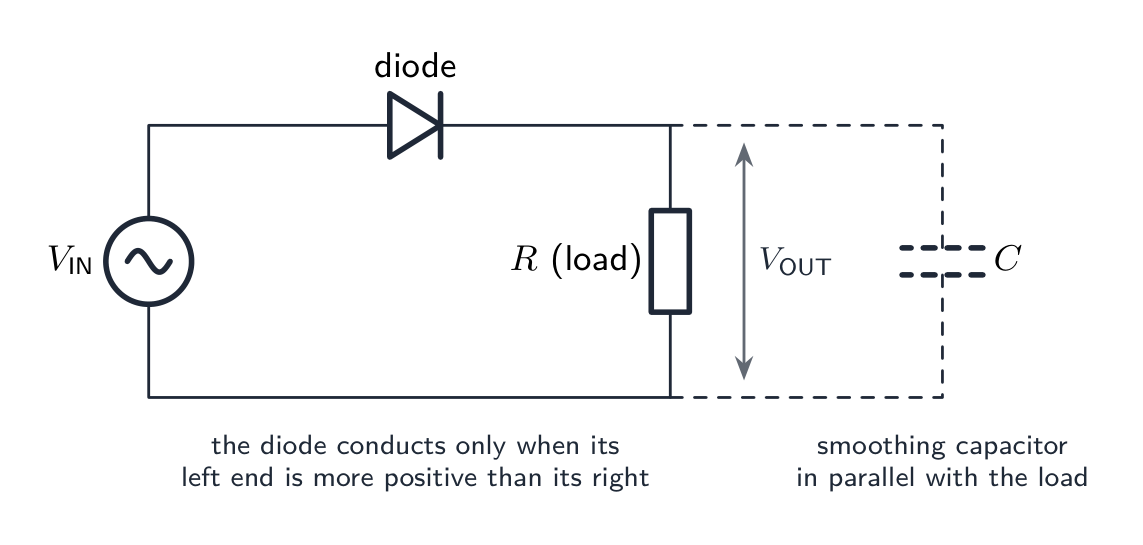
线路里一个二极管,负载上一个电容
Where does a smoothing capacitor go? · 平滑电容应放置在哪里?
It must discharge THROUGH the load between peaks, which needs it in parallel. In series it would block the d.c. entirely, which is the opposite of the point. · 它必须在峰值之间通过负载放电,这需要并联连接。若串联则会完全阻断直流,这与目的背道而驰。
Full-wave rectification
- A bridge rectifier 桥式整流器 uses four diodes so that the load current runs the same way whichever input terminal is positive.
- The output is a continuous run of positive humps with no gaps, at twice the input frequency. Mean output $= 2V_0/\pi \approx 0.64\,V_0$, double the half-wave value.
- All of the input is used, and what remains is far easier to smooth.
No gaps, and twice as often
全波整流
- 桥式整流器(bridge rectifier)用四个二极管,使得不论哪个输入端为正,负载电流都朝同一方向流。
- 输出是连成一片、没有间隙的正的包,频率是输入的两倍。平均输出 $= 2V_0/\pi \approx 0.64\,V_0$,是半波值的两倍。
- 输入被全部用上,而剩下的起伏也容易平滑得多。

没有间隙,而且频率翻倍
Rectifier and smoothing route · 整流和平滑电路
Watch alternating input become a smoother direct output. · 观察交流输入变为更平滑的直流输出。
How many diodes are in a bridge (full-wave) rectifier? · 桥式(全波)整流器中有多少个二极管?
Four diodes, arranged so the load current always flows the same way whichever input terminal is positive. · 四个二极管,排列方式使得无论哪个输入端为正,负载电流始终流向同一方向。
A full-wave rectified output repeats at twice the frequency of the a.c. input. · 全波整流输出的重复频率是交流输入频率的两倍。
Both half-cycles become positive humps, so the output ripples at double the input frequency. · 两个半周都变为正向峰,因此输出纹波频率是输入频率的两倍。
Worked example: explaining the bridge
- Explain how the four diodes produce full-wave rectification. This is the standard four-marker, and it is marked on naming the diodes.
- When terminal P is positive: current leaves P, passes through the diode pointing away from P to the top of the load, flows down through the load, and returns to Q through the diode pointing towards Q. The other two are reverse-biased and carry nothing.
- When Q is positive: the other pair conducts, but they are arranged so the current still enters the load at the top.
- So the current in the load is in the same direction in both half-cycles. Say which pair conducts in each half-cycle and which end of the load is positive.
Two diodes at a time, one direction through the load
例题:讲清楚这个桥
- *解释四个二极管如何实现全波整流。*这是标准的四分题,而得分点在于说出是哪些二极管。
- 当端子 P 为正:电流离开 P,经过那个背离 P 的二极管到达负载的上端,向下流过负载,再经过那个指向 Q 的二极管回到 Q。另外两个反向偏置,不载流。
- 当 Q 为正:导通的是另一对,但它们的排布使电流仍从上端进入负载。
- 所以两个半周里负载中的电流方向相同。要说出每个半周是哪一对导通、负载哪一端为正。

一次两个二极管,负载里一个方向
Put the explanation of one half-cycle of a bridge rectifier in order. · 按顺序说明桥式整流器半个周期的工作原理。
The four-mark answer is marked on naming the conducting pair in each half-cycle, not on saying the current "goes the same way". · 四分题的评分关键在于指出每个半周期中导通的二极管对,而非仅仅说电流“方向相同”。
Completing a bridge
- Given a bridge with diodes missing, use one rule: both diodes joined to the positive output terminal point towards it, and both joined to the negative output terminal point away from it.
- A single diode the wrong way round either short-circuits the supply on one half-cycle or passes nothing at all.
- Check your answer by tracing one half-cycle right round the loop before you move on.
补完一个桥
- 给你一个缺了二极管的桥,只用一条规则:接到正输出端的两个二极管都指向它,接到负输出端的两个都背离它。
- 只要有一个二极管方向装反,不是在某个半周把电源短路,就是根本不通。
- 往下做之前,先沿着一个半周把回路整个走一遍来验证。
In a bridge rectifier, both diodes joined to the positive output terminal point towards it. · 在桥式整流器中,连接到正极输出端的两个二极管均指向该端。
And both joined to the negative terminal point away from it. One diode reversed either short-circuits the supply on a half-cycle or passes nothing. · 连接到负极输出端的两个二极管均背离该端。若其中一个二极管反接,要么在半个周期内造成电源短路,要么导致无电流通过。
Smoothing with a capacitor
- Put a capacitor $C$ in parallel with the load $R$. On the rising part of each pulse it charges up to near the peak.
- On the falling part, and through any gap, the diodes are reverse-biased, so the capacitor discharges through the load and keeps the current flowing. That decay has time constant $RC$.
- At the next peak it charges again. The output now sits near the peak with small dips, and the size of the dips is the ripple 纹波.
Never down to zero, never above the peak
用电容平滑
- 把电容 $C$ 与负载 $R$ 并联。在每个脉冲的上升段,它充电到接近峰值。
- 在下降段以及任何间隙里,二极管反向偏置,于是电容通过负载放电,维持电流不断。这个衰减的时间常数是 $RC$。
- 到下一个峰它又充电。现在输出停在峰值附近,只有小小的下凹,而下凹的大小就是纹波(ripple)。

从不落到零,也从不高过峰值
To smooth a rectified output, you connect a capacitor: · 为了平滑整流输出,你应将电容器:
In parallel, it charges to the peak and then discharges through the load between peaks, holding the voltage up. · 并联连接,充电至峰值后在峰值间通过负载放电,从而维持电压。
Worked example: how big is the ripple
- A half-wave rectifier fed from a $50\ \text{Hz}$ supply has a $470\ \mu\text{F}$ capacitor across a $1.2\ \text{k}\Omega$ load. Estimate the fractional fall between peaks, and say what a bridge would change.
- Half-wave gives one peak per cycle, so the peaks are $T = 1/50 = 20\ \text{ms}$ apart.
- Time constant: $RC = (1.2\times10^3)(470\times10^{-6}) = 0.56\ \text{s}$.
- Discharge: $V = V_0 e^{-t/RC} = V_0 e^{-0.020/0.56} = 0.965\,V_0$, a fall of about $3.5\%$.
- With a bridge the peaks are only $10\ \text{ms}$ apart, so the fall halves to about $1.8\%$. Because $t \ll RC$, the ripple is roughly $V_0 t/(RC)$: proportional to the time between peaks, and inversely proportional to both $R$ and $C$.
例题:纹波有多大
- 由 $50\ \text{Hz}$ 电源供电的半波整流器,在 $1.2\ \text{k}\Omega$ 负载上并联了 $470\ \mu\text{F}$ 的电容。估算峰间的相对下降,并说明换成桥式会怎样。
- 半波每个循环一个峰,所以峰间隔 $T = 1/50 = 20\ \text{ms}$。
- 时间常数:$RC = (1.2\times10^3)(470\times10^{-6}) = 0.56\ \text{s}$。
- 放电:$V = V_0 e^{-t/RC} = V_0 e^{-0.020/0.56} = 0.965\,V_0$,下降约 $3.5\%$。
- 换成桥式后峰间只隔 $10\ \text{ms}$,下降减半到约 $1.8\%$。因为 $t \ll RC$,纹波大致是 $V_0 t/(RC)$:与峰间时间成正比,与 $R$ 和 $C$ 都成反比。
A full-wave rectifier from a 50 Hz supply feeds a 1.2 kilo-ohm load with a 470 microfarad capacitor. How many milliseconds pass between output peaks? · 来自50 Hz电源的全波整流器驱动1.2千欧负载,并配有470微法电容。输出峰值之间的时间间隔是多少毫秒?
Full-wave output runs at twice the input frequency, so 100 peaks per second and 10 ms between them. Half-wave would give 20 ms and about twice the ripple. · 全波输出频率是输入频率的两倍,即每秒100个峰值,间隔10 ms。半波整流则为20 ms且纹波约为两倍。
The mean output of a half-wave rectifier is $V_0$ divided by . · 半波整流的平均输出是$V_0$除以。
Half-wave gives 0.32 V0; a bridge uses both halves and doubles it to 2V0/pi = 0.64 V0. The bridge also doubles the ripple frequency, which is why the same capacitor smooths it better. · 半波整流输出为0.32 V₀;桥式整流利用两个半周将其加倍为2V₀/π = 0.64 V₀。桥式整流还使纹波频率加倍,因此相同的电容能更好地平滑它。
What reduces the ripple, and how to sketch it
- Larger $C$: more stored charge, so a smaller dip between peaks.
- Larger $R$: a smaller load current, so a slower discharge. Note this is the load resistance, so a heavier load (smaller $R$) makes the ripple worse.
- Full-wave instead of half-wave: less time to discharge between peaks.
- To sketch it: draw the humps faintly, then a curve that touches each peak, sags gently, and turns sharply up where the next hump meets it. It never reaches zero and never rises above the peak.
Bigger $RC$ hugs the peak line
什么能减小纹波,以及怎么画
- 更大的 $C$:储存的电荷更多,峰间的下凹更小。
- 更大的 $R$:负载电流更小,放电更慢。注意这是负载电阻,所以负载更重(即 $R$ 更小)会让纹波更糟。
- 用全波代替半波:峰间可供放电的时间更少。
- 画法:先淡淡地画出那些包,再画一条触到每个峰的曲线,轻轻下垂,在下一个包迎上来处急转向上。它从不到零,也从不高过峰值。
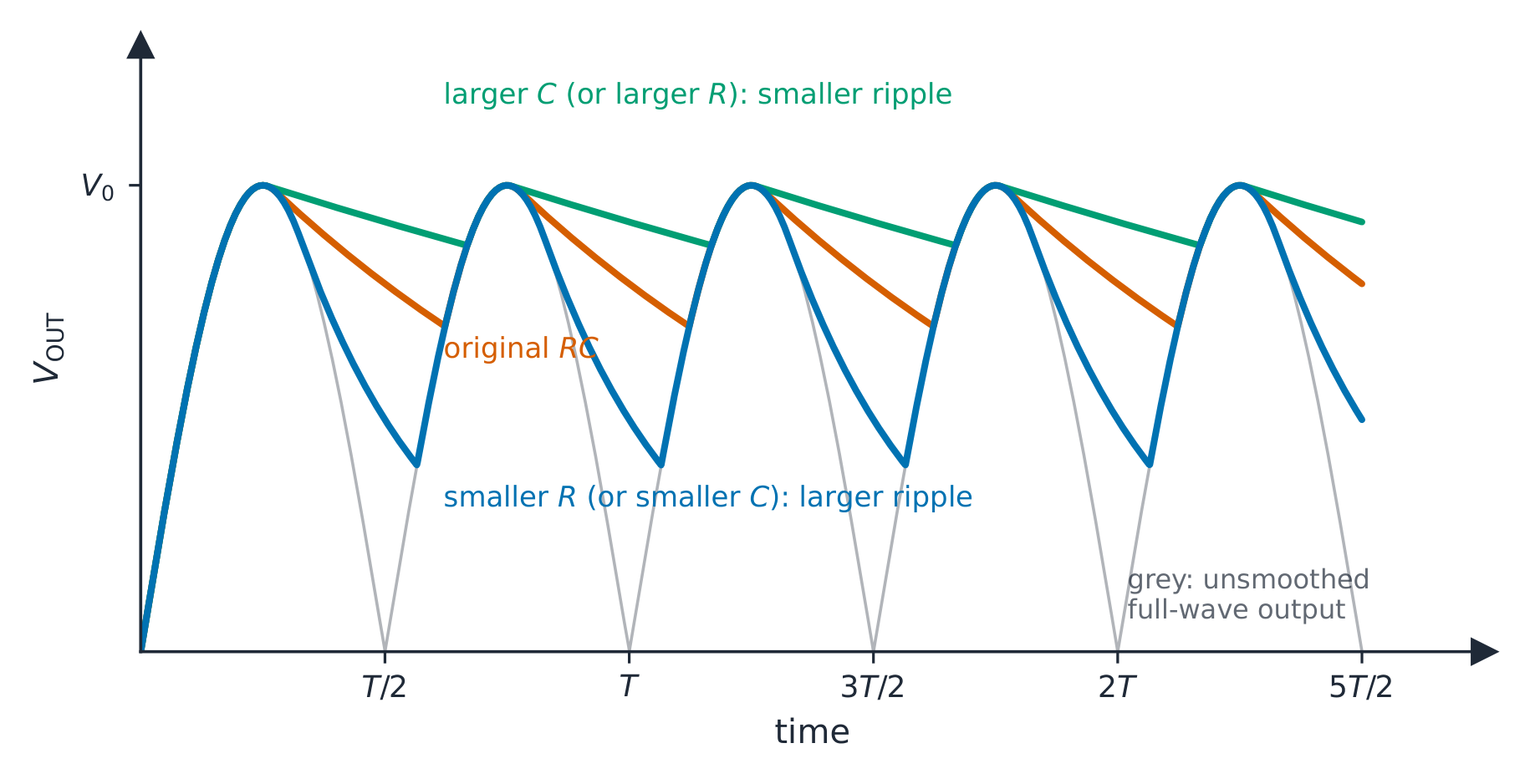
$RC$ 越大,越贴着峰值线
Select all · 所有 the changes that reduce the ripple. · 选择所有能减少纹波的变化。
A bigger $RC$ (or less time between peaks) makes the capacitor discharge less between peaks — smaller ripple. A smaller capacitor does the opposite. · 更大的$RC$(或更短的峰值间隔)意味着电容在峰值间放电更少——纹波更小。较小的电容则相反。
Marks that slip away
- The smoothing capacitor goes across the load, in parallel. In series it blocks the d.c. entirely.
- In the bridge explanation, name which pair of diodes conducts in each half-cycle. "The current goes the same way" alone is one mark of four.
- Full-wave output is at twice the input frequency, not the same frequency.
- A smaller load resistance means a larger ripple, because the capacitor discharges faster.
- Half-wave has flat zero gaps; full-wave has none. Draw the gaps the same width as the humps.
容易丢掉的分
- 平滑电容跨接在负载两端,是并联。串联会把直流整个挡住。
- 解释桥式时要说出每个半周是哪一对二极管导通。只说"电流方向相同",四分里只得一分。
- 全波输出的频率是输入的两倍,不是一样。
- 更小的负载电阻意味着更大的纹波,因为电容放电更快。
- 半波有平坦的零间隙,全波没有。画间隙时要与包同宽。
You've got it
- rectification converts alternating current into current in one direction; a diode conducts only when forward-biased, in the direction its triangle points
- half-wave uses one diode and passes half of each cycle, mean $V_0/\pi$; a bridge of four diodes passes both halves, mean $2V_0/\pi$, at twice the frequency
- a capacitor in parallel with the load smooths by discharging through the load between peaks, with time constant $RC$
- the ripple shrinks with larger $C$, larger load resistance, and full-wave rather than half-wave rectification
你掌握了
- 整流把交流变成单向的电流;二极管只在正向偏置时导通,方向就是三角形所指
- 半波用一个二极管、只通过每个循环的一半,平均值 $V_0/\pi$;四个二极管的桥式两半都通过,平均值 $2V_0/\pi$,频率是两倍
- 与负载并联的电容靠在峰间通过负载放电来平滑,时间常数为 $RC$
- 纹波随更大的 $C$、更大的负载电阻以及用全波而非半波整流而减小