The ideal gas equation · 理想气体方程
| English | 中文 | Pinyin · 拼音 |
|---|---|---|
| volume/ˈvɒljuːm/ | 体积 | tǐjī |
| pressure/ˈpreʃə/ | 压强 | yāqiáng |
| equation of state/ɪˈkweɪʒn ɒv steɪt/ | 状态方程 | zhuàng tài fāng chéng |
| ideal gas/aɪˈdɪəl ɡæs/ | 理想气体 | lǐ xiǎng qì tǐ |
| thermodynamic temperature/ˌθɜːməʊdaɪˈnæmɪk ˈtemprɪtʃə/ | 热力学温度 | rè lì xué wēn dù |
| molar gas constant/ˈməʊlə ɡæs ˈkɒnstənt/ | 摩尔气体常量 | mó ěr qì tǐ cháng liàng |
| Boltzmann constant/ˈbɒltsmən ˈkɒnstənt/ | 玻尔兹曼常量 | bō ěr zī màn cháng liàng |
| Boyle's law/bɔɪlz lɔː/ | 玻意耳定律 | bō yì ěr dìng lǜ |
| Charles's law/ˈtʃɑːlzɪz lɔː/ | 查理定律 | chá lǐ dìng lǜ |
| pressure law/ˈpreʃə lɔː/ | 气体压强定律 | qì tǐ yā qiáng dìng lǜ |
The tank that must not be filled at noon
- A scuba tank is filled to 200 bar on a cool morning and left in a car in the sun. Nothing is added and nothing escapes, yet by afternoon the gauge reads far higher.
- The gas has not changed. Its temperature has, and for a fixed amount in a fixed volume, pressure and temperature move together in strict proportion.
- Divers are taught this as a safety rule. The exam asks for it as an equation, and one equation covers every case of it.
- This lesson is the equation of state 状态方程 $pV = nRT$, its per-molecule twin, and the three special cases that fall out of it.
不该在正午充的那只气瓶
- 一只潜水气瓶在凉爽的早晨充到 200 巴,然后被留在阳光下的车里。没有加进任何东西,也没有漏出任何东西,可到了下午,压力表读数高出许多。
- 气体没有变。变的是它的温度,而对固定容积里固定量的气体,压强和温度严格成正比地一起变。
- 潜水员把这当作安全守则来学。考试则要求把它写成方程,而一个方程涵盖它的所有情形。
- 这一课讲状态方程(equation of state)$pV = nRT$、它按分子计的孪生形式,以及由它导出的三种特例。
What makes a gas ideal
- An ideal gas 理想气体 is one that obeys $pV \propto T$, where $T$ is the thermodynamic temperature 热力学温度, at all values of pressure, volume and temperature.
- The examiner's two-mark definition needs both halves: the relationship, and "at all values of $p$, $V$ and $T$". Stating the equation alone earns one.
- Real gases approach this behaviour at low pressure and high temperature, and depart from it when the molecules are crowded or slow.
什么样的气体是理想气体
- 理想气体(ideal gas)是在压强、体积和温度的所有取值下都遵守 $pV \propto T$ 的气体,其中 $T$ 是热力学温度(thermodynamic temperature)。
- 考官的两分定义需要两半:那个关系,以及"在 $p$、$V$、$T$ 的所有取值下"。只写方程得一分。
- 真实气体在低压高温下接近这种行为,在分子拥挤或缓慢时偏离它。
A two-mark definition of an ideal gas needs which elements? Select all · 所有 that apply. · 理想气体的两分定义需要哪些要素?选出所有适用的。
The relationship alone earns one mark; "at all values" earns the second. Being monatomic is not part of the definition. · 只写关系得一分;"在所有取值下"得第二分。是否单原子不是定义的一部分。
The equation of state, both forms
- $p$ is the pressure 压强 in Pa, $V$ the volume 体积 in m³, $T$ the thermodynamic temperature in kelvin, never °C.
- $n$ is the number of moles and $R = 8.31\ \text{J/(mol K)}$ the molar gas constant 摩尔气体常量. $N$ is the number of molecules and $k = 1.38 \times 10^{-23}\ \text{J/K}$ the Boltzmann constant 玻尔兹曼常量.
- The two forms are the same equation: since $N = nN_{\text{A}}$, it follows that $k = R/N_{\text{A}}$. Choose the form that matches the "amount" the question gives you: moles go with $R$, molecules with $k$.
A fixed amount in a fixed volume: only temperature is left to change the pressure
状态方程的两种形式
- $p$ 是以 Pa 为单位的压强(pressure),$V$ 是以 m³ 为单位的体积(volume),$T$ 是以开尔文为单位的热力学温度,绝不能用 °C。
- $n$ 是摩尔数,$R = 8.31\ \text{J/(mol K)}$ 是摩尔气体常量(molar gas constant)。$N$ 是分子数,$k = 1.38 \times 10^{-23}\ \text{J/K}$ 是玻尔兹曼常量(Boltzmann constant)。
- 两种形式是同一个方程:因为 $N = nN_{\text{A}}$,所以 $k = R/N_{\text{A}}$。选与题目给的"量"相匹配的形式:摩尔配 $R$,分子配 $k$。

固定容积里固定的量:只剩温度能改变压强
The equation of state of an ideal gas is: · 理想气体的状态方程是:
$pV = nRT$ (moles) or $pV = NkT$ (molecules) — with $T$ in kelvin. · $pV = nRT$(摩尔)或 $pV = NkT$(分子)——其中 $T$ 用开尔文。
You may use temperature in °C in the ideal gas equation. · 你可以在理想气体方程中使用 °C 的温度。
No — $pV \propto T$ only with $T$ in kelvin. Convert °C to K first. · 不——只有 $T$ 用开尔文时 $pV \propto T$ 才成立。先把 °C 换算成 K。
The Boltzmann constant equals $R / N_{\text{A}}$ — the gas constant per molecule. · 玻尔兹曼常数等于 $R / N_{\text{A}}$——每个分子的气体常数。
Since $N = n N_{\text{A}}$, comparing $pV = nRT$ with $pV = NkT$ gives $k = \dfrac{R}{N_{\text{A}}}$. · 由于 $N = n N_{\text{A}}$,比较 $pV = nRT$ 和 $pV = NkT$ 得到 $k = \dfrac{R}{N_{\text{A}}}$。
Worked example: how much gas is in the cylinder
- A cylinder of volume $0.020\ \text{m}^3$ holds gas at $27\ ^\circ\text{C}$ and a pressure of $2.0 \times 10^5\ \text{Pa}$. How many moles are there?
- Convert first: $T = 27 + 273 = 300\ \text{K}$. The volume and pressure are already in SI units.
- Rearrange and substitute:
- Convert to kelvin before anything else. Using 27 in place of 300 gives an answer eleven times too large, and it is the single commonest error in this topic.
例题:气瓶里有多少气体
- 一只容积 $0.020\ \text{m}^3$ 的气瓶装着 $27\ ^\circ\text{C}$、压强 $2.0 \times 10^5\ \text{Pa}$ 的气体。里面有多少摩尔?
- 先换算:$T = 27 + 273 = 300\ \text{K}$。体积和压强已经是 SI 单位。
- 移项代入:
- 在做任何别的事之前先换成开尔文。用 27 代替 300 会得到大十一倍的答案,而这是本单元里唯一最常见的错误。
A cylinder of volume 0.020 m^3 holds gas at 27 degrees C and 2.0 x 10^5 Pa. How many moles are there? (R = 8.31) · 一只容积 0.020 m^3 的气瓶装着 27 摄氏度、2.0 x 10^5 Pa 的气体。有多少摩尔?(R = 8.31)
T must be 300 K, not 27. n = pV/RT = (2.0e5 x 0.020)/(8.31 x 300) = 1.6 mol. Using 27 gives an answer eleven times too large. · T 必须是 300 K,不是 27。n = pV/RT = (2.0e5 x 0.020)/(8.31 x 300) = 1.6 mol。用 27 会得到大十一倍的答案。
A fixed amount changing state
- If the amount of gas does not change, $nR$ is a constant, so $pV/T$ is the same before and after:
- Write down the six quantities, mark the one you want, and substitute. Any quantity that is unchanged cancels from both sides.
- Because it cancels, you do not need the volume in a constant-volume problem, nor the pressure in a constant-pressure one.
固定量气体的状态变化
- 如果气体的量不变,$nR$ 就是常数,所以 $pV/T$ 在变化前后相同:
- 写下这六个量,标出你要求的那个,再代入。任何没有改变的量会从等式两边约掉。
- 正因为会约掉,恒容问题里你不需要体积,恒压问题里也不需要压强。
A gas at $200\ \text{kPa}$ and $300\ \text{K}$ is heated to $600\ \text{K}$ at constant volume. What is the new pressure? · $200\ \text{kPa}$、$300\ \text{K}$ 的气体在恒定体积下被加热到 $600\ \text{K}$。新的压强是多少?
At constant volume $\dfrac{p}{T}$ is constant: $p_2 = 200 \times \dfrac{600}{300} = 400\ \text{kPa}$. · 在恒定体积下 $\dfrac{p}{T}$ 恒定:$p_2 = 200 \times \dfrac{600}{300} = 400\ \text{kPa}$。
The three special cases
- Boyle's law 玻意耳定律, constant temperature: $pV$ is constant, so $p_1V_1 = p_2V_2$. Halve the volume and the pressure doubles.
- Charles's law 查理定律, constant pressure: $V/T$ is constant. Volume rises linearly with absolute temperature and extrapolates to zero at absolute zero.
- The pressure law 气体压强定律, constant volume: $p/T$ is constant. This is the scuba tank in the sun.
- All three are the same equation with one quantity held fixed. Learn the parent equation and derive the case you need.
The line points at absolute zero, which is what makes the kelvin scale the natural one
三种特例
- 玻意耳定律(Boyle's law),恒温:$pV$ 是常数,所以 $p_1V_1 = p_2V_2$。体积减半,压强加倍。
- 查理定律(Charles's law),恒压:$V/T$ 是常数。体积随绝对温度线性上升,外推到绝对零度时为零。
- 气体压强定律(pressure law),恒容:$p/T$ 是常数。这就是阳光下的那只潜水气瓶。
- 三者都是同一个方程固定住某一个量。记住母方程,再导出你需要的那一种。
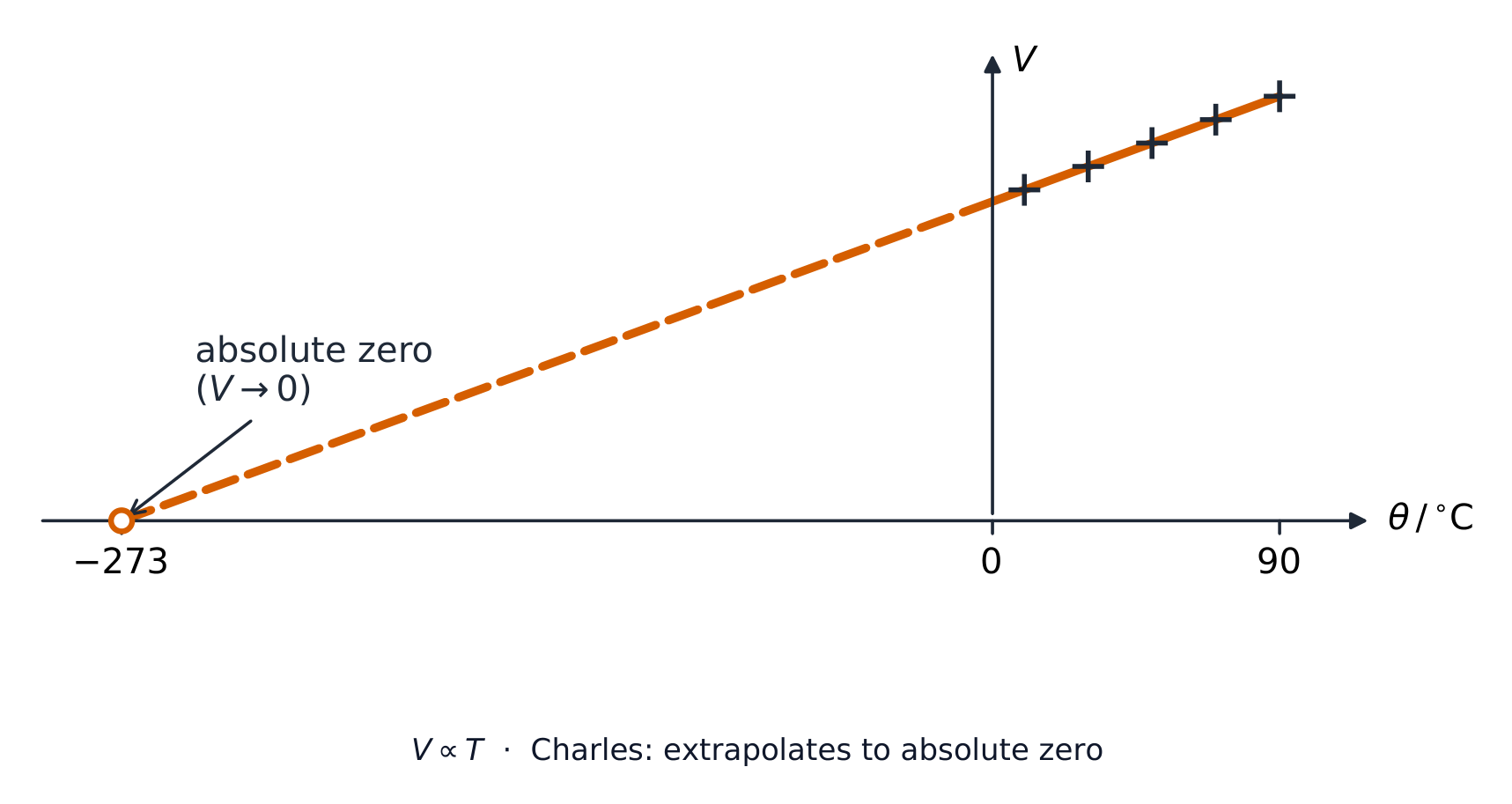
这条线指向绝对零度,这正是开尔文标度成为自然标度的原因
The ideal gas (Boyle) · 理想气体(玻意耳)
p = k / V
At constant temperature p ∝ 1/V — squeeze the volume and pressure rises. · 恒温下 p ∝ 1/V——压缩体积,压强上升。
At constant temperature, a gas at $100\ \text{kPa}$ is squeezed to half its volume. What is the new pressure? · 在恒温下,$100\ \text{kPa}$ 的气体被压缩到一半体积。新的压强是多少?
Boyle: $pV$ is constant, so halving $V$ doubles $p$ → $200\ \text{kPa}$. · 玻意耳:$pV$ 恒定,所以 $V$ 减半使 $p$ 加倍 → $200\ \text{kPa}$。
At constant pressure, $V$ divided by $T$ stays ____. · 在恒定压强下,$V$ 除以 $T$ 保持 ____。
That is Charles's law: $\dfrac{V}{T} =$ constant at fixed pressure. · 这就是查理定律:在固定压强下 $\dfrac{V}{T} =$ 常数。
Match each gas law to what is held constant and what stays constant. · 把每条气体定律与所固定的量以及保持恒定的量配对。
All three are the parent equation with one quantity fixed, so the fixed one cancels from p1V1/T1 = p2V2/T2. · 三者都是母方程固定住一个量的结果,所以那个固定的量会从 p1V1/T1 = p2V2/T2 中约掉。
Worked example: heating at constant pressure
- A fixed mass of gas at $300\ \text{K}$ occupies $0.50\ \text{m}^3$. It is heated to $450\ \text{K}$ at constant pressure. Find the new volume.
- Pressure is constant, so it cancels from $p_1V_1/T_1 = p_2V_2/T_2$, leaving $V/T$ constant.
- Both temperatures are already in kelvin here. Had they been in °C, the ratio would have been meaningless: $\tfrac{177}{27}$ is not $\tfrac{450}{300}$.
例题:恒压加热
- 固定质量的气体在 $300\ \text{K}$ 时占 $0.50\ \text{m}^3$。它在恒压下被加热到 $450\ \text{K}$。求新体积。
- 压强不变,所以它从 $p_1V_1/T_1 = p_2V_2/T_2$ 中约掉,剩下 $V/T$ 为常数。
- 这里两个温度已经是开尔文。若它们是 °C,这个比值就毫无意义:$\tfrac{177}{27}$ 并不等于 $\tfrac{450}{300}$。
A fixed mass of gas at 300 K occupies 0.50 m^3. It is heated to 450 K at constant pressure. What is the new volume in m^3? · 固定质量的气体在 300 K 时占 0.50 m^3。它在恒压下被加热到 450 K。新体积是多少 m^3?
Pressure cancels, leaving V/T constant: V2 = 0.50 x 450/300 = 0.75 m^3. The ratio only works because both temperatures are in kelvin. · 压强约掉,剩下 V/T 恒定:V2 = 0.50 x 450/300 = 0.75 m^3。这个比值成立,只因为两个温度都是开尔文。
Worked example: reading a p-V cycle
- A fixed amount of gas at temperature $T$ is in state X, with pressure $2p$ and volume $V$. It is cooled at constant volume to state Y at pressure $p$, then heated at constant pressure to state Z at volume $2V$.
- X to Y is at constant volume, so $p/T$ is constant. Halving the pressure halves the temperature: $T_{\text{Y}} = T/2$.
- Y to Z is at constant pressure, so $V/T$ is constant. Doubling the volume doubles the temperature: $T_{\text{Z}} = T$.
- On a $p$-$V$ diagram a vertical line is constant volume and a horizontal line is constant pressure, and $pV/T$ has the same value at every state on the cycle. That last fact is what lets you check your answers.
例题:读一个 p-V 循环
- 固定量的气体在温度 $T$ 时处于状态 X,压强 $2p$、体积 $V$。它在恒容下被冷却到压强为 $p$ 的状态 Y,再在恒压下被加热到体积为 $2V$ 的状态 Z。
- X 到 Y 是恒容,所以 $p/T$ 为常数。压强减半使温度减半:$T_{\text{Y}} = T/2$。
- Y 到 Z 是恒压,所以 $V/T$ 为常数。体积加倍使温度加倍:$T_{\text{Z}} = T$。
- 在 $p$-$V$ 图上,竖直线是恒容,水平线是恒压,而 $pV/T$ 在循环上的每一个状态都取同一个值。最后这个事实正是你用来检验答案的东西。
A fixed amount of gas at temperature T, pressure 2p and volume V is cooled at constant volume to pressure p. What is its new temperature? · 固定量的气体在温度 T、压强 2p、体积 V,被恒容冷却到压强 p。它的新温度是多少?
At constant volume p/T is constant, so halving the pressure halves the absolute temperature. On a p-V diagram this is a vertical line. · 恒容时 p/T 恒定,所以压强减半使绝对温度减半。在 p-V 图上这是一条竖直线。
Marks that slip away
- Kelvin, always. $T(\text{K}) = \theta(^\circ\text{C}) + 273$. This is the most-penalised error in the topic.
- Match the form to the amount: moles with $R$, molecules with $k$. Mixing them is out by $N_{\text{A}}$.
- The two-mark definition of an ideal gas needs "at all values of $p$, $V$ and $T$" as well as the relationship.
- Volumes in m³ and pressures in Pa. A volume in litres or a pressure in kPa must be converted first.
容易丢掉的分
- 永远用开尔文。$T(\text{K}) = \theta(^\circ\text{C}) + 273$。这是本单元被扣分最多的错误。
- 让形式与量匹配:摩尔配 $R$,分子配 $k$。混用会差 $N_{\text{A}}$ 倍。
- 理想气体的两分定义除了那个关系,还需要"在 $p$、$V$、$T$ 的所有取值下"。
- 体积用 m³,压强用 Pa。以升为单位的体积或以 kPa 为单位的压强必须先换算。
You've got it
- an ideal gas obeys $pV \propto T$ with $T$ thermodynamic, at all values of $p$, $V$ and $T$
- $pV = nRT$ with moles and $R$, or $pV = NkT$ with molecules and $k$, and $k = R/N_{\text{A}}$; temperature in kelvin and SI units throughout
- for a fixed amount, $\dfrac{p_1V_1}{T_1} = \dfrac{p_2V_2}{T_2}$, and anything held constant cancels
- the three cases: Boyle ($pV$ constant), Charles ($V/T$ constant), pressure law ($p/T$ constant)
你掌握了
- 理想气体在 $p$、$V$、$T$ 的所有取值下都遵守 $pV \propto T$,其中 $T$ 是热力学温度
- 用摩尔和 $R$ 时是 $pV = nRT$,用分子和 $k$ 时是 $pV = NkT$,且 $k = R/N_{\text{A}}$;温度用开尔文,全程用 SI 单位
- 对固定量的气体,$\dfrac{p_1V_1}{T_1} = \dfrac{p_2V_2}{T_2}$,任何保持不变的量都会约掉
- 三种特例:玻意耳($pV$ 恒定)、查理($V/T$ 恒定)、压强定律($p/T$ 恒定)