Gravitational field of a point mass · 点质量的引力场
| English | 中文 | Pinyin · 拼音 |
|---|---|---|
| orbit/ˈɔːbɪt/ | 轨道 | guǐ dào |
| orbital speed/ˈɔːbɪtl spiːd/ | 轨道速度 | guǐ dào sù dù |
| satellite/ˈsætəlaɪt/ | 卫星 | wèi xīng |
| Kepler's third law/ˈkepləz θɜːd lɔː/ | 开普勒第三定律 | kāi pǔ lēi dì sān dìng lǜ |
| geostationary/ˌdʒiːəʊˈsteɪʃənəri/ | 地球同步 | dì qiú tóng bù |
| equator/ɪˈkweɪtə/ | 赤道 | chì dào |
| free fall/friː fɔːl/ | 自由落体 | zì yóu luò tǐ |
Why the Moon doesn't fall
- The Moon is always falling toward Earth — but it also moves sideways fast.
- So it keeps missing: it is in orbit 轨道.
- Gravity provides exactly the centripetal force needed.
月球为什么不掉下来
- 月球一直在 朝 地球落——但它同时也在快速地横向运动。
- 所以它总是"错过"地球:它处在 轨道(orbit) 上。
- 引力恰好提供了所需的向心力。
Field of a point mass
- At distance $r$ from a mass $M$: $g = \dfrac{GM}{r^{2}}$ — falling off as $\dfrac{1}{r^{2}}$.
- Near Earth's surface $r \approx R$ is huge, so climbing a building barely changes $g$.
Field strength drops off as 1/r²: doubling the distance quarters the pull
Field-line spacing shows the field strength — closer lines mean a stronger field
质点的场
- 离质量 $M$ 距离 $r$ 处:$g = \dfrac{GM}{r^{2}}$——按 $\dfrac{1}{r^{2}}$ 减小。
- 在地球表面附近 $r \approx R$ 非常大,所以爬上一栋楼几乎不改变 $g$。

场强按 1/r² 减小:距离加倍,拉力变为四分之一

场线的疏密显示场的强弱——线越密场越强
Field of a point mass · 质点的引力场
g ∝ M/r²
Gravitational field strength obeys the inverse-square law — halve the distance and it quadruples. · 引力场强度服从 平方反比定律——距离减半,它就变为四倍。
The gravitational field strength at distance $r$ from a point mass $M$ is: · 在距离点质量 $M$ 为 $r$ 处的引力场强度是:
From $g = \dfrac{F}{m}$ with $F = \dfrac{GMm}{r^{2}}$, the test mass cancels: $g = \dfrac{GM}{r^{2}}$. · 由 $g = \dfrac{F}{m}$ 和 $F = \dfrac{GMm}{r^{2}}$,检验质量抵消:$g = \dfrac{GM}{r^{2}}$。
Climbing a tall building changes the value of g by a large amount. · 爬上一栋高楼会使 g 的值改变很大。
Earth's radius is ~6400 km, so a few metres of height barely changes $r$ — $g$ is effectively constant. · 地球半径约 6400 km,所以几米的高度几乎不改变 $r$——$g$ 实际上是恒定的。
Orbital speed 轨道速度
- Gravity = centripetal force: $\dfrac{GMm}{r^{2}} = \dfrac{mv^{2}}{r}$.
- The mass $m$ cancels: $v = \sqrt{\dfrac{GM}{r}}$ — independent of the satellite 卫星's mass.
轨道速度
- 引力 = 向心力:$\dfrac{GMm}{r^{2}} = \dfrac{mv^{2}}{r}$。
- 质量 $m$ 消去:$v = \sqrt{\dfrac{GM}{r}}$——与卫星(satellite)的质量无关。
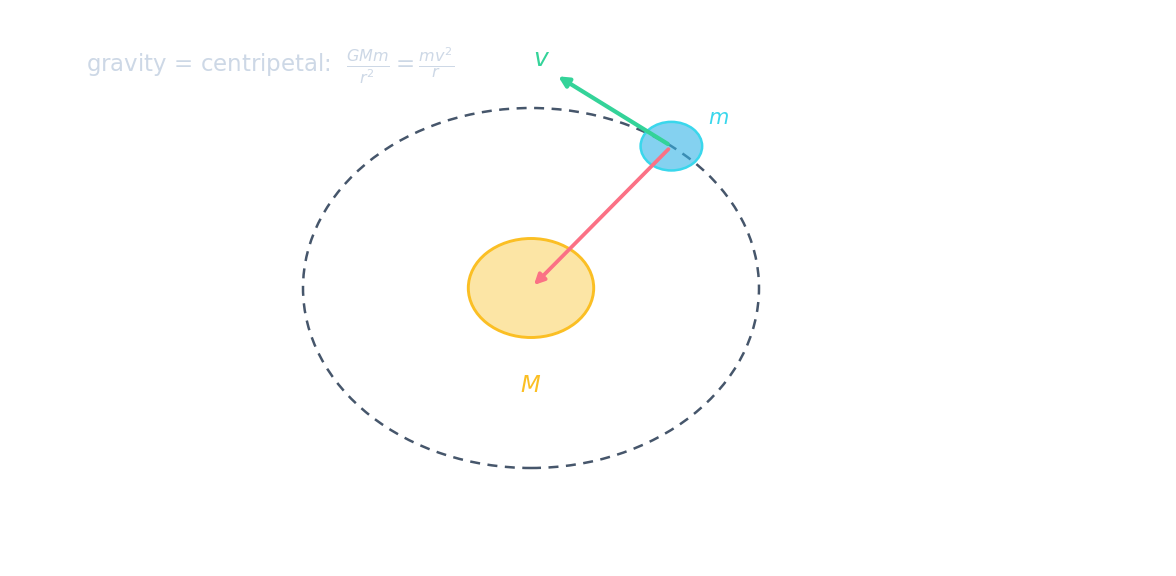
A satellite's orbital speed does not depend on its own mass. · 卫星的轨道速度不取决于它自身的质量。
The mass $m$ cancels in $\dfrac{GMm}{r^{2}} = \dfrac{mv^{2}}{r}$, leaving $v = \sqrt{\dfrac{GM}{r}}$. · 质量 $m$ 在 $\dfrac{GMm}{r^{2}} = \dfrac{mv^{2}}{r}$ 中抵消,剩下 $v = \sqrt{\dfrac{GM}{r}}$。
Kepler's third law 开普勒第三定律
- From $T = \dfrac{2\pi r}{v}$: $T^{2} = \dfrac{4\pi^{2}}{GM}\,r^{3}$, so $T^{2} \propto r^{3}$.
- A graph of $T^{2}$ against $r^{3}$ is a straight line — its gradient gives the central mass.
Plotting T² against r³ gives a straight line through the origin — its gradient fixes the central mass M
开普勒第三定律
- 由 $T = \dfrac{2\pi r}{v}$:$T^{2} = \dfrac{4\pi^{2}}{GM}\,r^{3}$,所以 $T^{2} \propto r^{3}$。
- $T^{2}$ 对 $r^{3}$ 的图是一条直线——它的斜率给出中心天体的质量。

画出 T² 对 r³ 的图得到过原点的直线——它的斜率确定中心质量 M
Kepler's third law (for circular orbits) states: · 开普勒第三定律(对圆形轨道)表述为:
$T^{2} = \dfrac{4\pi^{2}}{GM}\,r^{3}$, so the square of the period is proportional to the cube of the radius. · $T^{2} = \dfrac{4\pi^{2}}{GM}\,r^{3}$,所以周期的平方与半径的立方成正比。
If an orbit radius increases by a factor of 4, the period increases by a factor of: · 如果轨道半径增大为原来的 4 倍,周期增大为原来的多少倍:
$T \propto r^{3/2}$, so $T$ scales by $4^{3/2} = 8$. · $T \propto r^{3/2}$,所以 $T$ 变为 $4^{3/2} = 8$ 倍。
Worked example: a satellite above Mars
A satellite orbits Mars (mass $6.4 \times 10^{23}\ \text{kg}$, radius $3.4 \times 10^{6}\ \text{m}$) at a height of $1.7 \times 10^{6}\ \text{m}$ above the surface. Find its speed and period.
- Orbit radius, from the centre: $r = 3.4 \times 10^{6} + 1.7 \times 10^{6} = 5.1 \times 10^{6}\ \text{m}$.
- Speed: $v = \sqrt{\dfrac{GM}{r}} = \sqrt{\dfrac{6.67 \times 10^{-11} \times 6.4 \times 10^{23}}{5.1 \times 10^{6}}} = 2.9 \times 10^{3}\ \dfrac{\text{m}}{\text{s}}$.
- Period: $T = \dfrac{2\pi r}{v} = \dfrac{2\pi \times 5.1 \times 10^{6}}{2.9 \times 10^{3}} = 1.1 \times 10^{4}\ \text{s}$, about three hours.
- Check: the satellite's own mass never appeared — every satellite at this height moves at this speed. Using the height alone for $r$ gives a speed that is far too high.
例题:火星上空的卫星
一颗卫星在火星(质量 $6.4 \times 10^{23}\ \text{kg}$,半径 $3.4 \times 10^{6}\ \text{m}$)表面上方 $1.7 \times 10^{6}\ \text{m}$ 处绕行。求它的速率和周期。
- 从中心算起的轨道半径: $r = 3.4 \times 10^{6} + 1.7 \times 10^{6} = 5.1 \times 10^{6}\ \text{m}$。
- 速率: $v = \sqrt{\dfrac{GM}{r}} = \sqrt{\dfrac{6.67 \times 10^{-11} \times 6.4 \times 10^{23}}{5.1 \times 10^{6}}} = 2.9 \times 10^{3}\ \dfrac{\text{m}}{\text{s}}$。
- 周期: $T = \dfrac{2\pi r}{v} = \dfrac{2\pi \times 5.1 \times 10^{6}}{2.9 \times 10^{3}} = 1.1 \times 10^{4}\ \text{s}$,约三小时。
- 检查: 卫星自身的质量从未出现——在这个高度的每颗卫星都以这个速率运动。若只用高度作 $r$,得到的速率会高得离谱。
A satellite orbits the Earth (mass $6.0 \times 10^{24}\ \text{kg}$) at a radius of $8.0 \times 10^{6}\ \text{m}$ from the centre. What is its orbital speed, in km/s? · 一颗卫星在离地心 $8.0 \times 10^{6}\ \text{m}$ 的半径上绕地球(质量 $6.0 \times 10^{24}\ \text{kg}$)运行。它的轨道速率是多少(单位 km/s)?
$v = \sqrt{\dfrac{GM}{r}} = \sqrt{\dfrac{6.67 \times 10^{-11} \times 6.0 \times 10^{24}}{8.0 \times 10^{6}}} = 7.1 \times 10^{3}\ \dfrac{\text{m}}{\text{s}} = 7.1\ \dfrac{\text{km}}{\text{s}}$. · $v = \sqrt{\dfrac{GM}{r}} = \sqrt{\dfrac{6.67 \times 10^{-11} \times 6.0 \times 10^{24}}{8.0 \times 10^{6}}} = 7.1 \times 10^{3}\ \dfrac{\text{m}}{\text{s}} = 7.1\ \dfrac{\text{km}}{\text{s}}$。
Geostationary 地球同步 orbit
- Period 24 hours, directly above the equator 赤道, orbiting west to east — the same direction as the Earth turns.
- It stays fixed above one point — perfect for a TV dish. From $r^{3} = \dfrac{GMT^{2}}{4\pi^{2}}$ with $T = 86\,400\ \text{s}$, the radius is $\approx 4.2 \times 10^{7}\ \text{m}$, about $3.6 \times 10^{7}\ \text{m}$ above the surface.
地球同步轨道
- 周期 24 小时,正处于 赤道(equator) 上方,自西向东 运行——与地球自转方向相同。
- 它固定在某一点上方——非常适合电视天线。由 $r^{3} = \dfrac{GMT^{2}}{4\pi^{2}}$ 取 $T = 86\,400\ \text{s}$,半径 $\approx 4.2 \times 10^{7}\ \text{m}$,离地约 $3.6 \times 10^{7}\ \text{m}$。
Select all · 所有 the features of a geostationary satellite. · 选出所有地球同步卫星的特征。
It matches Earth's rotation (24 h, west to east) above the equator, so it stays fixed above one point. A polar orbit does not. · 它与地球的自转一致(24 小时,自西向东),在赤道上空,所以它固定在一点上空。极轨道则不然。
Synchronous orbits elsewhere
- Any planet has its own synchronous orbit: the period equals the planet's rotation period, and the orbit lies above the equator, moving with the rotation.
- Mars turns once in about $25$ hours, so a satellite with a $25$-hour period above its equator stays over one Martian spot.
- Change the period and the radius follows from Kepler's law: a longer period means a larger orbit.
其他天体的同步轨道
- 任何行星都有自己的同步轨道:周期等于行星的 自转 周期,轨道位于赤道上方,随自转方向运行。
- 火星约 $25$ 小时自转一圈,所以在其赤道上方、周期为 $25$ 小时的卫星会停留在火星的某一点上方。
- 改变周期,半径就由开普勒定律决定:周期更长意味着轨道 更大。
In every orbit formula $r$ is measured from the centre of the planet — add the planet's radius to a height. The satellite's mass cancels, so "a heavier satellite must go faster" is wrong. A geostationary orbit must be over the equator: any other orbit crosses the equator twice a day and drifts north and south as seen from the ground.
在每个轨道公式中 $r$ 都从行星的 中心 算起——把行星半径加到高度上。卫星的质量 消去,所以"更重的卫星必须跑得更快"是错的。地球同步轨道必须在 赤道 上方:任何其他轨道每天两次穿过赤道,从地面看会南北漂移。
A satellite is $600\ \text{km}$ above the surface of a planet of radius $6400\ \text{km}$. In the orbit equations, $r$ = ____ km. · 一颗卫星在半径 $6400\ \text{km}$ 的行星表面上方 $600\ \text{km}$ 处。在轨道方程中,$r$ = ____ km。
$r$ is measured from the centre: $6400 + 600 = 7000\ \text{km}$. · $r$ 从中心算起:$6400 + 600 = 7000\ \text{km}$。
Not weightless — falling
- At the Space Station's height of $400\ \text{km}$, $g = 9.81 \times \left(\dfrac{6370}{6770}\right)^{2} = 8.7\ \dfrac{\text{N}}{\text{kg}}$ — nearly the surface value.
- Astronauts float because they and the station are in free fall 自由落体 together, not because gravity has vanished.
不是失重——是在下落
- 在空间站 $400\ \text{km}$ 的高度,$g = 9.81 \times \left(\dfrac{6370}{6770}\right)^{2} = 8.7\ \dfrac{\text{N}}{\text{kg}}$——几乎是地面的值。
- 宇航员漂浮是因为他们和空间站一起处于 自由落体(free fall),而不是因为引力消失了。
Earth's radius is $6370\ \text{km}$ and its surface field strength is $9.81\ \dfrac{\text{N}}{\text{kg}}$. What is the field strength at a height of $400\ \text{km}$, in N/kg? · 地球半径 $6370\ \text{km}$,表面场强 $9.81\ \dfrac{\text{N}}{\text{kg}}$。$400\ \text{km}$ 高度处的场强是多少(单位 N/kg)?
$g \propto \dfrac{1}{r^{2}}$, so $g = 9.81 \times \left(\dfrac{6370}{6770}\right)^{2} = 8.7\ \dfrac{\text{N}}{\text{kg}}$ — the astronauts are not weightless, they are falling. · $g \propto \dfrac{1}{r^{2}}$,所以 $g = 9.81 \times \left(\dfrac{6370}{6770}\right)^{2} = 8.7\ \dfrac{\text{N}}{\text{kg}}$——宇航员并非失重,他们在下落。
You've got it
- field of a point mass: $g = \dfrac{GM}{r^{2}}$ (so $g$ is nearly constant near the surface)
- orbit: $v = \sqrt{\dfrac{GM}{r}}$ with $r$ from the centre (independent of satellite mass); $T^{2} \propto r^{3}$
- geostationary: 24 h, above the equator, west to east; a synchronous orbit matches any planet's rotation
你掌握了
- 质点的场:$g = \dfrac{GM}{r^{2}}$(所以在表面附近 $g$ 几乎恒定)
- 轨道:$v = \sqrt{\dfrac{GM}{r}}$,$r$ 从 中心 算起(与卫星质量无关);$T^{2} \propto r^{3}$
- 地球同步:24 h,赤道上方,自西向东;同步轨道与任何行星的自转相匹配